
For consumers, compare the actual Supplement Facts, serving size, added sugars, directions, storage requirements and quality testing. For supplement brands, the better format is the one that can carry the intended dose, remain stable through shelf life and deliver a consistent serving.
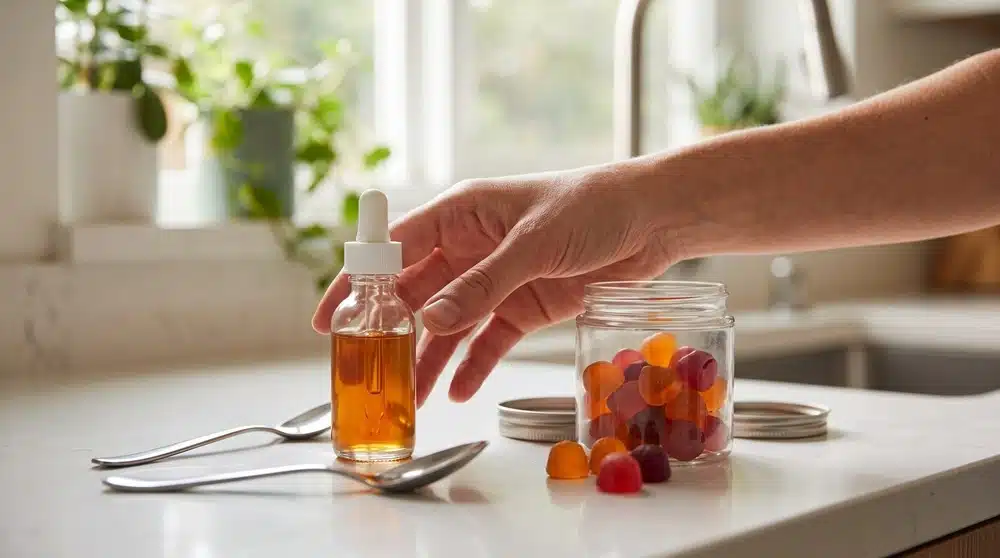
Liquid Supplements vs Gummies: Key Differences
| Factor | Liquid Supplements | Gummy Supplements | What to Verify |
|---|---|---|---|
| Physical form | Solution, suspension, emulsion, syrup, drop, tincture or shot. | Chewable gel matrix based on gelatin, pectin or another hydrocolloid. | Do not assume every liquid is fully dissolved or every gummy uses the same base. |
| Release before absorption | A dissolved ingredient may avoid a solid disintegration step; suspended ingredients still need to redisperse and dissolve. | The gummy must be chewed and the matrix must release its ingredients in gastrointestinal fluids. | Release speed is not the same as total systemic exposure. |
| Bioavailability | May be higher, similar or lower depending on the ingredient and formulation. | May be higher, similar or lower depending on the ingredient and formulation. | Look for data on the specific nutrient, dose and finished product. |
| Dosing | Flexible volume, but droppers, cups or pumps can introduce measurement error. Suspensions may require shaking. | Pre-portioned per gummy, but a full serving may require multiple gummies. | Compare amount per labeled serving, not per drop or per gummy alone. |
| Active-load capacity | Can support small drops, larger syrups or single-serving shots, subject to solubility, taste and stability. | Limited by gummy size, texture, flavor, process heat and the number of units consumers will take. | Confirm the target daily dose fits the format without unrealistic serving size. |
| Taste | Bitterness, mineral notes, oiliness or herbal intensity may be difficult to mask. | Fruit flavor and sweetness can improve palatability, but acids and sweeteners affect texture and stability. | Review the full flavor and sweetener system. |
| Sugar | May contain sugar, syrup, glycerin, juice concentrate, sugar alcohols or high-intensity sweeteners. | May contain sugar, glucose syrup, tapioca syrup, polyols or high-intensity sweeteners. | Check grams of Added Sugars and total serving size. |
| Stability risks | Microbial growth, oxidation, light exposure, pH drift, precipitation, emulsion failure and container interaction. | Heat damage, moisture gain or loss, sticking, sweating, crystallization, texture drift and potency loss. | Require product-specific stability data in final packaging. |
| Portability | Bottles can leak, break or require refrigeration; unit-dose vials and shots improve portability. | Portable and no measuring tool is needed, but heat and humidity can damage texture. | Evaluate the real distribution climate and sales channel. |
Does Liquid Mean Faster Absorption?
A liquid can sometimes release an ingredient sooner because the product may already be dissolved or finely dispersed. However, that does not prove that the nutrient enters the bloodstream sooner, reaches a higher concentration or produces a stronger health effect.
Release Is Not the Same as Bioavailability
Oral supplements pass through several distinct steps:
- Release: the active ingredient separates from the dosage form.
- Dissolution or dispersion: the ingredient becomes available in gastrointestinal fluids.
- Absorption: the ingredient crosses the intestinal barrier through a nutrient-specific pathway.
- Systemic exposure and use: the absorbed material is transported, metabolized and used or stored.
A liquid may shorten the first step for a soluble ingredient. It does not bypass intestinal transport, first-pass metabolism, nutrient competition, bile requirements for fat-soluble compounds or individual digestive differences.
Why the Evidence Is Product-Specific
Human studies do not support one universal ranking for all supplement forms. In one crossover study, a specific vitamin D gummy produced greater vitamin D exposure than a tablet. In another study, vitamin D oily drops and non-oily capsules produced similar exposure. A separate trial found an oral vitamin D spray and a capsule similarly effective in healthy adults. These findings show why results from one nutrient and one formulation should not be applied to all liquids or all gummies.
Therefore, avoid claims such as “absorbs in 15 minutes,” “90% absorption,” “works immediately” or “higher bioavailability” unless the exact finished product has appropriate evidence.
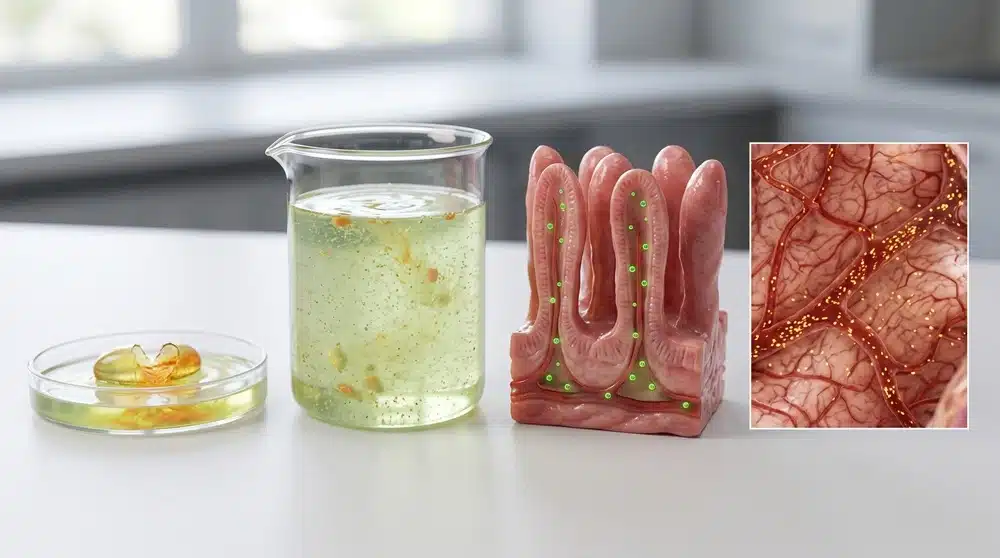
What Counts as a Liquid Supplement?
The word liquid describes several technically different systems.
Solutions
In a true solution, the ingredient is dissolved at the molecular or ionic level. Solubility can still change with pH, temperature, concentration and other ingredients.
Suspensions
A suspension contains undissolved particles distributed through the liquid. The particles may settle during storage, which is why the label may require “shake well.” Dose uniformity depends on redispersion, viscosity and measurement technique.
Emulsions and Oil-Based Liquids
Emulsions distribute one liquid phase within another, while oil-based drops may be used for selected fat-soluble ingredients. Droplet size, emulsifier system, oxidation control and packaging can affect performance.
Brands developing drops, syrups, tinctures, shots or emulsions should review the practical requirements of liquid supplement manufacturing, including pH, viscosity, preservation, filling and packaging compatibility.
What Counts as a Gummy Supplement?
A gummy is a chewable matrix that uses gelatin, pectin or another gelling system. The active ingredients are distributed through the cooked or processed mass before depositing and setting.
Gelatin and Pectin Systems
Gelatin and pectin have different gelation conditions, texture, source and processing requirements. A switch from gelatin to pectin is not a simple one-for-one substitution.
Sugar, Sugar-Free and Low-Sugar Formulas
Traditional gummies often use sugars or syrups for solids, sweetness and texture. Sugar-free systems may use polyols, fibers or high-intensity sweeteners, but these changes can affect water activity, stickiness, taste and digestive tolerance.
For commercial development, gummy supplement manufacturing must balance active dose, cook exposure, pH, flavor, texture, serving count and shelf-life stability.
Which Is Better for Different Users?
| User Priority | Format That May Fit Better | Important Limitation |
|---|---|---|
| Difficulty swallowing tablets | Either liquid or gummy. | Check whether chewing, measuring, sugar or texture creates another barrier. |
| Flexible serving size | Liquid. | Only when the label permits flexible use and the measuring device is accurate. |
| Pre-portioned convenience | Gummy. | The complete serving may be two or more gummies. |
| High active dose | Often liquid shot or another high-capacity format. | Solubility, flavor, viscosity and container size still limit the formula. |
| Travel | Gummy or unit-dose liquid. | Gummies can melt or stick; multi-serve liquids can leak. |
| Low added sugar | Either format. | Verify the actual label; do not assume liquids are sugar-free. |
| Precise single unit | Gummy. | Verify content uniformity and potency through shelf life. |
| Customized titration under professional guidance | Liquid may be practical. | Do not change a dose without appropriate directions or clinical advice. |
Children and Household Safety
Gummies can look and taste like candy, which may increase accidental overconsumption. Liquids may also be accidentally swallowed or incorrectly measured. Store every supplement out of sight and reach of children, close child-resistant packaging correctly and follow the labeled serving. Iron-containing supplements require particular caution because an iron overdose can be life-threatening.
Liquid Vitamins vs Gummy Vitamins
Neither format is automatically the better multivitamin. Compare:
- the amount of each vitamin and mineral per complete serving;
- the chemical form of each nutrient;
- serving count and measurement method;
- added sugars and other ingredients;
- storage instructions and expiration date;
- whether the formula omits high-load minerals because of taste or texture limitations;
- finished-product potency testing through shelf life.
Fat-soluble vitamins may require an appropriate lipid or emulsification system, while minerals can create taste, precipitation and interaction challenges in both liquids and gummies. A generic “liquid absorbs better” statement does not replace product-specific formulation data.
Liquid Collagen vs Collagen Gummies
For collagen products, the most important comparison is usually the actual collagen peptide dose per daily serving. Gummies have limited mass capacity and may require several units to deliver a meaningful gram-level serving. A liquid shot may carry more collagen, but flavor, viscosity, preservation and bottle size can become limiting factors.
Compare the collagen source, grams per serving, peptide specification, added sugars, total serving size, testing and cost per daily dose. Do not assume that liquid collagen is more bioavailable or that collagen gummies are ineffective solely because of the dosage form.
Sleep Gummies vs Liquid Sleep Supplements
The format alone does not determine how quickly a sleep supplement works. Onset depends on the active ingredient, chemical form, dose, release characteristics, food, individual metabolism and the specific finished product. “Fast acting” or exact-minute onset claims require evidence on the marketed formula.
Consumers should review the active amount per serving, directions, warnings, interaction risks and whether the product causes next-day drowsiness. People who are pregnant or breastfeeding, use medications, have a medical condition, or need help for persistent sleep problems should consult a qualified healthcare professional.
Consumer Label Checklist
- Read the full serving size. One serving may be multiple gummies or several milliliters.
- Compare active amount per serving. Do not compare one gummy with one dropper unless those are full servings.
- Check the nutrient or botanical form. The chemical form can matter more than the dosage form.
- Check Added Sugars. Both liquids and gummies may contain sweeteners.
- Read Other Ingredients. Review gelatin, pectin, glycerin, oils, flavors, colors, preservatives and allergens.
- Follow measuring and shaking directions. Suspensions may not be uniform if they are not redispersed.
- Review storage conditions. Heat, light, humidity and refrigeration requirements can affect quality.
- Look for quality transparency. Prefer clear lot information, contact details and credible testing documentation.
- Keep away from children. Candy-like products need the same care as other supplements.
- Do not use format as a treatment shortcut. A diagnosed deficiency or medical condition requires professional evaluation.
Formulation Guide for Supplement Brands
A custom formula supplement manufacturer should select the dosage form after reviewing the target dose, active compatibility, consumer profile, claims, packaging and shelf-life target.
Liquid Formulation Risks
| Risk | Questions to Ask | Suggested Verification |
|---|---|---|
| Solubility and precipitation | Is the active truly dissolved, suspended or emulsified? | Appearance, particle size, redispersion and potency at multiple bottle positions. |
| Microbial control | Does the water activity, pH and preservative system support the intended shelf life? | Microbial limits, preservative effectiveness where appropriate and in-use testing. |
| Oxidation and light | Are sensitive vitamins, oils or botanicals protected? | Assay, oxidation markers, headspace and light-barrier packaging review. |
| pH and flavor | Does the required pH affect active stability or taste? | pH trend, sensory testing and active assay during stability. |
| Dose uniformity | Will settling or creaming change the measured dose? | Shake-well validation, viscosity, fill-volume and delivered-dose testing. |
| Container compatibility | Can the formula interact with the bottle, liner, dropper, pump or closure? | Leak, migration, closure, dispensing and package compatibility studies. |
Gummy Formulation Risks
| Risk | Questions to Ask | Suggested Verification |
|---|---|---|
| Process heat | When are heat-sensitive actives added and what loss occurs? | In-process and finished-product assay with justified overage. |
| pH and gel system | Does the active or acid system disrupt gelatin or pectin texture? | pH, gel strength, deposit behavior and texture profile. |
| Content uniformity | Does each gummy receive a consistent active dose? | Individual-unit or validated composite testing and weight variation. |
| Water activity | Will the gummy stick, sweat, dry out or support microbial growth? | Water activity, moisture, texture and microbial stability. |
| Potency through shelf life | Do vitamins or botanicals degrade during storage? | Real-time and accelerated stability in final packaging. |
| Distribution climate | Can heat and humidity damage the product? | Packaging barrier, transport simulation and high-temperature review. |
Finished-Product Testing
A structured supplement quality control plan may include identity and supplier qualification, active potency, microbial limits, heavy metals, allergens, fill or unit weight, content uniformity, pH, viscosity, water activity, texture, packaging integrity and stability testing as applicable.
The package is part of the formulation. Review bottles, droppers, pumps, jars, liners, seals, desiccants, light barriers and shipping conditions through a supplement packaging assessment.
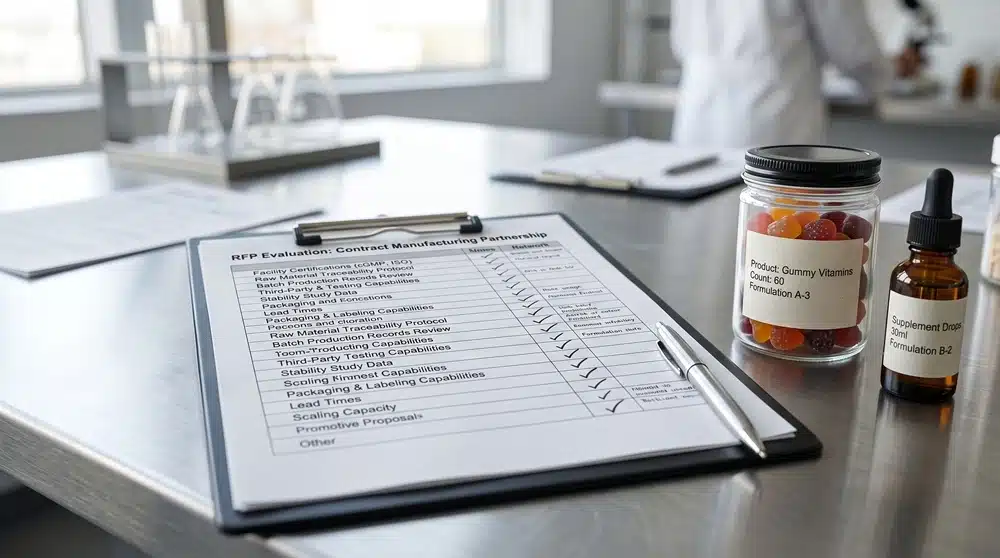
Supplier and RFP Checklist
Ask a prospective liquid or gummy manufacturer:
- Which dosage-form technologies are produced in-house?
- Is the liquid a solution, suspension or emulsion?
- Which gummy base, process and depositing system will be used?
- What is the maximum practical active load per serving?
- Which ingredients are sensitive to heat, pH, oxygen, light or moisture?
- How are measuring accuracy and dose uniformity verified?
- Which raw-material and finished-product specifications are established?
- What microbial controls apply to the liquid formula?
- How are gummy water activity, moisture and texture controlled?
- Is potency overage used, and how is it justified?
- What stability protocol supports the labeled shelf life?
- Is testing performed in the final commercial package?
- What are the packaging, leakage, melting and distribution-climate risks?
- What documentation is available for allergens, vegan status, gelatin source and sweeteners?
- How are deviations, change control, complaints and recalls managed?
Claims, Labeling and Safety Boundaries
- Do not claim that all liquids have higher bioavailability than all gummies.
- Do not promise an exact absorption time without finished-product evidence.
- Do not describe an oral liquid as bypassing digestion like an injection.
- Do not claim rapid correction of a nutrient deficiency without appropriate clinical and regulatory context.
- Do not assume “sugar-free” or “no added sugar” based on the dosage form; confirm that the product meets applicable claim requirements.
- Declare serving size, dietary ingredients and other ingredients accurately.
- Health-related claims must be truthful, not misleading and supported by evidence relevant to the marketed product.
- Store all supplement formats away from children and follow labeled directions.
Frequently Asked Questions
Are liquid vitamins better than gummies?
Not automatically. Liquids may be easier to swallow and can offer flexible serving volumes. Gummies may be easier to take consistently and provide pre-portioned units. Compare the same nutrient, chemical form, dose, added sugars, stability and testing.
Are liquid supplements faster than gummies?
A liquid may release a dissolved ingredient sooner, but there is no universal time advantage for every nutrient or product. Intestinal absorption and systemic exposure remain ingredient- and formulation-specific.
Do liquid vitamins absorb in 15 minutes?
There is no reliable universal 15-minute rule. Time to absorption varies by nutrient, dose, food, formulation and individual physiology.
Are gummies less bioavailable?
Not as a category. A vitamin D crossover study found greater exposure from a specific gummy than from a tablet. That result does not prove every gummy is superior, but it shows why bioavailability must be evaluated product by product.
Is liquid collagen better than collagen gummies?
Compare grams of collagen peptides per complete daily serving, source, added sugars, stability and cost. Liquids may support a larger serving than gummies, but the format alone does not establish superior absorption.
Which is better for sleep: liquid or gummies?
The active ingredient, dose and finished formula matter more than the format alone. Exact onset or “fast acting” claims require evidence on the specific product.
Are gummies safer for children?
Gummies can be easier to chew, but their candy-like appearance may increase accidental overconsumption. Liquids can also be mismeasured or swallowed accidentally. Store all supplements securely and follow age-appropriate label directions.
Can both liquids and gummies contain sugar?
Yes. Review the Added Sugars declaration and ingredient list. Liquids and gummies can use sugars, syrups, glycerin, juice concentrates, sugar alcohols or high-intensity sweeteners.
Which format is easier to manufacture?
Neither is universally easier. Liquids require control of solubility, pH, microbial stability, dispensing and packaging. Gummies require control of gel chemistry, process heat, depositing, water activity, texture and potency.
Can a brand use the claim “fast absorption”?
Only when the express and implied claim is supported by competent evidence relevant to the marketed product and is permitted in the target market. A theoretical formulation advantage is not the same as proof of a consumer benefit.
Conclusion
Liquid supplements are not automatically more bioavailable, and gummies are not automatically less effective. Liquids may reduce a physical release step and support flexible or larger servings. Gummies may improve palatability, portability and adherence. The best choice depends on the specific active ingredients, dose, consumer, stability risks, packaging and finished-product evidence.
For supplement brands, choose the dosage form through feasibility testing rather than marketing assumptions. Confirm dose capacity, sensory acceptability, uniformity, microbial or water-activity control, packaging compatibility and potency through the end of shelf life.
References
- Bioequivalence Studies of Vitamin D Gummies and Tablets in Healthy Adults
- Bioavailability of Vitamin D3 in Non-Oily Capsules Compared With Oily Drops
- Vitamin D3 Capsule and Oral Spray Delivery Study
- FDA Dietary Supplement Current Good Manufacturing Practice Guide
- FDA Questions and Answers on Dietary Supplements
- FDA Added Sugars on the Nutrition Facts Label
- FDA Structure/Function Claims
- FTC Health Products Compliance Guidance
- Poison Control: Iron Poisoning
Disclaimer: This article is for educational and formulation-planning purposes. It does not diagnose, treat, cure or prevent disease and does not replace medical, regulatory or legal advice.

Warren Wan is a seasoned expert with extensive experience in the dietary supplement supply chain, possessing rich practical experience in the research, development, process control, and global sourcing of core ingredients such as collagen peptides, bone broth protein, and keratin. As the author of this column, he is dedicated to stripping away the marketing packaging, transforming obscure ingredient science and production quality control standards into easy-to-understand, hardcore science popularization, helping readers understand the truth behind the labels and make more rational health choices.


