
In the competitive world of dietary supplements, the softgel remains the gold standard for consumers. They are easier to swallow, mask unpleasant tastes, and often provide better bioavailability for oil-based ingredients like Omega-3s and Vitamin D.
However, for brand owners, softgel manufacturing is arguably the most complex production method in the industry. Unlike mixing a powder for a hard capsule or pressing a standard tablet, softgels require precise temperature control, specialized rotary die equipment, and rigorous drying protocols.
Whether you are a startup exploring custom supplement formulation or an established brand looking for a better OEM partner, understanding this process is critical. In this guide, we break down exactly how softgels are made, from raw gelatin to the final polished product, and why choosing a manufacturer with strong R&D capabilities is the key to a successful product launch.
What is a Softgel?
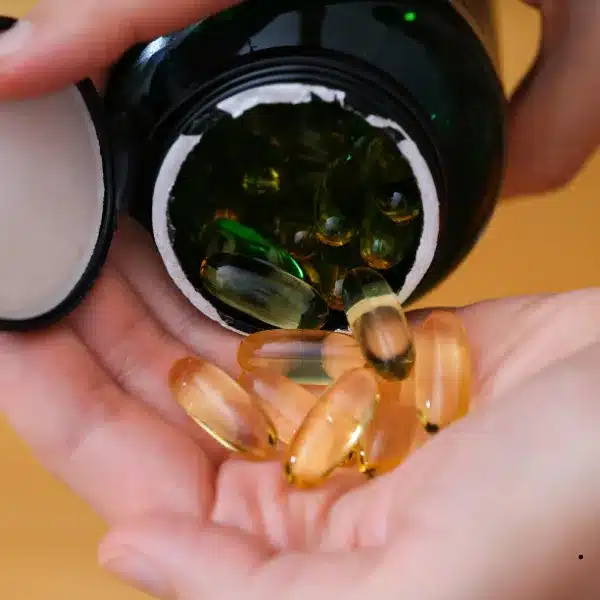
At its core, a softgel (soft gelatin capsule) is a hermetically sealed shell that surrounds a liquid or semi-solid fill. Unlike hard capsules, which are two separate pieces snapped together, the softgel shell and the fill are brought together simultaneously in a single step, creating a robust, one-piece dosage form.
This unique structure offers several distinct advantages:
- Protection: The sealed shell protects sensitive ingredients (like Omega-3 fish oil) from oxidation and light.
- Accuracy: Liquid fills offer a high degree of dosage precision compared to powders.
- Consumer Preference: Their smooth texture makes them easier to swallow than large tablets.
Types of Softgel Shells
To meet modern consumer demands, manufacturers now offer distinct shell materials. Understanding these options is vital when planning your product line:
Derived from bovine (cow) or porcine (pig) sources. This remains the traditional choice for general market supplements due to three key factors:
✓ Excellent Solubility
✓ High Shell Strength
✓ Cost-Effectiveness
As the plant-based market booms, vegan softgel manufacturing has become a critical capability. Typically made from Tapioca starch or Carrageenan (seaweed extract).
These shells offer the durability of gelatin while appealing to a wider demographic, including those with specific dietary or religious restrictions.
Chemically treated or formulated to withstand stomach acid, these release their contents only upon reaching the small intestine. This is the preferred choice for:
- Fish Oils: To prevent “fishy burps” or reflux.
- Probiotics: To ensure live cultures survive the harsh stomach environment.
The 6-Step Softgel Manufacturing Process
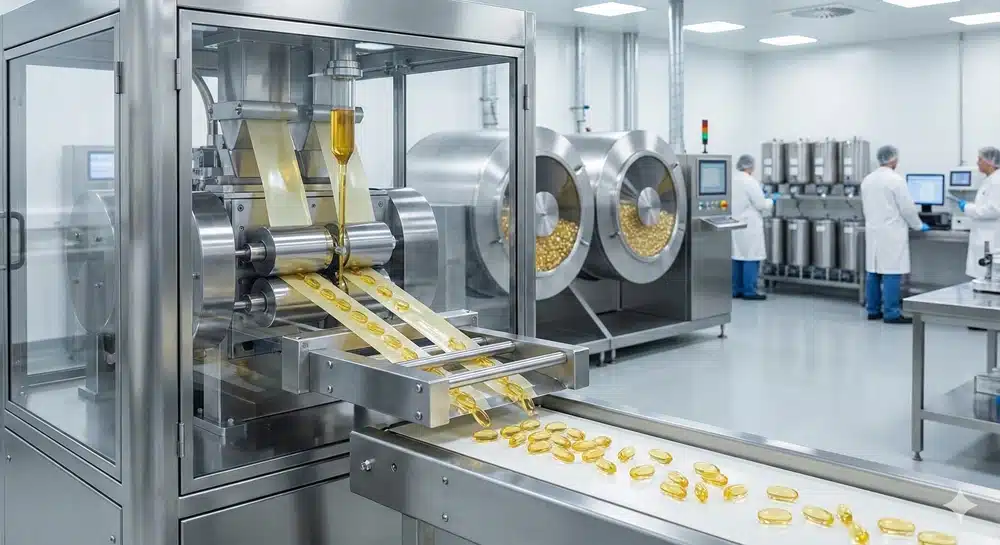
While the concept is simple, the execution is highly technical. The industry standard for producing softgels is the Rotary Die Encapsulation method, a continuous process invented in the 1930s that remains the most efficient way to produce high-quality softgels today.
Here is the step-by-step journey from raw ingredients to finished product.
Gelatin Preparation
The process begins with the shell. Gelatin powder (or the vegan alternative) is mixed with water and a plasticizer—usually glycerin or sorbitol—in a large stainless steel tank.
- Heating & Vacuuming: The mixture is heated to approx 80°C (175°F) to melt the gelatin. Crucially, a vacuum is applied to the tank to remove air bubbles. If bubbles remain, the final softgels will have weak spots and leak.
- Coloring: If your brand requires opaque or colored shells, food-safe dyes or opacifiers (like Titanium Dioxide or calcium carbonate) are added during this stage.
Fill Material Preparation
While the shell mass is being prepared, the active ingredients (the “fill”) are processed in a separate tank.
Types of Fills
- Pure Oils: (e.g., Fish Oil, Vitamin E, Flaxseed Oil).
- Suspensions: Powders suspended in a carrier oil (e.g., Multivitamins, Calcium, herbal extracts).
The Formulation Challenge: Suspensions are tricky. If the particle size of the powder is too large, it will clog the injection pump. If the mixture isn’t homogenous, dosage accuracy fails.
Encapsulation (The Rotary Die Process)
This is where the magic happens. The gel mass and the fill material meet at the encapsulation machine.
- Ribbon Formation: The molten gelatin flows from a spreader box onto two cooled drums, forming two flat, continuous ribbons of gel.
- Injection: These two ribbons pass between two rotating die rollers. As the ribbons meet, a high-precision pump injects the exact dosage of liquid fill between them.
- Sealing & Cutting: The die rollers use heat and pressure to seal the gelatin pockets around the liquid and cut the softgels out of the ribbon simultaneously.
Tumble Drying
Fresh off the encapsulation machine, the softgels are very soft, warm, and coated in a thin layer of mineral oil (used to lubricate the ribbons). They are immediately dropped into a tumble dryer.
- Goal: To remove surface moisture and firm up the shape.
- Duration: Typically 15–30 minutes. At this stage, the softgel still contains about 20% water and is too soft for packaging.
Tunnel Drying (Curing)
This is the longest and most critical step. The softgels are spread onto trays and stacked in a drying tunnel with strictly controlled humidity and temperature.
- The Curing Process: Air is circulated over the trays to slowly draw excess moisture out of the shell without cracking it.
- Duration: Depending on the formula size and shell type, this takes 24 to 72 hours.
- Risk: If dried too fast, the shell becomes brittle. If removed too soon, the softgels may deform or stick together in the bottle.
Inspection & Polishing
Once fully cured, the softgels undergo final quality control.
- Sizing & Sorting: Automated sorters remove any misshapen or under-filled capsules.
- Polishing: The capsules are gently cleaned with a lint-free cloth or solvent to remove any remaining oil residues, giving them a glossy, premium finish.
- Packaging: Finally, they are ready for bottling, blistering, or bulk shipment.
Softgels vs. Capsules vs. Tablets: Which is Best?
For brand owners, choosing the right delivery form is a balance between formulation requirements, marketing strategy, and budget. While softgels are often seen as the premium choice, hard capsules and tablets have their own distinct advantages.
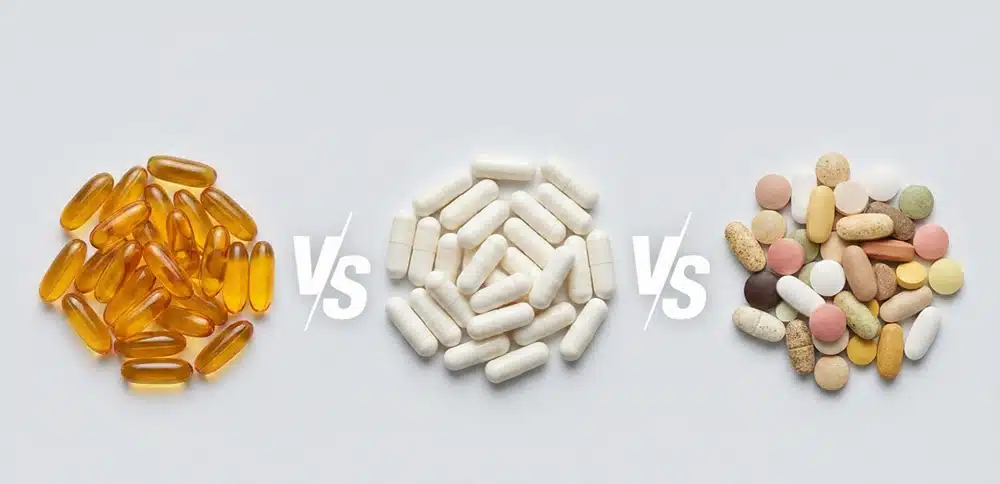
Here is a breakdown of how they compare.
Softgels
Softgels are the undisputed winner for liquid and oil-based formulations. Because the active ingredients are already dissolved or suspended in a liquid carrier, they often offer higher bioavailability, meaning the body absorbs them faster than compressed tablets.
- Pros: Easy to swallow, masks unpleasant odors, premium consumer perception, high barrier to counterfeiting.
- Cons: Higher manufacturing cost, longer lead times (due to curing), and strictly limited to liquid/paste fills.
Hard Capsules
Two-piece hard capsules (made of gelatin or HPMC vegetarian cellulose) are the most versatile format. They can hold powders, pellets, or even smaller capsules inside them.
- Pros: Rapid product development (easier R&D), ideal for dry ingredients that are moisture-sensitive, lower MOQ requirements than softgels.
- Cons: Can be tampered with (can be pulled apart), lower perceived value than softgels.
Tablets
Tablets are compressed powders. They are the most common form of supplement globally due to their durability and cost-efficiency.
- Pros: Lowest cost per unit, highest stability (longest shelf life), can pack the most active ingredient volume per dose.
- Cons: Harder to swallow, binders and fillers are required to hold them together, slower absorption rates.
Comparison at a Glance
| Feature | Softgels | Hard Capsules | Tablets |
| Ideal For | Oils (Omega-3, Vit D), Pastes | Powders, Unique Blends | Simple Formulas, Bulk |
| Bioavailability | High (Pre-dissolved) | Moderate | Moderate to Low |
| Swallowability | Excellent | Good | Varies |
| Cost to Make | High | Moderate | Low |
| Customization | Shape, Color, Opacity | Color, Banding, Size | Shape, Embossing |
Pro Tip: You don’t have to stick to just one format. A versatile manufacturing partner like Gensei can produce Liquids, Gummies, Powders, and Capsules alongside softgels. This allows you to diversify your product line—offering a premium softgel for your flagship Omega-3 and a cost-effective tablet for your daily multivitamin—all under one roof.
Key Challenges in Softgel Manufacturing
Why do some softgel batches fail while others succeed? The process is chemically sensitive, and even minor deviations in temperature or humidity can ruin a production run.
There are three common enemies in softgel manufacturing:
Leaking
This is the most costly defect because it often isn’t discovered until the drying phase.
- The Cause: Leaks usually occur because the “seam” where the two ribbons meet is too thin, or because the fill material is chemically incompatible with the gelatin.
- The Fix: Precision die alignment and ensuring the wedge temperature is optimized for the specific gelatin blend being used.
Sticking
If you have ever opened a bottle of supplements and found them fused into a giant lump, “sticking” is to blame.
- The Cause: This happens when softgels are packed before they are fully cured, or if they are stored in high-humidity environments without proper coating.
- The Fix: Rigorous tunnel drying cycles (up to 72 hours) and applying a microscopic layer of MCT oil or wax during the polishing stage.
Cross-Linking
Cross-linking is a chemical reaction where the gelatin shell becomes tough, rubbery, and insoluble over time.
- The Danger: A cross-linked softgel will not dissolve in the stomach, meaning the consumer gets zero benefit from the supplement.
- The Cause: It is often triggered by aldehydes in the fill material or exposure to high heat/humidity.
- The Solution: This is why Stability Testing is non-negotiable. At Gensei, we stress-test formulations in our R&D lab to ensure the shell remains soluble throughout its entire shelf life.
How to Choose the Right Softgel Manufacturer
Finding a factory is easy; finding a strategic partner is difficult. Because softgel production is so technical, choosing the wrong partner can lead to leaking batches, delayed launches, and wasted capital.
If you are evaluating a softgel contract manufacturer, ensure they meet these four critical criteria:
Low MOQ Flexibility
This is the biggest hurdle for growing brands. Traditional softgel manufacturers often demand Minimum Order Quantities (MOQs) of 300,000 to 500,000 units per run. For many businesses, this ties up massive amounts of cash flow in inventory that might sit for months.
- The Solution: Look for a manufacturer that offers Low MOQ options. At Gensei, we support smaller batch runs, allowing you to launch new SKUs or test the market without over-committing your budget.
Full-Service R&D Capability
Does the manufacturer just run the machine, or do they help you engineer the product? As discussed in the “Challenges” section, issues with suspension viscosity or shell compatibility can ruin a product.
- The Solution: Your partner should have an in-house R&D team capable of custom formulation, feasibility testing, and stability studies before mass production begins.
Manufacturing Diversity (The “One-Stop” Shop)
Many brands start with a single softgel product but eventually expand into gummies, tablets, or powders.
- The Solution: Avoid the logistical nightmare of managing five different vendors. A comprehensive OEM partner like Gensei can manufacture Capsules, Tablets, Powders, Gummies, and Liquids all under one roof. This consolidates your supply chain and simplifies quality control.
End-to-End Packaging Solutions
The manufacturing process doesn’t end when the softgel is cured.
- The Solution: Look for a partner who handles the packaging—bottling, blistering, labeling, and boxing. This “turnkey” approach reduces lead times because you aren’t shipping bulk capsules to a separate co-packer.
FAQs
Conclusion
The softgel manufacturing process is a perfect blend of engineering precision and chemical science. From the rotary die encapsulation to the final polishing, every step requires strict adherence to quality standards to ensure a product that is safe, effective, and visually appealing.
For brand owners, the takeaway is clear: Softgels are a premium dosage form that consumers love, but they are not simple to make. Success depends heavily on the expertise of your manufacturing partner.
Whether you are looking to troubleshoot a difficult formula or launch your first line of premium supplements, Gensei is here to help. With our commitment to Low MOQs, rigorous R&D, and end-to-end OEM services, we turn complex manufacturing into a seamless experience for your brand.
Ready to start your project?
- If you want to learn more about Softgel Supplements, please stay tuned to Gensei.
- Contact Gensei Today for a consultation on your custom softgel formulation.
references
- Shell Formulation in Soft Gelatin Capsules: Design and Characterization
- 2 – Capsules – Visual Encyclopedia of Chemical Engineering Equipment
- Cross-linking is a chemical reaction where the gelatin shell becomes tough, rubbery, and insoluble over time.(source link: Enzymes in the Dissolution Testing of Gelatin Capsules – PMC)
- Softgel Capsules Market Size Worth USD 17.27 Billion by 2034.(source link: https://finance.yahoo.com/news/softgel-capsules-market-size-worth-130000722.html?guccounter=1)