
Softgels are made by developing a compatible liquid or semi-solid fill and a flexible shell system, qualifying the materials, preparing the shell and fill separately, and forming, filling, sealing, and cutting the capsules in one rotary-die operation. The capsules are then dried to a validated endpoint, inspected, tested against finished-product specifications, packaged, documented, and released by quality control.
The visible capsule-forming step is only one part of the project. Commercial success depends on preformulation, shell–fill compatibility, process controls, defect prevention, stability, packaging, documentation, and compliant label claims.
What Is a Softgel?
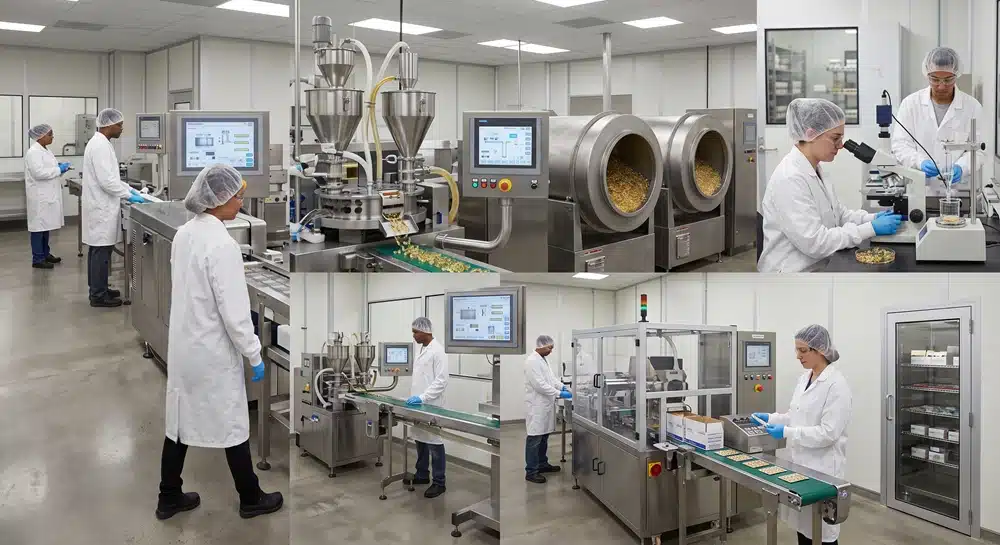
A softgel, or soft capsule, is a one-piece dosage form in which a flexible shell encloses a liquid, solution, suspension, or semi-solid fill. The shell and fill are formed and sealed during the same encapsulation operation, unlike two-piece hard capsules that are manufactured first and filled later.
Traditional softgels use gelatin, water, and a plasticizer such as glycerin or sorbitol. Other shell systems may use modified starches, carrageenan-containing systems, or other approved gelling materials. A “vegetarian” or “vegan” claim should be verified across the complete shell formula, processing aids, colors, lubricants, and supply chain—not assumed from one polymer name.
When Is a Softgel the Right Dosage Form?
Softgels are often considered for ingredients that can be delivered as oils, non-aqueous solutions, suspensions, or selected semi-solid systems. They can mask odor and taste, create a sealed unit dose, and support certain solubilized or lipid-based formulation strategies.
However, the dosage form alone does not guarantee better absorption. Product performance depends on the active ingredient, carrier system, dose, dispersion, release, digestion, stability, and supporting evidence.
Common Softgel Fill Categories
| Fill Category | Exemples | Formulation Questions |
|---|---|---|
| Neat oils | Fish oil, algal oil, flaxseed oil, l'onagre huile | Oxidation, odor, peroxide value, viscosity, oxygen exposure, and packaging |
| Oil solutions | Fat-soluble vitamins, CoQ10, carotenoids, selected oil-soluble actives | Solubility at release and shelf-life temperatures, precipitation, potency, and light sensitivity |
| Suspensions | Fine powders dispersed in a compatible carrier | Particle size, sedimentation, pumpability, dose uniformity, abrasion, and shell interaction |
| Semi-solid fills | Structured lipid systems or temperature-dependent matrices | Processing temperature, flow, fill accuracy, solidification, and release |
Fills That Require Caution or May Be Unsuitable
- high-water or strongly water-miscible fills that may migrate into the shell;
- extreme-pH systems that may weaken or alter the shell;
- volatile solvents that can migrate or create safety and stability concerns;
- reactive aldehydes, peroxides, or degradation products associated with gelatin cross-linking;
- coarse suspensions that can clog the pump or damage the seam;
- fills that precipitate, separate, or change viscosity during storage;
- live or highly moisture-sensitive ingredients without product-specific feasibility data.
Feasibility should be demonstrated on the actual shell, fill, equipment, serving size, and target package before commercial production.
Softgel Shell Materials
Gelatin Softgel Shells
Gelatin remains a common softgel material because it forms strong, flexible films and seals effectively in rotary-die equipment. Gelatin may be sourced from bovine, porcine, fish, or other declared sources. Buyers should verify source, gel strength, viscosity, microbiological specifications, contaminants, traceability, and religious or dietary certifications when relevant.
Non-Gelatin and Plant-Based Shell Systems
Non-gelatin systems may use modified starches, carrageenan-containing blends, or other gelling technologies. They can support vegetarian or animal-free product positioning when the complete formulation and supply chain substantiate the claim. These systems may require different processing windows, drying behavior, sealing controls, fill-compatibility work, and stability studies.
Brands researching shell raw materials can review our softgel gelatin and gelatine supplier guide.
The Eight-Step Softgel Manufacturing Process
| Étape | Main Activity | Primary Output |
|---|---|---|
| 1 | Product brief and preformulation | Feasible dosage-form and development plan |
| 2 | Component qualification and specifications | Approved shell, fill, color, processing aid, and packaging components |
| 3 | Shell mass preparation | Deaerated, controlled shell mass ready for ribbon formation |
| 4 | Fill preparation | Uniform, pumpable, specification-compliant fill |
| 5 | Rotary-die encapsulation | Formed, filled, sealed, and cut wet softgels |
| 6 | Drying and conditioning | Dimensionally stable softgels at the approved endpoint |
| 7 | Inspection, testing, and batch release | Approved finished bulk softgels |
| 8 | Packaging, stability, and distribution | Market-ready product protected through shelf life |
1. Product Brief and Preformulation
The project begins by defining the target market, active ingredients, serving size, desired softgel dimensions, shell claim, color, opacity, package, shelf life, label direction, order quantity, and launch timeline.
Preformulation evaluates whether the ingredients can be dissolved, suspended, or structured in a compatible fill. The development team should review:
- active solubility and target concentration;
- carrier selection;
- particle size and sedimentation risk;
- fill viscosity and pumpability;
- oxidation, hydrolysis, and light sensitivity;
- shell–fill migration and chemical compatibility;
- capsule size, fill volume, serving count, and swallowability;
- target-market ingredient, color, allergen, and claim requirements.
This step prevents a commercially attractive concept from reaching the production line before basic feasibility is established. Brands can use our custom supplement formulation service to define the formula and dosage-form requirements.
2. Component Qualification and Specifications
Before manufacturing, components should be received, quarantined, sampled, tested or examined as appropriate, reviewed, and released against approved specifications. Components may include:
- gelatin or non-gelatin shell materials;
- plasticizers and water;
- colors, opacifiers, flavors, and processing aids;
- active ingredients and carrier oils;
- antioxidants or suspension aids;
- bottles, blisters, closures, desiccants, labels, and cartons.
Specifications should be sufficiently detailed to support identity, purity, strength, composition, processing performance, and finished-product requirements. A supplier certificate alone does not replace the manufacturer’s responsibility to establish and follow appropriate controls.
3. Shell Mass Preparation
The shell ingredients are combined in a jacketed vessel under controlled mixing and temperature conditions. Gelatin systems commonly include gelatin, purified water, and a plasticizer. Non-gelatin systems use their own qualified polymer and plasticizer combinations.
The shell mass is mixed until uniform and deaerated to reduce bubbles and weak areas. Colorants or opacifiers may be added when permitted for the target market and supported by the approved formula. The mass is then held within a defined processing window before ribbon formation.
Important controls may include:
- component weights and sequence of addition;
- temperature and mixing time;
- vacuum or deaeration conditions;
- viscosity, gel strength, appearance, and absence of entrapped air;
- hold time and protection from contamination or degradation.
4. Fill Preparation
The fill is prepared separately. Oils may require filtration, antioxidant protection, temperature control, or low-oxygen handling. Suspensions require controlled particle size, mixing, and viscosity to keep the active uniformly distributed while remaining pumpable.
Fill preparation controls may include:
- verified component weights;
- mixing order, speed, time, and temperature;
- particle-size distribution;
- viscosity and specific gravity;
- assay or concentration;
- homogeneity and sedimentation behavior;
- oxidation markers for sensitive oils;
- bioburden and hold-time controls where applicable.
The approved fill must remain suitable throughout the encapsulation run. A formula that is uniform in a laboratory beaker may still fail if it settles, thickens, foams, crystallizes, or separates in production equipment.
5. Rotary-Die Encapsulation
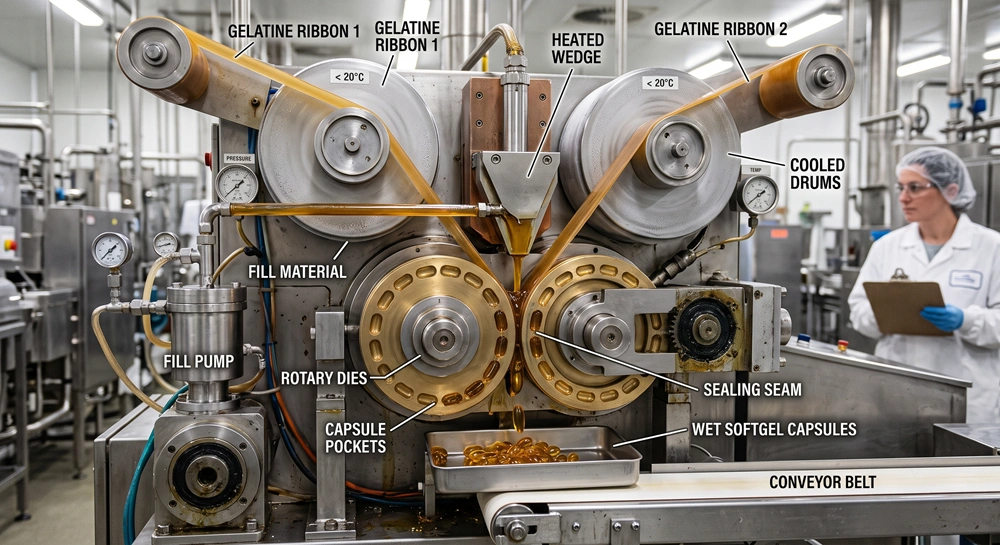
Rotary-die encapsulation is a continuous form–fill–seal process. The shell mass is cast into two ribbons. The ribbons travel between rotating die rolls while a metering pump delivers fill through a heated wedge. The dies form the capsule pockets, the pump injects the fill, and heat and pressure create the seam and cut each capsule from the ribbons.
Key in-process checks may include:
- ribbon thickness and temperature;
- die alignment and lubrication;
- wedge temperature;
- pump calibration and fill weight;
- seam thickness and integrity;
- capsule shape, dimensions, and appearance;
- fill homogeneity during the run;
- yield, rejects, and reconciliation.
Production settings are product-specific. They should be recorded in the approved master manufacturing record and batch production record rather than copied from a generic online guide.
6. Drying and Conditioning
Freshly encapsulated softgels contain more moisture and are mechanically softer than the finished product. Initial tumble drying removes surface moisture and helps the capsules retain their shape. The capsules then undergo controlled tray, tunnel, or other validated drying and conditioning.
The drying endpoint is not simply a universal number of hours. It depends on:
- shell composition and plasticizer ratio;
- fill composition and moisture migration;
- capsule size, shape, and shell thickness;
- temperature, relative humidity, airflow, and loading;
- target shell moisture, hardness, dimensions, and seam performance.
Under-drying can contribute to sticking, deformation, and package instability. Over-drying can contribute to brittleness or cracking. Drying should continue to the qualified product endpoint, followed by appropriate equilibration and inspection.
7. Inspection, Testing, and Batch Release
After drying, capsules may be sorted, cleaned, polished, printed, or otherwise finished according to the approved process. Visual and automated inspection can remove leaking, misshapen, empty, underfilled, overfilled, damaged, or contaminated units.
Finished-product specifications and testing may include:
- description and visual appearance;
- identity and assay of dietary ingredients;
- fill weight and weight variation;
- content uniformity where appropriate;
- seam integrity and leakage;
- shell moisture or related physical attributes;
- disintegration or dissolution where applicable;
- microbiological quality;
- heavy metals and other risk-based contaminants;
- oxidation markers for oils;
- package count, labels, and coding.
Quality-control personnel review the batch documentation, deviations, test results, reconciliation, labels, and packaging records before release. Learn more about our supplement quality-control approach.
8. Packaging, Stability, and Distribution
Softgels can gain or lose moisture and may be sensitive to oxygen, heat, light, and mechanical pressure. Packaging must be selected for the actual formula and distribution environment rather than appearance alone.
Options may include HDPE or PET bottles, light-protective bottles, blister packs, induction seals, desiccants, oxygen-control systems, cartons, and bulk containers. Compatibility studies should consider shell moisture, plasticizer migration, oil oxidation, odor, leakage, deformation, label adhesion, and closure performance.
Stability studies should support the intended shelf life, storage statement, package, and finished-product specifications. Brands can review our supplement packaging options.
Critical Process Parameters and Quality Attributes
| Process Area | Examples of Process Parameters | Related Quality Attributes |
|---|---|---|
| Shell mass | Component ratio, temperature, mixing, vacuum, hold time, viscosity | Ribbon formation, film strength, flexibility, bubble control, seam quality |
| Fill mass | Particle size, viscosity, mixing, temperature, oxygen exposure | Uniformity, pumpability, fill accuracy, stability, oxidation |
| Encapsulation | Ribbon thickness, wedge temperature, die alignment, pump settings | Fill weight, seam thickness, capsule shape, leakage, yield |
| Séchage | Temperature, humidity, airflow, time, tray load | Moisture, hardness, dimensions, brittleness, sticking, deformation |
| Emballage | Container barrier, headspace, seal, desiccant, storage | Oxidation, moisture balance, odor, leakage, shelf life |
A manufacturer should define the controls that are necessary for the specific formula and document them in the master manufacturing and batch production records.
Common Softgel Defects and Troubleshooting
| Defect | Possible Causes | Investigation and Corrective Direction |
|---|---|---|
| Leaking seams | Incorrect ribbon thickness, die alignment, wedge setting, seam geometry, contamination, or fill incompatibility | Review seam measurements, equipment settings, die condition, fill chemistry, drying, and leak-test data |
| Sticking or clumping | Incomplete drying, high humidity, heat exposure, unsuitable coating or packaging | Confirm drying endpoint, storage conditions, package barrier, line conditions, and stability data |
| Brittle or cracked shells | Over-drying, low plasticizer, moisture loss, cold conditions, or shell formulation imbalance | Review shell formula, moisture, drying cycle, packaging, and distribution simulation |
| Deformation or flattening | Insufficient drying, excessive heat, stacked pressure, or unsuitable packaging | Check hardness, dimensions, moisture, tray loading, package configuration, and transport conditions |
| Fill-weight variation | Pump calibration, changing viscosity, air, sedimentation, or unstable fill temperature | Verify pump, fill properties, agitation, hold time, temperature, and in-process weight controls |
| Settling or content nonuniformity | Coarse particles, low viscosity, inadequate mixing, long hold time | Review particle size, suspension system, recirculation or agitation, sampling, and run duration |
| Gelatin cross-linking | Reactive aldehydes, oxidized oils, heat, humidity, or other shell–fill interactions | Investigate raw materials and degradants, perform stability and dissolution review, and use compendial enzyme-tier testing when applicable |
| Rancid odor or potency loss | Oxidation from oxygen, light, heat, poor oil quality, or unsuitable package | Review PV/p-AV/TOTOX or project-specific markers, antioxidants, nitrogen control, headspace, and packaging |
Softgels vs Hard Capsules vs Tablets
| Facteur de décision | Capsules molles | Capsules dures | Tablettes |
|---|---|---|---|
| Remplissage type | Oils, solutions, suspensions, selected semi-solids | Powders, granules, pellets, mini-tablets, selected liquid-filled systems | Compressible powders and granules |
| Best-fit advantage | Sealed liquid dose, odor and taste masking, selected solubilized delivery systems | Development flexibility, dry ingredients, often lower technical barrier | High throughput, dose capacity, scoring or special release options |
| Limite majeure | Shell–fill compatibility, drying, higher process complexity | Not ideal for many free liquids without specialized sealing or technology | Compression and excipient requirements; swallowability may be challenging |
| Bioavailability conclusion | The dosage form alone does not determine absorption. Performance must be evaluated for the exact ingredient and formulation. | ||
| Commercial considerations | Specialized equipment, tooling, drying capacity, and stability work | Often faster and more flexible for powder formulas | Efficient at scale when the formula compresses reliably |
For dry powder products, compare our hard capsule manufacturing capabilities. The right format should be selected through feasibility work rather than consumer perception alone.
Quality Documentation for U.S. Dietary Supplements
Manufacturers, packers, labelers, and holders of dietary supplements for the U.S. market are subject to applicable requirements in 21 CFR Part 111. A compliant softgel project requires more than a finished-product certificate.
Key documents and controls include:
- approved component and finished-product specifications;
- supplier qualification and component receiving records;
- a master manufacturing record for each unique formula and batch size;
- a complete batch production record for every batch;
- equipment calibration, maintenance, and cleaning records;
- in-process checks and actual manufacturing results;
- deviation, investigation, material review, and disposition records;
- quality-control review and release;
- packaging and label reconciliation;
- complaint, return, reserve-sample, and distribution records as applicable.
“FDA registered” does not mean FDA approved, and a third-party GMP certificate does not replace the brand’s responsibility to qualify the manufacturer and review the project documentation.
What Determines Softgel MOQ, Cost, and Lead Time?
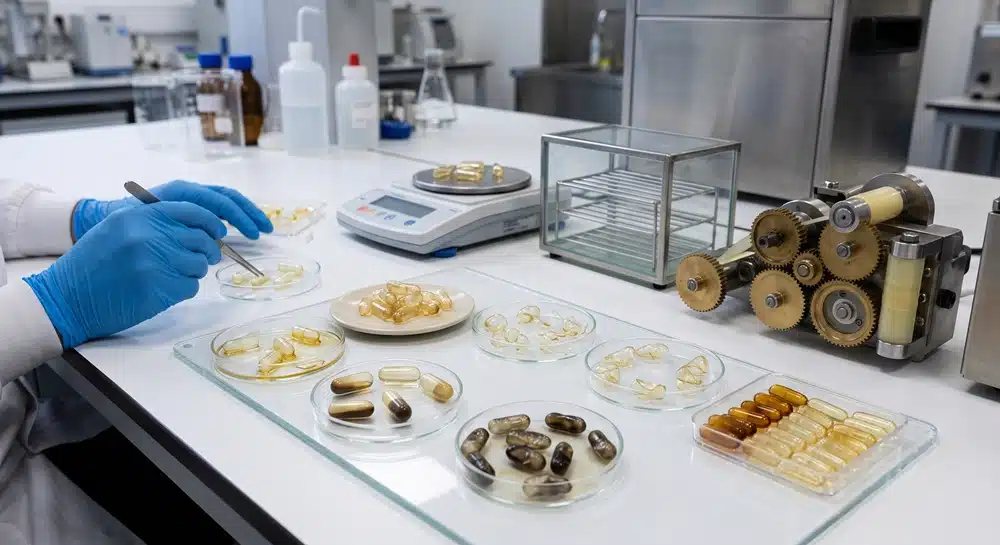
There is no universal softgel MOQ or timeline. A realistic quotation depends on the complete project.
| Conducteur | Why It Affects the Project |
|---|---|
| Private label vs custom formula | Custom development requires feasibility, samples, testing, specifications, and approvals |
| Shell system | Gelatin, fish gelatin, and non-gelatin systems have different materials and process requirements |
| Fill complexity | Solutions are usually simpler than difficult suspensions or oxidation-sensitive systems |
| Capsule size, shape, and tooling | Custom dies, small capsules, twist-off formats, or unique shapes may require additional setup |
| Raw-material minimums | Specialty oils, colors, shells, and branded ingredients may set the practical batch size |
| Testing and stability | Assay, contaminants, oxidation, dissolution, and stability add time and cost |
| Emballage | Custom bottles, blisters, closures, labels, and cartons have their own minimums and lead times |
| Marché cible | Ingredient, color, label, allergen, documentation, and testing requirements differ |
A manufacturer should provide a project-specific MOQ, development schedule, production schedule, testing plan, packaging timeline, and assumptions rather than quoting an unexplained industry-wide number.
How to Choose a Softgel Contract Manufacturer
This article explains the process. Brands ready to compare commercial capabilities should visit our softgel capsule manufacturing services page.
Use the following scorecard when comparing manufacturers:
| Evaluation Area | Éléments à vérifier |
|---|---|
| Dosage-form expertise | Relevant shell systems, fill types, sizes, shapes, mini softgels, and project history |
| Formulation support | Preformulation, shell–fill compatibility, pilot batches, analytical and stability planning |
| Quality system | Part 111 controls, specifications, QC authority, deviations, change control, complaints, and recalls |
| Essais | Identity, assay, contaminants, fill weight, leakage, dissolution, oxidation, and stability capabilities |
| Traçabilité | Component lot traceability, batch records, reconciliation, reserve samples, and distribution records |
| Commercial fit | MOQ, capacity, lead time, tooling, raw-material minimums, pricing assumptions, and scale-up plan |
| Emballage | Bottles, blisters, light and oxygen protection, label control, and package compatibility |
| Transparence | Audit access, quality agreement, change notification, subcontractor disclosure, and data ownership |
Softgel Manufacturer RFP Questions
- Which gelatin and non-gelatin shell systems do you manufacture in-house?
- Which fill types have you produced at commercial scale?
- How do you assess shell–fill compatibility before a pilot run?
- What fill viscosity, particle-size, water-activity, pH, and solvent limits apply?
- Can you develop solutions, suspensions, and semi-solid fills?
- What mini softgel, oval, oblong, round, twist-off, or custom tooling is available?
- What quantities are required for feasibility, pilot, validation, and commercial batches?
- Which raw-material and packaging minimums determine the final MOQ?
- What in-process controls are recorded during shell preparation, fill preparation, encapsulation, and drying?
- How are fill weight, seam integrity, leakage, and capsule dimensions controlled?
- How is the drying endpoint established for each formula?
- Which finished-product specifications and tests are included in the quotation?
- Can you perform or coordinate disintegration, dissolution, oxidation, and stability studies?
- How do you investigate gelatin cross-linking or delayed dissolution?
- How are deviations, out-of-specification results, reprocessing, and rejected material controlled?
- What audit reports, certifications, registrations, and regulatory inspection history can be reviewed?
- Will the project have a written quality agreement and supply agreement?
- How are formula ownership, tooling ownership, data ownership, and confidentiality handled?
- What packaging barriers do you recommend for the fill and target distribution climate?
- What information do you need to provide a reliable MOQ, cost, and launch schedule?
To request a feasibility review, send your formula or ingredient list, target dose, shell preference, capsule size, package, market, quantity, and timeline through our softgel project contact form.
Questions fréquemment posées
How are softgel capsules made?
Softgels are commonly produced by preparing shell and fill masses separately, forming two shell ribbons, metering fill between them, and forming, sealing, and cutting each capsule in a rotary-die machine. The wet capsules are then dried, inspected, tested, packaged, documented, and released.
What is the rotary-die softgel process?
The rotary-die process is a continuous form–fill–seal method. Two flexible shell ribbons pass between rotating dies while a metering pump injects fill through a wedge. The dies shape, seal, and cut the capsules in one operation.
What raw materials are used in softgel shells?
Traditional shells commonly use gelatin, water, and a plasticizer such as glycerin or sorbitol. Optional colors or opacifiers must be appropriate for the target market. Non-gelatin systems may use modified starches, carrageenan-containing systems, or other qualified gelling materials.
What ingredients can go into a softgel?
Common fills include oils, oil solutions, fine suspensions, and selected semi-solid systems. High-water, highly reactive, volatile, extreme-pH, unstable, or coarse-particle fills may require substantial development or may be unsuitable.
How long does softgel drying take?
There is no universal drying time. The endpoint depends on the shell, fill, capsule size, equipment, temperature, humidity, airflow, loading, and finished-product specifications. Time should be determined by the approved and qualified process.
Why do softgels leak?
Leaks can result from ribbon thickness, seam geometry, die alignment, wedge conditions, equipment wear, contamination, fill viscosity, shell–fill incompatibility, or drying. The batch data and defect pattern should be investigated before assigning one cause.
Why do softgels stick together?
Sticking may be associated with incomplete drying, high storage humidity, heat, shell moisture imbalance, surface conditions, or unsuitable packaging. Drying, packaging, shipping, and stability data should be reviewed together.
What is gelatin cross-linking?
Cross-linking is a chemical change that can make gelatin less readily soluble and delay capsule rupture or dissolution. It may be associated with reactive fill components, oxidation products, heat, or humidity. Investigation and compendial enzyme-tier testing may be appropriate.
Are softgels always more bioavailable than tablets?
No. Softgels can support selected liquid, solubilized, or lipid-based systems, but absorption depends on the exact active ingredient, carrier, dose, release, stability, and human evidence. The softgel format alone is not proof of superior bioavailability.
What is the difference between a softgel and a hard capsule?
A softgel is a one-piece shell formed, filled, and sealed in one process and is commonly used for liquids or suspensions. A hard capsule is normally a two-piece shell that is filled later and is commonly used for powders, granules, or pellets.
Can softgels be vegetarian or vegan?
Non-gelatin shell systems can support vegetarian or animal-free positioning, but the full formula and supply chain must be verified. Shell polymers, plasticizers, colors, lubricants, processing aids, and fill ingredients all affect the final claim.
Can a manufacturer make mini softgels?
Mini softgels may be feasible, but active concentration, fill volume, shell ratio, tooling, swallowability, serving count, and manufacturing yield must be reviewed. A “small capsule” target may require a more concentrated fill or multiple units per serving.
What is the difference between private label and custom softgel manufacturing?
Private label projects typically use an existing formula and can move faster. Custom projects require formula development, compatibility work, samples, specifications, testing, packaging review, and approval before commercial production.
What quality tests are used for softgels?
Testing depends on the product and specifications. It may include identity, assay, fill weight, content uniformity, leakage, seam integrity, shell moisture, disintegration or dissolution, microbiology, heavy metals, oxidation markers, packaging checks, and stability.
Références
- Electronic Code of Federal Regulations. 21 CFR Part 111—Current Good Manufacturing Practice for Dietary Supplements.
- U.S. Food and Drug Administration. Small Entity Compliance Guide for Dietary Supplement CGMP.
- Naharros-Molinero A, et al. Shell Formulation in Soft Gelatin Capsules: Design and Characterization.
- Softcaps Science. The Manufacturing Process of Softgel Capsules.
- United States Pharmacopeia. Use of Enzymes in the Dissolution Testing of Gelatin Capsules.
- United States Pharmacopeia. General Chapter <711> Dissolution.
- Aenova Group. Softgel Capsules: Formulation, Manufacturing, Packaging, and Stability Considerations.

Warren Wan est un expert chevronné qui possède une vaste expérience dans la chaîne d’approvisionnement des compléments alimentaires, ainsi qu’une solide expertise pratique dans la recherche, le développement, le contrôle des processus et l’approvisionnement mondial d’ingrédients clés tels que les peptides de collagène, les protéines de bouillon d’os et la kératine. En tant qu'auteur de cette chronique, il s'attache à aller au-delà des discours marketing pour transformer les notions scientifiques obscures relatives aux ingrédients et les normes de contrôle qualité de la production en une vulgarisation scientifique rigoureuse et accessible, aidant ainsi les lecteurs à comprendre la vérité qui se cache derrière les étiquettes et à faire des choix plus rationnels en matière de santé.


