
If you’ve walked down the supplement aisle or checked your favorite online store lately, you’ve likely experienced it: sticker shock. In 2026, protein powder—once an affordable staple of the fitness world—has reached record-high price points that have left even the most dedicated athletes and health-conscious consumers asking the same question: Why are protein supplements so expensive right now?
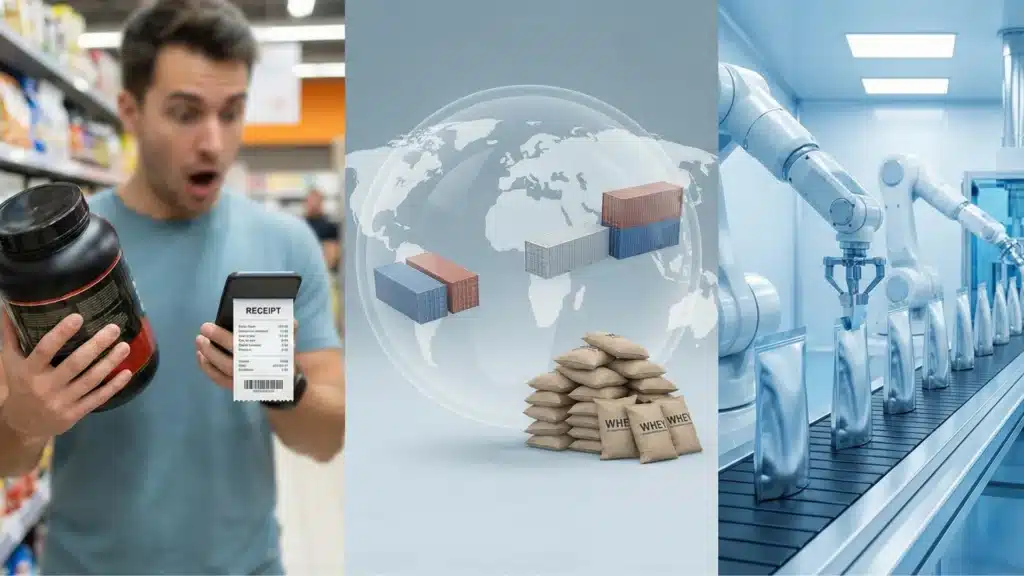
The answer isn’t as simple as general inflation. We are currently navigating a “perfect storm” in the global nutrition market. From the unprecedented surge in demand driven by the GLP-1 weight-loss revolution to a critical global whey shortage and the rising costs of high-tech, cGMP-compliant manufacturing, the landscape of protein production has fundamentally shifted.
As a leader in powder supplement formulation and manufacturing, Gensei is pulling back the curtain on the industry. In this guide, we will break down the “Truth” behind 2026 pricing, exploring the complex supply chain dynamics, the science of bioavailable formulations, and what it actually takes to produce a stable, high-quality protein blend in today’s volatile market.By the end of this article, you’ll understand exactly what you’re paying for—and how to distinguish between a “premium price” and a “premium value.”
The “GLP-1 Effect”: A New Frontier of Demand
In 2026, the protein market has been hit by a massive, unexpected disruptor: the “GLP-1 Effect.” As GLP-1 receptor agonists (medications like semaglutide and tirzepatide) have become globally mainstream for weight management, the demographic of protein consumers has expanded overnight. This isn’t just about “gym-goers” anymore; it’s a fundamental shift in how millions of people eat.
The Muscle Mass Dilemma
While GLP-1 medications are highly effective at reducing appetite and weight, a significant portion of that weight loss can come from lean muscle mass if protein intake isn’t strictly monitored. To combat this, doctors and nutritionists now prescribe high-protein diets as a mandatory companion to these medications.
- Sudden Influx of New Buyers: Millions of users who previously never purchased protein powder are now daily consumers.
- Medical Necessity vs. Recreational Use: Protein has transitioned from a fitness supplement to a “medical necessity” for many, creating a baseline demand that doesn’t fluctuate with seasonal gym trends.
Market Strain
This surge in demand has placed an immense strain on the global supply of high-quality protein sources. When demand spikes this quickly, manufacturers are forced to compete for limited raw materials, driving up the cost for everyone—from the large-scale brand to the individual consumer.
At Gensei, we’ve seen this shift firsthand. Our R&D team has been working double-time to develop specialized, highly palatable, and easy-to-digest powder blends specifically designed for this new segment of consumers who may have sensitive appetites but require optimal nutrient density.
The 2026 Global Whey Shortage
To understand why your protein tub costs more today, we have to look at the primary raw material: Whey. In 2026, the global dairy market has reached a tipping point where whey is no longer just a “byproduct” of cheese—it is a high-value global commodity in its own right.
| Raw Material | 2024 Avg Price (per kg) | 2026 Avg Price (per kg) | % Increase | Primary Driver |
| Whey Isolate (WPI 90) | $8.50 | $14.20 | +67% | GLP-1 Demand & Low Inventory |
| Whey Concentrate (WPC 80) | $5.20 | $9.80 | +88% | Global Feed Shortages |
| Plant Blend (Pea/Rice) | $4.10 | $6.50 | +58% | Climate-driven Crop Yields |
| Natural Monk Fruit | $120.00 | $195.00 | +62% | Clean Label Popularity |
The Great Decoupling
Historically, when cheese production was high, whey was abundant and cheap. However, 2026 has seen a “decoupling” of prices. While standard dairy products like butter have stabilized or even decreased in price, Whey Protein Isolate (WPI) and Whey Protein Concentrate (WPC80) have skyrocketed to record-breaking levels, with WPI prices in some regions exceeding $11/lb ($24,000 per metric ton).
Why the Supply Can’t Keep Up
- The “Forward-Sold” Reality: Major US and European dairy producers have already “sold forward” their production capacity well into late 2026. This means new brands or smaller manufacturers are fighting over a tiny fraction of the remaining supply, often paying massive premiums just to secure stock.
- Climate & Yield Stress: Rising global temperatures have impacted livestock productivity. Heat-stressed cows produce less milk, and the milk they do produce often has a lower protein-to-fat ratio, tightening the yield of high-quality whey.
- A Multi-Industry Scramble: It’s not just supplement companies anymore. The food industry—from high-protein ice creams to snack bar giants—is now competing for the same limited whey stream to meet the “protein-everything” consumer trend.
The Global Ripple Effect
When the US market (the world’s largest producer) experiences a shortage, it triggers a global chain reaction. Chinese and Asian markets, which traditionally relied on US exports, have pivoted to European suppliers, effectively draining global reserves and pushing prices up in every corner of the world.
Because we operate at a significant scale and maintain deep relationships with global dairy cooperatives, Gensei works to mitigate “spot market” price spikes for our clients. Our procurement strategy is engineered to navigate global shortages, ensuring our partners receive consistent, high-purity raw materials even when the rest of the market is facing “sold-out” notices.
Manufacturing Complexity
While the cost of raw protein is a massive factor, the journey from a raw ingredient to a finished, shelf-stable powder is where significant hidden costs reside. In 2026, simply “mixing” ingredients is no longer enough; professional manufacturing requires precision science and high-end engineering.
The Cost of cGMP Compliance
At Gensei, we operate under cGMP (current Good Manufacturing Practice) standards. This is not just a badge; it is a rigorous, daily commitment to safety that carries substantial operational overhead.
- Environmental Control: Protein powders are highly sensitive to moisture and contaminants. Maintaining pharmaceutical-grade air filtration and humidity-controlled environments in 2026 involves significant energy costs.
- Rigorous Testing: Every batch must undergo heavy metal screening, microbial testing, and active ingredient verification. These lab costs are non-negotiable for premium brands but add layers of expense that budget “white-label” products often skip.
The R&D of Palatability
Raw protein is naturally unpalatable and difficult to dissolve. To create a product consumers actually enjoy, manufacturers must invest in advanced R&D:
- Natural Flavor Systems: As 2026 consumers move away from synthetic sweeteners, the cost of high-quality natural flavors and “masking” technologies (to hide the bitterness of certain amino acids) has risen.
- Homogeneity: Ensuring that every single scoop in a 2lb tub has the exact same nutrient profile requires high-end industrial blenders and expert formulation to prevent “settling” or ingredient separation.

Bioavailability
We don’t just want protein to sit in the tub; we want it to be absorbed by the body. Gensei’s seasoned R&D team crafts blends that ensure optimal ingredient synergy and bioavailability. By engineering the particle size and stability of our powders, we ensure that the consumer gets the maximum nutritional “bang for their buck.”
Supply Chain Disruptions & Climate Impact
In 2026, the price of a protein tub is also being shaped by forces thousands of miles away from the gym. Unlike the predictable markets of a decade ago, today’s supplement industry is grappling with a “double squeeze”: the rising cost of international logistics and the biological impact of a changing climate.
The Climate Factor: Heat Stress and Protein Yield
It’s a biological reality that many consumers overlook: protein powder begins on the farm. In 2025 and early 2026, record-breaking heatwaves across major dairy-producing regions—including the US Midwest, Europe, and Australia—have fundamentally altered milk production.
- Lower Nutrient Density: When cows experience “heat stress,” they don’t just produce less milk; the protein and fat components within that milk also decline. This means it takes more raw milk to produce a single pound of Whey Protein Isolate (WPI), driving up the “cost per gram” of protein at the source.
- The Adaptation Tax: To maintain yields, dairy farmers are investing heavily in advanced cooling systems, fans, and specialized heat-resistant feed. These “climate adaptation” costs are inevitably passed down the supply chain.
2026 Logistics: The “New Normal” for Freight
Getting heavy containers of powder across the ocean has become significantly more expensive this year. Several factors have converged to create a challenging shipping environment in 2026:
- Port Congestion & Container Shortages: Surging global demand has outpaced the capacity of major ports, leading to “spot market” shipping rates that are 4–6 times higher than pre-2024 levels.
- Trade Policies & Tariffs: New trade regulations and shifting geopolitical landscapes in 2026 have added layers of complexity—and cost—to imported raw materials. For many manufacturers, the “landed cost” of ingredients now includes a 10–25% premium due to these administrative and trade-related barriers.
How Gensei Navigates the Chaos
In an era of unpredictability, stability is a competitive advantage. Gensei utilizes a dual-sourcing strategy, maintaining relationships with suppliers in multiple geographic regions. By diversifying our supply chain, we are less vulnerable to localized climate events or regional port strikes.
Furthermore, our scale allows us to utilize forward-booking for logistics, locking in freight rates and container space months in advance. This foresight helps shield our partners from the sudden “sticker shock” that often hits smaller, less-integrated manufacturers who rely on the volatile spot market.
The “Clean Label” & Innovation Tax
In 2026, the phrase “you get what you pay for” has never been more accurate in the supplement industry. As consumers move away from “old-school” formulas filled with synthetic additives, a new standard has emerged: the Clean Label. However, achieving a clean label while maintaining high performance creates what industry insiders call an “Innovation Tax.”
| Feature | Legacy “Budget” Powder | Gensei “Clean Label” Standard | Impact on Price |
| Sweetener | Sucralose / Aspartame | Stevia / Monk Fruit / Allulose | High (Natural costs 5x more) |
| Fillers | Maltodextrin / Thickening Gums | Clean fiber / No Fillers | Medium (Pure protein is pricier) |
| Mixing | Raw “Agglomerated” | Precision Instantized (Sunflower) | Low (Adds to R&D cost) |
| Testing | Standard Internal | 3rd Party Batch Testing (NSF/cGMP) | Medium (Verification costs) |
The Natural Sweetener Premium
For decades, the industry relied on low-cost artificial sweeteners like sucralose and acesulfame potassium. In 2026, there is a massive consumer shift toward natural alternatives like Stevia, Monk Fruit, and Allulose.
- Sourcing Costs: High-purity natural sweeteners can cost 3 to 5 times more per kilo than their synthetic counterparts.
- The Flavor Challenge: Natural sweeteners often have “bitter” aftertastes that require complex (and expensive) masking technologies to fix. At Gensei, our R&D team specializes in these botanical flavor systems, ensuring that “natural” doesn’t have to mean “bad-tasting.”
The Rise of “Clear Whey” Innovation
One of the biggest drivers of protein costs in 2026 is the explosion of Clear Whey Isolate. Unlike traditional milky shakes, clear whey looks and tastes like a refreshing fruit juice.
- Advanced Filtration: To make whey transparent, it must undergo acidification and ultrafiltration to strip away every trace of fat and lactose. Each additional filtration step increases the loss of raw material and consumes more energy, pushing the final price higher.
- The Refreshment Factor: Despite the cost, the demand for clear, “non-bloating” protein has created a premium market tier where consumers are willing to pay more for the unique experience.
Transparency as a Cost Center
In 2026, a “Clean Label” also means a Transparent Label. Consumers now expect:
- Third-Party Testing: Regular audits for heavy metals and purity (e.g., NSF or Informed Sport) add thousands of dollars to the production cost of every batch.
- Smart Packaging: Many premium brands now include QR codes on their labels that link to real-time lab results for that specific batch. This level of traceability requires sophisticated software and logistics integration.
We believe the “Innovation Tax” is actually an investment in consumer longevity. By replacing cheap fillers and synthetic dyes with high-stability, natural alternatives, we help our partners build brands that consumers trust for the long term. Our cGMP-compliant facilities are specifically optimized to handle these delicate, natural ingredients that “budget” factories often struggle to process.
How to Identify Value (Not Just the Lowest Price)
| Factor to Check | Why it Matters | Red Flag |
| Protein-to-Weight Ratio | Are you paying for flour or protein? | Less than 70% protein by weight. |
| Amino Profile | Ensures it’s not “Amino Spiked” with cheap taurine. | Missing a full amino acid breakdown. |
| Sodium Levels | High sodium often masks poor taste/quality. | Over 250mg per scoop. |
| Solubility | Clumpy powder is wasted product. | Requires a high-speed blender to mix. |
In a market where prices are rising across the board, the temptation to buy the cheapest tub on the shelf is high. However, in 2026, “cheap” protein often comes with hidden costs to your health and your results. Here is how to audit your supplement choice for true value:
Look for Protein Yield
Don’t just look at the price per tub; look at the grams of protein per scoop.
- The Filler Trap: A 2lb tub that is 30% maltodextrin (filler) or “creatine monohydrate” (used for nitrogen spiking) might be cheaper, but you are paying for powder that doesn’t help you reach your protein goals.
- The Math: Divide the total price by the total grams of protein in the container to find the true cost.
Check the Manufacturing Pedigree
Does the brand mention their manufacturing standards? A product made in a cGMP-compliant facility (like Gensei’s) ensures that the label matches the contents. In 2026, “label fraud”—where a product contains less protein than claimed—is more common in budget brands trying to survive the whey shortage.
Palatability and Mixability
If a protein powder is so clumpy or foul-tasting that you stop using it after three days, the entire purchase is a 100% loss. High-quality powders use advanced agglomeration techniques (a Gensei specialty) that allow the powder to dissolve instantly in water without a shaker ball.
FAQs
Conclusion
As we move through 2026, it is clear that the days of “commodity-priced” protein are behind us. What we are witnessing is not a temporary price spike, but a fundamental evolution of the nutritional industry. The “perfect storm” of the GLP-1 revolution, global supply chain shifts, and the rising demand for Clean Label transparency has redefined the value of a single scoop of protein.
In this new landscape, the price tag on a supplement tub represents more than just raw ingredients; it reflects a commitment to pharmaceutical-grade safety, environmental resilience, and advanced R&D.
At Gensei, we view these market challenges as an opportunity to lead through innovation. Our goal isn’t just to manufacture powder; it’s to engineer stability and trust. By maintaining our cGMP-compliant facilities and leveraging our unrivaled formulation expertise, we ensure that our partners can deliver consistent, high-purity supplements even in the most challenging economic climates.
Understanding “The Truth” behind 2026 pricing empowers you—the consumer or the brand owner—to prioritize quality over cost and science over marketing. In an era of high prices, the most expensive product is the one that doesn’t deliver results.
Don’t let market volatility compromise your brand. Partner with Gensei for unrivaled formulation expertise, cGMP-compliant manufacturing, and a stable global supply chain.
Inquire for Your Next Projectreferences
- FDA: Current Good Manufacturing Practice (cGMP) Regulations(source link: FDA Dietary Supplement Guidance)
- Provides the raw data for the whey price surges discussed.(source link: USDA Agricultural Marketing Service)
- Supports the “GLP-1 Effect” by providing scientific evidence that weight-loss drugs require increased protein intake.(source link: NIH PubMed – Muscle Loss During Weight Management
- International Dairy Foods Association (IDFA): Global Trends.(source link: IDFA Industry Resources)
- Authoritative data on the global shipping and logistics costs.(source link: UNCTAD Maritime Transport Reports)
- inflation and raw material pricing.(source link: World Bank Commodity Markets)