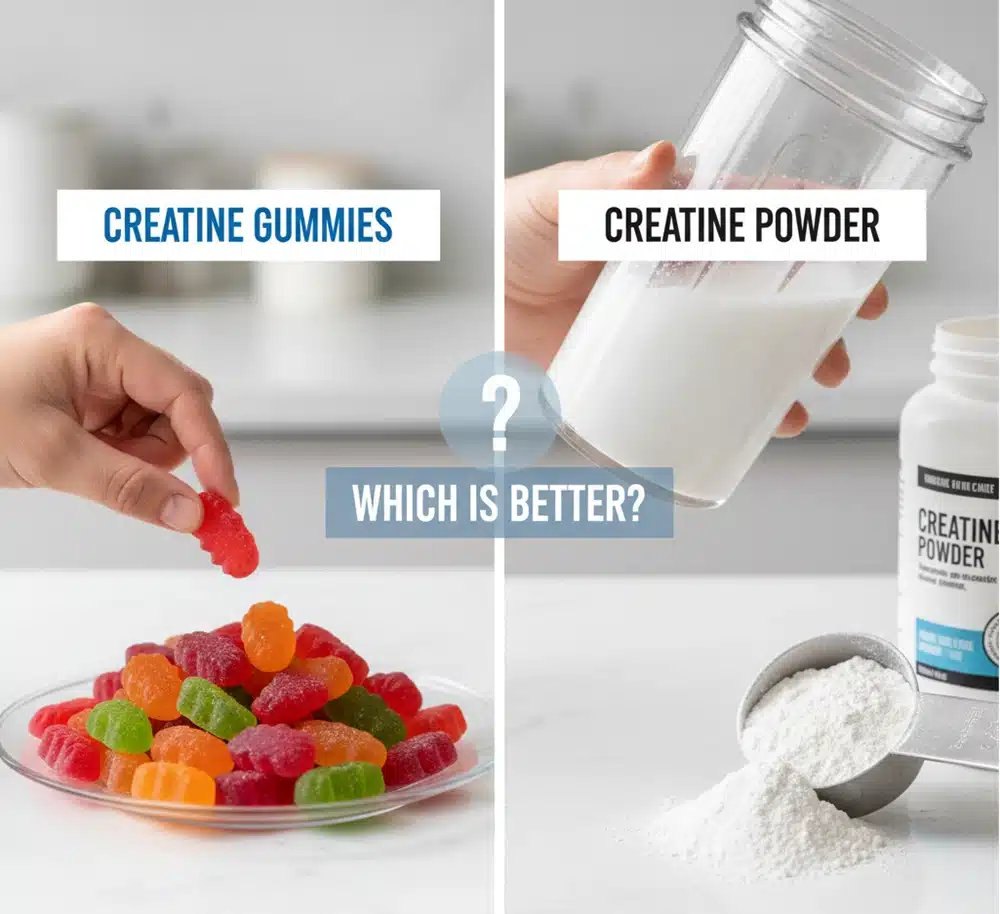
Creatine Monohydrate is widely considered the “gold standard” of sports supplements, backed by decades of research proving its ability to increase strength and muscle mass. However, once you decide to take it, you are immediately faced with a second choice: creatine monohydrate powder vs capsules.
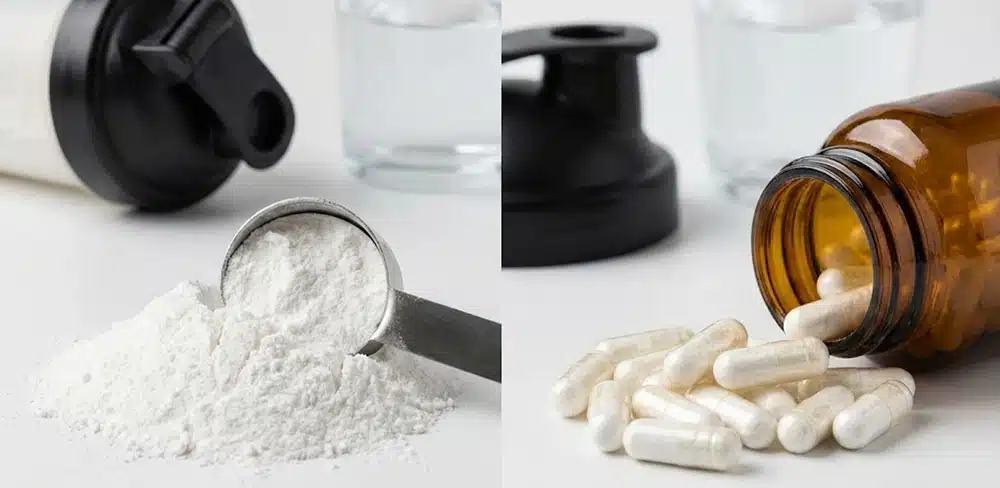
Both forms deliver the exact same active ingredient to your muscles, yet the user experience is drastically different. So, which one should you buy?
If you want the best value for your money and flexible dosing, Powder is the superior choice. However, if you prioritize convenience, travel often, and hate the taste of gritty water, Capsules are worth the extra cost.
The 5 Key Differences Explained
| Feature | Creatine Powder | Creatine Capsules |
|---|---|---|
| Cost Per Serving | Low ($0.10 – $0.25) | High ($0.40 – $1.00+) |
| Convenience | Low (Requires mixing/shaker) | High (Grab & Go) |
| Absorption Speed | Fast (Dissolves immediately) | Slower (15-30 mins delay) |
| Taste/Texture | Gritty or Chalky | Tasteless / Smooth |
| Best For… | Budget shoppers & daily protein shake drinkers | Travelers & texture-sensitive users |
Cost & Value (The Biggest Differentiator)
When comparing creatine monohydrate powder vs capsules, price is the most significant difference. While both forms provide the exact same active ingredient, the manufacturing process drastically changes the price tag.
Why is Powder Cheaper?
Creatine powder is the raw form of the supplement. Manufacturing it is straightforward: the creatine is synthesized, purified, tested for quality, and bottled. Because there are no extra processing steps, companies can sell it in bulk quantities (often 500g or 1kg tubs) for a very low price.
💰Average Cost: Approx. $0.10 – $0.25 per serving (5g).
Why are Capsules Expensive?
Creatine capsules (or pills) start as the same powder, but they require a secondary manufacturing phase called “encapsulation.” A specialized capsule supplement manufacturer must process the raw ingredients into finished pills, which adds multiple layers of cost.
- Materials: The manufacturer must purchase gelatin or vegetable cellulose shells.
- Labor & Machinery: Capsule Supplement Manufacturing is a complex mechanical process. Specialized machines are needed to fill, seal, and polish the capsules.
- Volume: You simply cannot fit as much creatine in a bottle of pills as you can in a tub of powder.
💰Average Cost: Approx. $0.40 – $1.00+ per serving (5g).
The “Hidden” Cost of Capsules The biggest mistake beginners make is looking at the bottle price rather than the serving size. A bottle of capsules might look cheaper at $19.99 compared to a $29.99 tub of powder. However, that $19.99 bottle might only last you 20 days (if taking the full 5g dose), whereas the tub of powder could last you 3–4 months.
If you are on a strict budget, powder is the clear winner. You are paying for the creatine, not the manufacturing process.
Absorption Speed & Bioavailability
One of the most common arguments in the “powder vs capsules” debate is absorption speed. Does liquid creatine actually hit your muscles faster than a pill?
The Science of Absorption Technically, creatine powder absorbs faster.
- Powder: Since it is already loose, it dissolves almost immediately upon hitting your stomach acid (or even in your glass of water beforehand). This allows the body to begin processing it right away.
- Capsules: The outer shell (usually gelatin or vegetable cellulose) acts as a barrier. Your stomach needs about 15 to 30 minutes to dissolve this shell before the creatine inside can be released and absorbed.
Does Speed Actually Matter? This is where the marketing often misleads consumers. While powder is faster, it does not make a significant difference for muscle growth.
Creatine is not like caffeine or a pre-workout stimulant where you need an immediate “kick” of energy. Creatine works by saturation—building up a reserve of phosphocreatine in your muscles over weeks.
⚠️ The Reality Check
Whether the creatine enters your bloodstream in 10 minutes (powder) or 40 minutes (capsules) is irrelevant to the long-term saturation of your muscles. As long as you take it consistently every day, your body will store it effectively.
Bioavailability (How Much Your Body Uses) Both forms contain the exact same molecule: Creatine Monohydrate. Once the capsule shell dissolves, the bioavailability is virtually identical to powder. Studies have not shown a significant difference in the amount of creatine utilized by the body between the two forms.
Convenience & Portability
While powder wins on price, capsules are the undisputed king of convenience.
To understand why, we need to look at the “Gym Bag Test.” This is a simple measure of how much effort it takes to get the supplement from your shelf into your body when you are in a rush.
The Capsule Experience
Capsules require zero preparation. You don’t need a shaker bottle, a scoop, or even a specific amount of water.
- Travel Friendly: You can throw a bottle in your gym bag without worrying about it spilling.
- TSA Approved: If you fly often, capsules are much less likely to be flagged by airport security than a tub of white powder.
- Discreet: You can take them anywhere—at your desk, in the car, or walking to the gym—without drawing attention to yourself shaking a loud plastic bottle.
The Powder Experience
Powder requires “hardware.” You need a shaker bottle or a glass and a spoon.
- The Mess Factor: We have all been there—you try to dump a scoop of powder into a water bottle, and half of it spills onto the counter or your car seat.
- Cleanup: After drinking powder, you are left with a dirty shaker that starts to smell if you don’t wash it immediately.
- Texture Fatigue: Drinking a gritty, sandy liquid every single day can get tiring. With capsules, the experience is over in 2 seconds.
🏆Capsules win comfortably here. If you hate the mess of mixing powders, travel frequently, or just want a “set it and forget it” solution, the extra cost of capsules is money well spent.
Dosing Flexibility & The Loading Phase
While capsules are convenient for maintenance, they become a nightmare if you plan to do a “Loading Phase.”
The “Loading Phase” Math Problem A standard creatine loading phase involves taking 20 grams per day for 5–7 days to saturate your muscles quickly.
- With Powder: This is easy. You take 4 scoops (5g each) spaced throughout the day.
- With Capsules: This is difficult. A standard creatine capsule contains only 750mg to 2.5g of creatine. This means to get 20 grams, you might have to swallow 8 to 25 pills per day.
📝 Important Note
Even for a standard maintenance dose (5g), many capsule brands require you to take 3–7 pills at once. If you struggle with swallowing large tablets, this can become a daily annoyance.
Micro-Dosing vs. Fixed Dosing Powder gives you total control. If you want to take exactly 3g because you are smaller, or 7g because you are larger, you simply adjust your scoop. Capsules lock you into fixed increments. You cannot take “3.5 grams” if each pill is 2.5 grams. You are forced to round up or down.
🏆Powder wins comfortably here. If you plan to “load” creatine (20g/day) or hate swallowing handfuls of pills, powder is the only logical choice. Capsules force you into a “fixed dose” that is often annoying to manage.
5. Taste & Texture
If you have a sensitive stomach or hate the texture of “sandy water,” this category might be your deciding factor.
The Powder Reality: Gritty & Chalky
Unless you buy “Micronized” creatine (which is ground into a finer dust), standard creatine powder does not dissolve 100% in water. It tends to settle at the bottom of the glass.
- The “Sand” Effect: Drinking the last sip of a creatine shake often feels like drinking wet sand.
- The Taste: Unflavored powder is not actually “tasteless.” It has a slightly bitter, chemical aftertaste that many people find unpleasant in plain water. You usually need to mask it with juice or protein powder.
The Capsule Advantage: Tasteless & Smooth
Capsules completely bypass your taste buds.
- Zero Flavor: The gelatin or vegetable shell has no taste. You swallow it, and it’s gone.
- No Aftertaste: You won’t be burping up chemical flavors later (unlike some fish oil pills).
- Texture: As long as you can swallow the pill size (usually ’00’ size, which is about 23mm long), the experience is smooth and grit-free.
🏆Capsules win comfortably here. If you cannot stand the texture of gritty water or the slight chemical taste of unflavored powder, capsules are the superior experience. They offer a “zero taste” solution.
Which Should You Buy?
After comparing the science, cost, and convenience, the honest truth is that neither form is “better” for muscle growth. Both powder and capsules deliver the same active ingredient (Creatine Monohydrate) to your muscles.
The decision isn’t about biology; it’s about lifestyle.
To help you make the final call, look at the three profiles below and see which one describes you best.
1. The Budget Athlete (Winner: Powder) If you are a student, looking to save money, or simply want the most efficient option, buy Powder. You will get 4x more servings for your money. If you already drink a daily protein shake, dumping a scoop of creatine in there takes zero extra effort.
2. The Frequent Traveler (Winner: Capsules) If you fly often, go to the gym directly from the office, or have a messy gym bag, buy Capsules. The convenience of having a sealed bottle in your bag without worrying about white powder spilling everywhere is worth the extra premium.
3. The Texture-Hater (Winner: Capsules) If you have a sensitive gag reflex or simply cannot stand the gritty texture of undissolved powder, Capsules are the only way to go. They offer a flavorless, smooth experience that ensures you actually take your supplement every day.
Final Verdict: Powder vs. Capsules
- Buy Powder if: You want to save money ($0.15/serving) and don’t mind mixing drinks.
- Buy Capsules if: You prioritize convenience, travel often, or hate gritty textures.
- The Bottom Line: Both build muscle equally well. Choose the one you will consistently take every single day.
FAQs
conclusion
Ultimately, the choice comes down to your personal priorities. If budget is your only concern, powder is the logical path. However, if you value convenience, precision, and a flavorless experience, capsules are the superior option for a busy lifestyle.
- Still weighing the pros and cons? We have broken down the cost, absorption, and convenience to help you choose the right form. For a broader look at the industry, read our Capsule Supplements Guide.
- Ready to start manufacturing? As a leading contract manufacturer, Gensei produces high-quality creatine capsules directly for your brand. Contact our technical team today to match your formula with the perfect shell.
references
- Creatine Monohydrate is widely considered the “gold standard” of sports supplements, backed by decades of research proving its ability to increase strength and muscle mass.(source link: Creatine Supplementation for Muscle Growth: A Scoping Review of Randomized Clinical Trials from 2012 to 2021 – PMC.)
- Labor & Machinery: Specialized machines are needed to fill, seal, and polish the capsules.(source link: Syntegon GKB 2100 | Capsule sealing made easy)