
In the world of high-performance sports nutrition, few ingredients carry as much weight—or as much confusion—as Creatine and Collagen Peptides. While both have earned their place on the shelves of elite athletes and wellness enthusiasts alike, they serve fundamentally different purposes within the human body. One is the undisputed king of explosive power and muscle energy, while the other acts as the essential “glue” that holds your joints, tendons, and connective tissues together.

If you are looking to optimize your supplement stack, the question isn’t always about which one is “better,” but rather which one aligns with your specific physiological goals. Are you looking to shatter a personal record in the weight room, or are you focused on long-term joint resilience and recovery?
As a leader in sports nutrition contract manufacturing, Gensei understands the science behind these bioactive compounds. In this comprehensive guide, we will break down the biological mechanisms of creatine versus collagen, compare their primary benefits, and reveal why the most effective fitness regimens often find a way to utilize both.
Quick Answer: Creatine vs Collagen Peptides
Creatine and collagen peptides are not direct competitors. They support different parts of athletic performance and healthy aging.
Creatine is the better choice when the main goal is strength, power, muscle performance, high-intensity training, or improved training output. It works primarily through the phosphocreatine system, helping the body regenerate ATP during short bursts of intense activity.
Collagen peptides are the better choice when the main goal is joint comfort, tendon and ligament support, skin elasticity, connective tissue resilience, or long-term recovery. They provide glycine, proline, and hydroxyproline-rich peptides that support the structural proteins found in skin, tendons, ligaments, cartilage, and bone.
For modern athletes and supplement brands, the more valuable question is not “Which one is better?” but “How can creatine and collagen peptides be used together in a formula that supports both performance and structural resilience?”
That is why many sports nutrition brands are now developing hybrid performance powders that combine creatine monohydrate with hydrolyzed collagen peptides.
Creatine: The Gold Standard for Power and Performance
In the world of sports science, few supplements have undergone as much rigorous, peer-reviewed scrutiny as Creatine Monohydrate. Frequently referred to as the “gold standard,” it is a naturally occurring compound found in muscle cells that helps your muscles produce energy during heavy lifting or high-intensity exercise.
As a bulk amino acids supplier, Gensei can help source creatine and related sports nutrition ingredients for custom performance formulas.The Mechanism: ATP and Cellular Energy
At the heart of creatine’s effectiveness is ATP (Adenosine Triphosphate). ATP is the primary energy currency of your cells. When you exercise intensely, your muscles deplete their ATP stores rapidly.
Creatine works by increasing your body’s stores of phosphocreatine. Think of phosphocreatine as a backup battery for your muscles; it allows your body to quickly regenerate ATP, ensuring that you can push through that final repetition or maintain your sprint speed for a few seconds longer.
Primary Benefits for Performance
Research consistently shows that creatine supplementation can significantly improve maximal power output and strength in resistance training.
Creatine draws water into your muscle cells (cellular hydration), which not only gives them a fuller appearance but also acts as a biological signal for protein synthesis and muscle growth.
By speeding up the replenishment of energy stores, creatine reduces the time needed for recovery between sets and high-intensity bouts of cardio.
Emerging studies suggest that creatine may support brain health by reducing mental fatigue and improving cognitive function during periods of sleep deprivation.
At Gensei, we prioritize micronized creatine, where the particles are milled to a much smaller size. This ensures superior solubility—meaning it won’t settle at the bottom of a shaker—and better bioavailability.
Our precision milling allows the body to absorb the ingredient more efficiently, virtually eliminating the digestive discomfort often associated with lower-grade, coarse powders.
Collagen Peptides: The Inner Scaffolding for Longevity
While creatine fuels the engine of your muscles, Collagen Peptides act as the chassis of the vehicle. Collagen is the most abundant protein in the human body, providing structural integrity to everything from your skin and gut lining to—most importantly for athletes—your joints, tendons, and ligaments.
For brands sourcing hydrolyzed collagen, our collagen peptide ingredients can be selected by source, molecular weight, solubility, flavor profile, and application.The Mechanism: The Extracellular Matrix
Unlike whey protein or creatine, collagen is uniquely rich in three specific amino acids: Glycine, Proline, and Hydroxyproline. These act as the raw building blocks for the “extracellular matrix”—the biological mesh that keeps your connective tissues resilient.
As we age, or under the stress of heavy training, the body’s natural collagen production begins to decline. Supplementing with collagen peptides provides the body with the specific signaling molecules needed to stimulate “fibroblasts,” the cells responsible for repairing and strengthening our internal scaffolding.
Primary Benefits for Longevity and Resilience
Collagen peptides help maintain the integrity of your cartilage, the rubber-like tissue that protects your joints from the impact of high-intensity training.
By providing specific amino acids for connective tissue repair, collagen can significantly reduce the risk of common athletic injuries like strains and tears.
Hydrolyzed collagen peptides are broken down into smaller molecules, ensuring they are absorbed quickly and delivered directly to the tissues that need them most.
Beyond fitness, collagen supports skin elasticity and gut lining integrity, which are essential components of a holistic approach to longevity and systemic health.
At Gensei, we specialize in advanced enzymatic hydrolysis. This process breaks the collagen down into short-chain peptides that are highly soluble and neutral in taste, making them ideal for high-performance sports formulas.
We ensure our collagen is sourced from premium, traceable origins, providing your brand with a clean-label product that meets the highest safety and purity standards.
Side-by-Side Comparison: Creatine vs. Collagen
When choosing between creatine and collagen peptides, it is helpful to view them through the lens of Energy vs. Structure. Creatine provides the immediate fuel for muscle contraction, while collagen provides the structural framework that allows those muscles to perform safely and recover effectively.
The following table summarizes the key differences that every athlete and brand owner should understand:
| Key Feature | Creatine Monohydrate | Collagen Peptides |
|---|---|---|
| Primary Goal | Explosive Power & Strength | Joint Health & Longevity |
| Biological Mechanism | ATP (Energy) Regeneration | Extracellular Matrix Support |
| Target Tissues | Skeletal Muscle Cells & Brain | Tendons, Ligaments, Skin & Gut |
| Results Timeline | 1–2 Weeks (with loading) | 4–12 Weeks (consistent use) |
| Best Used For | Hypertrophy & Performance | Recovery & Injury Prevention |
Can You Take Creatine and Collagen Together?

Yes. Creatine and collagen peptides can be taken together because they work through different biological pathways. Creatine supports rapid energy production inside muscle cells, while collagen peptides support connective tissue structure, including tendons, ligaments, cartilage, skin, and bones.
Creatine helps replenish phosphocreatine stores, which allows the body to regenerate ATP during high-intensity exercise. This is why creatine is commonly used in strength, sprint, resistance training, and power-focused formulas.
Collagen peptides do not work like creatine. They do not directly increase ATP production or explosive power. Instead, hydrolyzed collagen provides a concentrated source of collagen-specific amino acids and peptides, especially glycine, proline, and hydroxyproline. These nutrients are associated with the extracellular matrix, the structural network that supports connective tissues.
Because the two ingredients serve different roles, they do not replace each other. A creatine-only formula may support training output, but it does not provide the same structural peptide profile as collagen. A collagen-only formula may support connective tissue resilience, but it does not provide the same performance mechanism as creatine.
Why the Combination Makes Sense
Training progress depends on more than muscle energy. Stronger muscles create greater mechanical load on tendons, ligaments, and joints. If a consumer improves strength faster than their connective tissues can adapt, they may experience more discomfort, stiffness, or recovery limitations.
A creatine-collagen stack addresses both sides of the training equation:
– Creatine supports the output system: strength, power, high-intensity performance, and repeated effort.
– Collagen peptides support the structural system: tendons, ligaments, cartilage, and connective tissue resilience.
This is why the combination has become attractive in hybrid sports nutrition products. Instead of forcing consumers to choose between performance and recovery, a well-designed formula can position itself around stronger movement, better training consistency, and long-term resilience.
Practical Daily Stack Example
A simple daily stack may include:
– Creatine monohydrate: 3-5 g per serving
– Hydrolyzed collagen peptides: 5-15 g per serving
– Vitamin C: included when the formula is positioned around collagen synthesis support
– Electrolytes or flavor system: optional, depending on powder format
For brands, the most common commercial challenge is not ingredient compatibility. It is serving size, taste, solubility, mouthfeel, and cost. Creatine may create sediment if the particle size is too coarse. Collagen peptides may create bitterness or animal-source notes if the raw material quality is inconsistent. A good manufacturer should optimize both the ingredient specifications and the sensory profile before scale-up.
Bottom Line
Creatine and collagen peptides can be taken together, and for active consumers they may be more valuable together than separately. Creatine supports the engine. Collagen peptides support the chassis. A strong formula needs both performance and structure.
The “Power Couple”: Why You Don’t Have to Choose
In the past, athletes often felt they had to choose between “performance” (Creatine) and “recovery” (Collagen). However, modern sports science has shifted toward a more holistic view. At Gensei, we increasingly see that the most effective supplement regimens utilize these two ingredients as a synergistic “Power Couple.”
Synergy in the Body: Energy Meets Resilience
The relationship between creatine and collagen is complementary rather than competitive. While creatine provides the explosive energy required to lift heavier weights or sprint faster, collagen ensures that the “scaffolding”—your tendons and ligaments—is strong enough to handle that increased mechanical load.
By stacking them, you are essentially strengthening both the motor and the chassis of your body simultaneously.
The Ideal Stack: Benefits of Combined Use
Combining these two powerhouses offers a comprehensive approach to physical optimization:
- Total Body Recovery: Creatine handles cellular energy recovery, while collagen manages structural tissue repair.
- Injury Mitigation: Stronger muscles (from creatine) combined with more resilient connective tissue (from collagen) create a significant buffer against common training injuries.
- Efficiency: Taking both ensures that you are covering all your bases—from muscle hypertrophy to healthy aging—without gaps in your nutritional profile.
Creatine vs Collagen for Women

For women, creatine and collagen peptides should not be viewed as competing supplements. They support different goals, and the better choice depends on the consumer’s stage of life, training routine, and product expectation.
Creatine is often underused in women’s sports nutrition because it has historically been marketed toward male bodybuilders. In reality, creatine can be valuable for women who want to support strength, power, lean muscle, training capacity, and active aging. It is especially relevant for women who do resistance training, high-intensity exercise, sprint training, or strength-focused programs.
Collagen peptides are often more familiar to female consumers because they are commonly associated with skin, hair, nails, joints, and beauty-from-within products. However, collagen is not only a beauty ingredient. For active women, collagen peptides can also support connective tissue resilience, tendon and ligament structure, joint comfort, and recovery positioning.
Which One Should Women Choose?
If the primary goal is strength, muscle performance, and gym progress, creatine is usually the stronger first choice.
If the primary goal is skin elasticity, joint support, tendon resilience, or beauty-plus-recovery positioning, collagen peptides are usually the stronger first choice.
If the consumer is active, training regularly, or entering a stage of life where muscle maintenance and joint resilience both matter, the combination may be the most complete option.
| Goal | Better Ingredient Choice |
| Strength and power | Creatine |
| Muscle performance | Creatine |
| Skin elasticity | Collagen peptides |
| Joint and tendon support | Collagen peptides |
| Active aging | Both |
| Recovery-focused sports nutrition | Both |
| Beauty plus performance formula | Both |
Formulation Note for Brands
Women-focused products should avoid outdated messaging that implies creatine is only for “bulking.” A more modern positioning is lean strength, training consistency, muscle maintenance, and active aging. Collagen can then complement this by supporting the structural side of movement: skin, joints, tendons, ligaments, and connective tissue.
This is why creatine-collagen powders for women are becoming more common. They allow a brand to combine performance, recovery, and beauty-from-within positioning in one daily product.
Formulation Innovation: The Rise of “Combo” Powders
As a sports nutrition contract manufacturing partner, Gensei has noticed a major trend: brands are moving away from single-ingredient products. Innovative companies are now requesting “All-in-One” performance powders that blend micronized creatine with hydrolyzed collagen peptides.
When formulating for Gensei clients, we optimize for solubility and taste, ensuring that creatine and collagen can be consumed together without clumping or gritty textures.
- Enhanced intra-workout stamina
- Accelerated post-workout tissue repair
- Simplified daily supplement routine
Why Sports Nutrition Brands Are Combining Creatine and Collagen

The sports nutrition market is moving beyond single-ingredient powders. Consumers increasingly want formulas that solve more than one problem at a time. They do not only want muscle power; they also want recovery, mobility, joint support, and a product that fits into a simple daily routine.
This shift has created strong demand for creatine-collagen combination products.
For a brand owner, the appeal is clear. Creatine is one of the most recognizable performance ingredients in sports nutrition. Collagen peptides are one of the strongest structural support ingredients in the wellness and active aging categories. When combined correctly, they allow a product to sit at the intersection of performance, recovery, joint health, and beauty-from-within.
Why Combination Powders Are Commercially Attractive
Creatine-collagen formulas can support multiple consumer angles:
– Strength and power
– Muscle performance
– Joint and connective tissue support
– Recovery positioning
– Active aging
– Women’s sports nutrition
– Beauty plus performance
– Daily wellness for active consumers
This broader positioning can make the product easier to differentiate from a basic creatine monohydrate tub or a basic collagen peptide powder.
Example Commercial Formula Direction
A common concept for a hybrid performance powder may include:
– 5 g creatine monohydrate
– 10 g hydrolyzed collagen peptides
– Vitamin C for collagen synthesis support positioning
– Electrolytes for hydration positioning
– Natural flavor system
– Optional magnesium or hyaluronic acid for recovery and joint-positioned formulas
The exact formula should depend on market, price point, flavor system, claims strategy, serving size, and regional regulatory requirements.
Manufacturing Challenges Brands Should Expect
A creatine-collagen blend is not difficult in theory, but it must be engineered properly for consumer experience. The most common technical challenges include:
– Creatine sediment or gritty mouthfeel
– Collagen bitterness or animal-source notes
– Poor dispersibility in cold water
– Large serving size
– Moisture sensitivity
– Flavor masking
– Powder flowability during filling
– Scoop accuracy
– Shelf-life and caking risk
This is where an experienced sports nutrition manufacturer can create meaningful value. The goal is not simply to mix two powders together. The goal is to create a finished product that tastes clean, dissolves well, fills consistently, and remains stable throughout its shelf life.
Manufacturing Quality
When evaluating a manufacturer for creatine and collagen, three critical factors determine whether a product will deliver results or sit unused on a shelf due to poor quality.
The origin of ingredients matters. For collagen, this means distinguishing between bovine, marine, or poultry sources and ensuring they are free from hormones and antibiotics. For creatine, it means ensuring the absence of contaminants like dicyandiamide or dihydrotriazine.
Traceable OriginsHigh-quality manufacturing solves “clumping” or “grittiness” through particle engineering. By utilizing micronized creatine and hydrolyzed peptides, a manufacturer ensures the product dissolves instantly in water, improving user experience and absorption.
Micronized TechTrust is built through transparency. Reputable brands look for manufacturers that adhere to strict GMP (Good Manufacturing Practices) and offer third-party testing for heavy metals, allergens, and banned substances.
GMP CertifiedHow Gensei Improves Creatine-Collagen Powder Performance

A successful creatine-collagen product depends on more than ingredient selection. It depends on how those ingredients behave together in the finished formula.
At Gensei, the formulation goal is to improve the consumer experience while protecting the functional identity of each ingredient.
Micronized Creatine for Better Mouthfeel
Coarse creatine can settle at the bottom of a shaker and create a gritty texture. For premium powders, micronized creatine can improve dispersibility and mouthfeel. This does not change creatine into a different ingredient, but it can improve how the finished product feels and mixes.
Low Molecular Weight Collagen Peptides
Collagen peptide performance is influenced by molecular weight distribution, taste, odor, and solubility. Low molecular weight hydrolyzed collagen peptides are generally easier to formulate into instant powders, flavored blends, and daily stick packs.
For B2B projects, brands should ask for peptide specifications, source origin, allergen status, heavy metal testing, and solubility performance before choosing a collagen supplier.
Flavor and Odor Optimization
Creatine is usually neutral, but collagen peptides can introduce source-dependent notes. Bovine, marine, and poultry collagen each behave differently in flavor systems. Flavor masking is especially important for vanilla, berry, citrus, and unflavored products.
Powder Flowability and Fill Accuracy
Creatine and collagen have different densities and powder behaviors. A stable blend must flow properly during filling and maintain uniform distribution. Poor flow can lead to scoop variation, uneven serving size, and consumer complaints.
Stability Review Before Scale-Up
Before moving into mass production, brands should review moisture content, caking risk, packaging barrier properties, and accelerated stability data. This is especially important for stick packs, tubs, and products sold in humid markets.
Representative OEM Case Study: Building a Creatine + Collagen Recovery Powder
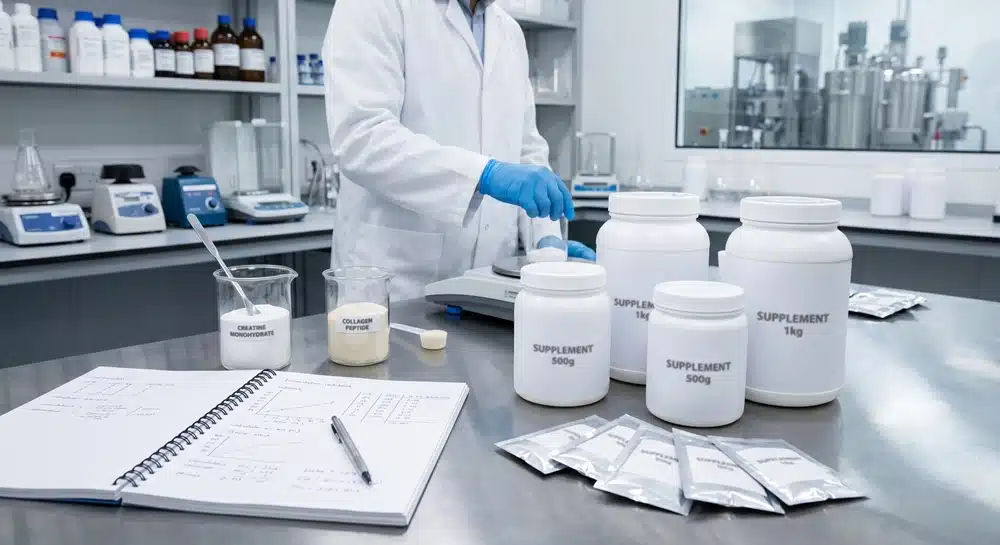
A sports nutrition brand wanted to develop a daily recovery powder that combined 5 g creatine monohydrate with 10 g hydrolyzed collagen peptides. The brand’s target audience was active consumers who wanted strength support, joint resilience, and a simple daily routine.
The initial prototype had three issues:
– The creatine created a gritty texture in cold water.
– The collagen peptide base created a mild bitterness.
– The serving size was large, making flavor balance difficult.
The formulation approach focused on three improvements:
1. Switching to a finer creatine particle specification to improve mouthfeel.
2. Selecting a low-odor collagen peptide grade with better instant dispersion.
3. Rebuilding the flavor system around acidity, sweetness, and masking notes.
The final concept became a daily hybrid performance powder positioned around strength, recovery, and connective tissue support. Instead of competing directly with basic creatine powders, the product created a broader performance-and-resilience story.
For brands, the lesson is clear: a creatine-collagen formula should not be developed by simply blending two commodity ingredients. It should be engineered around solubility, flavor, serving size, shelf life, and market positioning.
FAQs About Creatine vs Collagen Peptides
Can you take creatine and collagen peptides together?
Yes. Creatine and collagen peptides can be taken together because they work through different mechanisms. Creatine supports ATP regeneration and high-intensity performance, while collagen peptides support connective tissue structure. They are complementary rather than competitive.
Which is better, creatine or collagen peptides?
Creatine is better for strength, power, and muscle performance. Collagen peptides are better for joint, tendon, ligament, skin, and connective tissue support. For active consumers, the best answer is often both.
Does creatine contain collagen?
No. Creatine does not contain collagen. Creatine is a nitrogen-containing compound involved in energy metabolism, while collagen peptides are hydrolyzed protein fragments derived from collagen-rich animal sources.
Can collagen replace creatine?
No. Collagen peptides cannot replace creatine because they do not directly support the phosphocreatine energy system. Collagen supports structural tissues, while creatine supports high-intensity energy production.
Can creatine replace collagen?
No. Creatine does not provide the collagen-specific peptide profile associated with connective tissue support. It can support training output, but it does not replace collagen peptides in a joint, tendon, or beauty-from-within formula.
What is the best creatine-to-collagen ratio?
A common commercial starting point is 3-5 g creatine monohydrate with 5-15 g collagen peptides. The final ratio depends on product positioning, serving size, flavor system, price point, and target consumer.
Is creatine or collagen better for women?
Creatine is often better for women focused on strength, lean muscle, training performance, and active aging. Collagen peptides are often better for skin elasticity, joint comfort, and connective tissue support. A combination formula can serve both goals.
Are creatine-collagen powders stable?
They can be stable when properly formulated. Brands should evaluate moisture content, caking risk, powder flowability, flavor stability, packaging barrier properties, and shelf-life data before launch.
What should brands test before launching a creatine-collagen powder?
Brands should test active content, heavy metals, microbial limits, banned substances if targeting athletes, moisture, particle size, bulk density, solubility, flavor stability, and packaging compatibility.
What is the MOQ for creatine-collagen products?
MOQ depends on dosage form, formula complexity, flavor, packaging format, and ingredient sourcing. A simple unflavored powder typically has a different MOQ than a flavored stick pack or multi-ingredient sports nutrition blend.
Conclusion
Choosing between creatine vs. collagen peptides doesn’t have to be an “either/or” decision. As we have explored, these two supplements operate on entirely different biological pathways. Creatine is your primary tool for increasing cellular energy and muscle performance, while collagen peptides serve as the essential structural foundation for your joints and connective tissues.
If your goal is a finished market-ready product, our private label sports nutrition supplements service can support formula development, packaging, testing, and production.If your focus is raw strength, explosive speed, and muscle hypertrophy, Creatine Monohydrate is your essential supplement.
If you prioritize joint health, faster recovery from connective tissue strain, and overall structural integrity, Collagen Peptides are the key.
For the modern athlete, stacking both provides a comprehensive system of energy and support that leads to sustainable progress and reduced injury risk.
references
- 1. International Society of Sports Nutrition Position Stand: Safety and efficacy of creatine supplementation in exercise, sport, and medicine
- https://pubmed.ncbi.nlm.nih.gov/28615996/
- 2. Full text: International Society of Sports Nutrition position stand on creatine
- https://jissn.biomedcentral.com/articles/10.1186/s12970-017-0173-z
- 3. NIH Office of Dietary Supplements: Exercise and Athletic Performance
- https://ods.od.nih.gov/factsheets/ExerciseAndAthleticPerformance-HealthProfessional/
- 4. Collagen peptide supplementation and body composition / joint outcomes review
- https://pubmed.ncbi.nlm.nih.gov/34491424/
- 5. Collagen supplementation for joint health review
- https://pmc.ncbi.nlm.nih.gov/articles/PMC10058045/
- 6. Vitamin C-enriched gelatin supplementation before intermittent activity and collagen synthesis
- https://pubmed.ncbi.nlm.nih.gov/27852613/
- 7. NSF Certified for Sport Program
- https://www.nsf.org/consumer-resources/articles/certified-for-sport-program
- 8. FDA: Structure/Function Claims
- https://www.fda.gov/food/nutrition-food-labeling-and-critical-foods/structurefunction-claims

Warren Wan is a seasoned expert with extensive experience in the dietary supplement supply chain, possessing rich practical experience in the research, development, process control, and global sourcing of core ingredients such as collagen peptides, bone broth protein, and keratin. As the author of this column, he is dedicated to stripping away the marketing packaging, transforming obscure ingredient science and production quality control standards into easy-to-understand, hardcore science popularization, helping readers understand the truth behind the labels and make more rational health choices.