
Ces deux ingrédients peuvent être utilisés dans les poudres protéinées, les boissons prêtes à l'emploi, les substituts de repas et les produits de nutrition sportive. Le choix de la meilleure option dépend de votre clientèle cible, des allégations protéiques, du profil en acides aminés, du profil gustatif, de la gestion des allergènes, de l'objectif de coût et du format de fabrication.
Si vous développez une poudre protéinée, un substitut de repas ou une formule de nutrition sportive, travailler avec un fabricant de compléments protéinés qui permet d'évaluer la source de protéines, le masquage des arômes, la taille des portions, la solubilité, le conditionnement et les tests sur le produit fini avant la production.
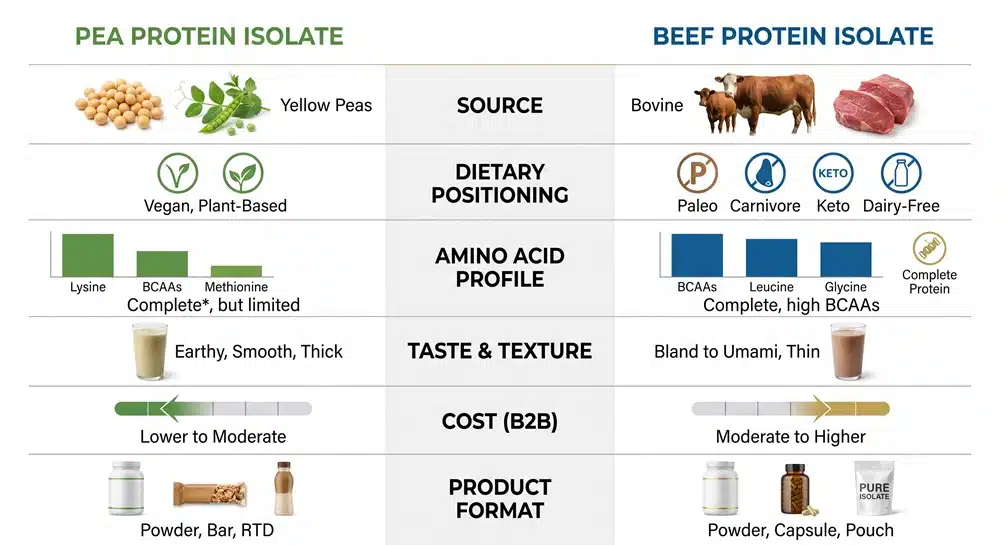
Comparaison rapide : protéines de pois vs isolat de protéines de bœuf
Qu'est-ce que l'isolat de protéines de pois ?
L'isolat de protéines de pois est un ingrédient protéiné végétal concentré, généralement issu de pois jaunes. Le procédé de fabrication permet d'éliminer la majeure partie de l'amidon et des fibres du pois, ce qui donne une poudre riche en protéines pouvant être utilisée dans les poudres protéinées végétaliennes, les boissons protéinées sans produits laitiers, les substituts de repas, les barres protéinées et les produits de nutrition fonctionnelle.
La protéine de pois est très appréciée car elle permet de proposer des produits adaptés aux régimes végétaliens, végétariens, sans produits laitiers et sans soja. Elle s'intègre également très bien dans les mélanges de protéines végétales, notamment lorsqu'elle est associée à des protéines complémentaires telles que la protéine de riz, afin d'améliorer le profil en acides aminés global.
Du point de vue de la formulation, la protéine de pois ne pose pas forcément de problème. Les marques doivent tout de même tenir compte de plusieurs critères : le masquage du goût, la texture granuleuse, la dispersibilité, la formation de mousse, la viscosité, l'arrière-goût, la taille des portions et le conditionnement. Une formule végétale riche en protéines peut être un échec commercial si le smoothie a un goût de craie, s'il est trop épais ou s'il est difficile à mélanger.
Qu'est-ce que l'isolat de protéines de bœuf ?
L'isolat de protéines de bœuf est un ingrédient protéiné d'origine animale commercialisé comme alternative sans produits laitiers au lactosérum ou à la caséine. Il est utilisé dans certaines poudres protéinées, certaines préparations prêtes à mélanger et certains produits de type paléo. Cependant, le terme “ isolat de protéines de bœuf ” peut désigner différents types d'ingrédients, et tous les produits ne présentent pas le même profil en acides aminés.
Certains ingrédients à base de protéines de bœuf peuvent provenir de tissus musculaires, tandis que d’autres s’apparentent davantage au collagène hydrolysé, à la gélatine ou à des substances de type bouillon d’os. Cela a son importance, car les protéines riches en collagène peuvent présenter une teneur élevée en glycine, proline et hydroxyproline, mais être pauvres en certains acides aminés essentiels. C'est pourquoi les marques de compléments alimentaires ne devraient pas partir du principe que tout isolat de protéines de bœuf est automatiquement équivalent à du steak, à un isolat de lactosérum ou à une protéine sportive complète.
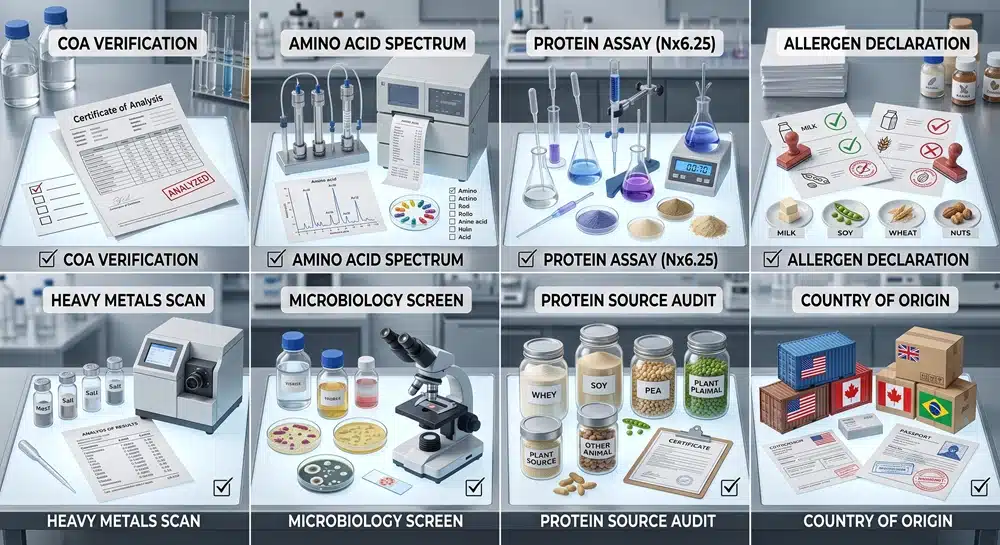
Avant d'utiliser de l'isolat de protéines de bœuf dans une formule, demandez un certificat d'analyse (COA) à jour, la méthode d'analyse des protéines, le profil en acides aminés, la déclaration de provenance, la déclaration relative aux allergènes, les informations sur le pays d'origine, les résultats microbiologiques et les analyses relatives aux métaux lourds. Si le produit est destiné à la nutrition sportive, portez une attention particulière aux acides aminés essentiels, à la leucine et à la teneur totale en protéines par portion.
Lequel est le meilleur ?
Les protéines de pois conviennent mieux aux produits végétaliens, à base de plantes, sans produits laitiers, sans soja et à prix abordable. L'isolat de protéines de bœuf est quant à lui plus adapté aux marques qui recherchent une source de protéines d'origine animale mais sans produits laitiers, en particulier pour les formules de type paléo, inspirées des bouillons ou destinées à la nutrition sportive de niche.
Pour la plupart des poudres de protéines végétales grand public, l'isolat de protéines de pois constitue la base la plus polyvalente. Il est plus facile à positionner auprès des consommateurs végétaliens, peut être mélangé à des protéines de riz ou à d'autres protéines végétales, et est bien connu des acheteurs sur le marché de la nutrition végétale.
En ce qui concerne les produits protéiques d'origine animale, l'isolat de protéines de bœuf peut constituer un argument de vente différenciant, mais il nécessite une diligence raisonnable accrue de la part des fournisseurs. Cet ingrédient doit être évalué en fonction de son profil en acides aminés, de ses caractéristiques sensorielles, de sa solubilité, de sa teneur en protéines et de la validité des allégations qui lui sont associées, plutôt que sur la seule base de son nom.
Profil en acides aminés et qualité des protéines
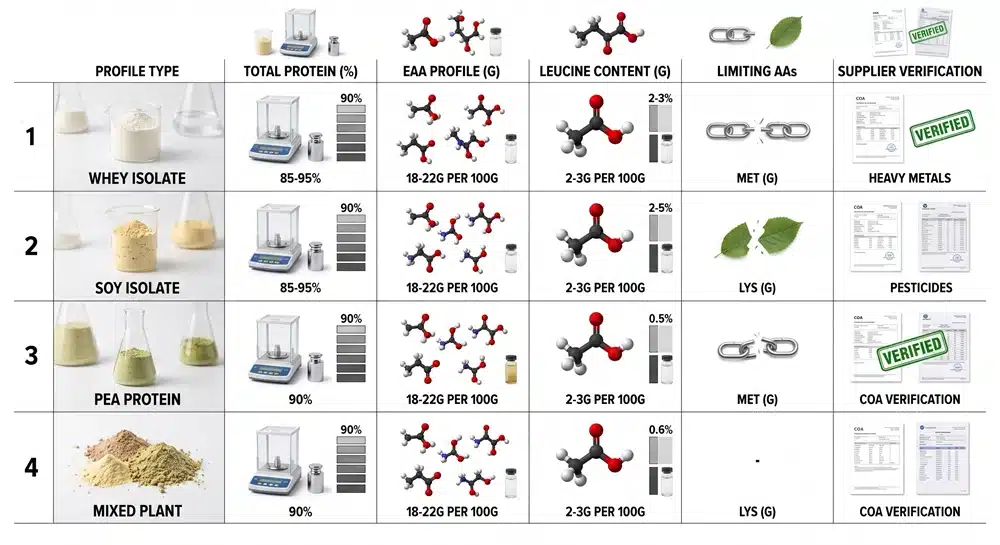
La qualité des protéines ne se mesure pas uniquement au nombre de grammes de protéines par portion. Le profil en acides aminés, la digestibilité, la teneur en acides aminés essentiels et la teneur en leucine sont autant de facteurs importants, en particulier pour les produits de nutrition sportive.
La protéine de pois est généralement riche en lysine, mais peut présenter une teneur plus faible en acides aminés soufrés, tels que la méthionine. C'est pourquoi de nombreuses formules à base végétale associent la protéine de pois à la protéine de riz ou à d'autres protéines végétales complémentaires. Ce mélange permet d'obtenir un profil en acides aminés plus équilibré tout en conservant le caractère végétalien du produit.
L'isolat de protéines de bœuf mérite d'être examiné de plus près. Si la source est riche en collagène, le produit peut contenir des taux élevés de glycine et de proline, mais ne pas présenter le même profil en acides aminés essentiels que les protéines animales issues du lactosérum, de l'œuf ou du muscle. Seul un profil complet en acides aminés permet de confirmer de manière concrète s’il convient à un complément de soutien musculaire, à un substitut de repas ou à un apport quotidien en protéines.
Pour les consommateurs actifs, une question fréquente concernant la composition des produits est de savoir si une portion apporte suffisamment de protéines totales et de leucine pour répondre à l'usage prévu. De nombreuses formules de nutrition sportive visent un apport d'environ 20 à 40 grammes de protéines par portion, mais la quantité exacte dépend de l'utilisateur, du type de formule, du contexte alimentaire et de la stratégie d'étiquetage.
Digestibilité, tolérance et profil allergénique
L'isolat de protéines de pois et l'isolat de protéines de bœuf peuvent tous deux être présentés comme des alternatives sans produits laitiers à la protéine de lactosérum. Ils constituent donc une option intéressante pour les consommateurs qui évitent le lactose, les protéines de lait ou les poudres protéinées traditionnelles à base de produits laitiers.
La protéine de pois est souvent considérée comme adaptée aux produits végétaliens et sans produits laitiers, mais elle peut ne pas convenir aux personnes présentant une sensibilité aux légumineuses ou une allergie aux pois. Elle peut également poser des problèmes de texture ou provoquer de légers ballonnements chez certains consommateurs, notamment en cas de portions importantes ou lorsqu’elle est associée à des fibres et à des alcools de sucre.
L'isolat de protéines de bœuf ne convient pas aux consommateurs végétaliens ou végétariens. Il peut convenir à des concepts sans produits laitiers, sans soja ou de type paléo, mais les marques doivent vérifier si cet ingrédient correspond à leur positionnement en matière de religion, de culture, d'allergènes et d'éthique. Les certifications halal, casher, « nourri à l'herbe », d'origine bovine et les documents relatifs au pays d'origine peuvent s'avérer importants sur certains marchés.
Goût, texture et facilité de mélange
Les protéines de pois présentent souvent des notes terreuses, de haricot ou légèrement amères. L'isolat de protéines de bœuf peut présenter des notes salées, rappelant le bouillon ou d'origine animale, selon sa source et son mode d'hydrolyse. Aucun de ces ingrédients ne doit être choisi uniquement sur la base de ses caractéristiques nutritionnelles ; les qualités sensorielles sont déterminantes pour fidéliser la clientèle.
Pour les poudres prêtes à mélanger, évaluez le comportement des protéines dans l'eau, les substituts de lait et dans un shaker. Les points clés à vérifier sont notamment la formation de grumeaux, la formation de mousse, le goût de craie, la présence de sédiments, l'arrière-goût, la viscosité et la stabilité de la saveur au fil du temps.
Pour les marques qui développent des produits à base de protéines en poudre, fabrication de compléments en poudre Ce soutien permet de tester les mélanges aromatiques, les édulcorants, les agents anti-agglomérants, les procédés d'instantanéisation, les conditionnements et la taille des cuillères doseuses avant la production commerciale.
Meilleures utilisations par type de produit
Comment les marques de compléments alimentaires devraient faire leur choix
Pour les marques de compléments alimentaires, le meilleur ingrédient est celui qui correspond au client, à l'allégation, à la formule, aux caractéristiques sensorielles visées et au plan de fabrication. Utilisez le cadre décisionnel suivant avant de demander un devis.
- Public cible : végan, sans produits laitiers, paléo, nutrition sportive, substitut de repas, gestion du poids ou bien-être général.
- Protéine cible : grammes de protéines par portion, profil en acides aminés, apport recommandé en leucine et taille de la portion.
- Positionnement de l'étiquette : végétalien, à base de plantes, issu d'animaux nourris à l'herbe, sans produits laitiers, sans soja, sans gluten, sans OGM, halal ou casher.
- Format de la formule : pot de poudre, sachet, stick, barre protéinée, boisson prête à préparer ou substitut de repas.
- Cible sensorielle : saveur, douceur, sensation en bouche, solubilité, texture et arrière-goût.
- Documents relatifs à la qualité : Composition chimique (COA), profil en acides aminés, déclaration relative aux allergènes, métaux lourds, analyses microbiologiques, analyses de pesticides ou de solvants résiduels, le cas échéant.
- Besoins commerciaux : Quantité minimale de commande (MOQ), délais de livraison, disponibilité des ingrédients, volatilité des prix et coûts d'emballage.
Pour les marques de nutrition sportive, fabrication sous contrat de produits nutritionnels pour le sport Il convient d'établir un lien entre le choix des ingrédients et l'élaboration des saveurs, la taille des portions, le conditionnement et la formulation de l'étiquetage conforme à la réglementation.
Spécifications de qualité à demander
Que vous optiez pour un isolat de protéines de pois ou un isolat de protéines de bœuf, la documentation fournie par le fournisseur est indispensable. Demandez au minimum les éléments suivants :
- Certificat d'analyse en vigueur pour ce lot précis
- Teneur en protéines et méthode d'analyse
- Profil complet en acides aminés
- Analyses microbiologiques
- Analyse des métaux lourds
- Déclaration d'allergènes
- Pays d'origine et provenance des matières premières
- Informations sur l'humidité, la densité apparente, la granulométrie et la solubilité
- Certificats « sans OGM », « halal », « casher », « nourri à l'herbe » ou « végétalien », le cas échéant
- Pour les ingrédients d'origine bovine : déclaration de l'origine bovine et toute documentation relative à l'origine animale requise par le marché concerné
Ces détails ne sont pas uniquement d'ordre technique. Ils ont une incidence sur les allégations, l'examen des étiquettes, la confiance des clients, les risques réglementaires, les performances de fabrication et la fidélisation des clients.
Considérations relatives à la conformité et aux allégations figurant sur les étiquettes
Les produits protéinés doivent éviter toute formulation suggérant un traitement ou une prévention des maladies. Au lieu d’affirmer qu’une poudre protéinée traite une maladie, remédie à la perte musculaire ou prévient des troubles de santé, utilisez des formulations axées sur la structure et la fonction, telles que “ contribue à l’apport quotidien en protéines ”, “ favorise la récupération musculaire lorsqu’elle est associée à une activité physique ” ou “ aide à couvrir les besoins en protéines dans le cadre d’une alimentation équilibrée ”, lorsque ces allégations sont dûment étayées.
Aux États-Unis, les compléments alimentaires ne font pas l'objet d'une autorisation préalable de la FDA avant leur mise sur le marché. Il incombe aux marques de garantir la sécurité des produits, le respect des règles d'étiquetage, la qualité de la fabrication et la validité des allégations. Les allégations publicitaires doivent également être véridiques, non trompeuses et étayées par des preuves appropriées.
Si votre marque a besoin d'une formule protéinée sur mesure, fabrication de compléments alimentaires sous marque de distributeur peut contribuer à faire le lien entre l'approvisionnement en ingrédients, le développement des formules, le conditionnement et le positionnement des produits dans le respect de la réglementation.
FAQ
La protéine de pois est-elle meilleure que l'isolat de protéine de bœuf ?
Les protéines de pois conviennent mieux aux produits végétaliens, à base de plantes et sans produits laitiers. L'isolat de protéines de bœuf peut être plus adapté aux formules d'origine animale, sans produits laitiers ou de type paléo. En matière de nutrition sportive, comparez le profil complet en acides aminés, et pas seulement le nom de la source de protéines.
L'isolat de protéines de bœuf est-il une protéine complète ?
Cela dépend de la matière première et du mode de transformation. Certains isolats de protéines de bœuf peuvent présenter un profil en acides aminés essentiels plus riche que d’autres, tandis que les protéines de bœuf riches en collagène peuvent être plus pauvres en certains acides aminés essentiels. Les marques devraient exiger un profil complet en acides aminés avant d’avancer des allégations relatives à une protéine complète.
L'isolat de protéines de pois est-il une protéine complète ?
La protéine de pois contient des acides aminés essentiels, mais elle est souvent plus pauvre en acides aminés soufrés, tels que la méthionine. De nombreuses marques associent la protéine de pois à de la protéine de riz ou à d'autres protéines végétales afin d'améliorer l'équilibre global en acides aminés.
Quelle protéine est la plus efficace pour soutenir la masse musculaire ?
Le choix le plus judicieux dépend de la teneur totale en protéines par portion, de la teneur en acides aminés essentiels, de la teneur en leucine, de la digestibilité et de la pratique de la musculation. Un mélange de protéines de pois bien conçu peut convenir à la nutrition sportive, tandis que l’isolat de protéines de bœuf nécessite une vérification de sa composition en acides aminés avant de pouvoir être présenté comme un produit particulièrement adapté au développement musculaire.
Quelle protéine est la plus facile à formuler ?
Les protéines de pois sont largement utilisées et plus faciles à intégrer dans les produits végétaliens, mais elles peuvent présenter un goût terreux et poser des problèmes de texture. L'isolat de protéines de bœuf permet de différencier une formule, mais son utilisation peut nécessiter davantage de vérifications de l'origine des matières premières, de tests sensoriels et d'examens de la documentation.
Le Collagensei peut-il contribuer à la mise au point de préparations à base de protéines de pois ou de bœuf ?
Oui. Collagensei peut aider les marques de compléments alimentaires à évaluer la source de protéines, la taille des portions, le goût, la facilité de mélange, le format d'emballage, la documentation relative à la qualité ainsi que les besoins en matière de production sous marque de distributeur pour leurs projets de compléments protéinés.
Références
- FDA : Questions et réponses sur les compléments alimentaires
- FDA : Allégations « structure/fonction »
- FTC : Lignes directrices relatives à la conformité des produits de santé
- Prise de position de la Société internationale de nutrition sportive : protéines et activité physique
- Revue comparative des protéines végétales et animales et de leurs propriétés anaboliques
- Protéines végétales : revue de la qualité nutritionnelle et des effets
- Composition en acides aminés des isolats de protéines végétales disponibles dans le commerce
- USDA FoodData Central

Warren Wan est un expert chevronné qui possède une vaste expérience dans la chaîne d’approvisionnement des compléments alimentaires, ainsi qu’une solide expertise pratique dans la recherche, le développement, le contrôle des processus et l’approvisionnement mondial d’ingrédients clés tels que les peptides de collagène, les protéines de bouillon d’os et la kératine. En tant qu'auteur de cette chronique, il s'attache à aller au-delà des discours marketing pour transformer les notions scientifiques obscures relatives aux ingrédients et les normes de contrôle qualité de la production en une vulgarisation scientifique rigoureuse et accessible, aidant ainsi les lecteurs à comprendre la vérité qui se cache derrière les étiquettes et à faire des choix plus rationnels en matière de santé.


