
For supplement brands, the best capsule shell is not simply an “animal vs plant” decision. It depends on your formula chemistry, target customer, storage conditions, capsule filling process, packaging system, certification needs, and finished-product quality specifications. If you are developing a capsule supplement, Gensei can help review capsule material fit through capsule supplement manufacturing and custom formula supplement manufacturer support.
Quick Answer: Are HPMC Capsules More Moisture Resistant Than Gelatin?
Yes, in most supplement formulation scenarios, HPMC capsules are more suitable for moisture-sensitive ingredients than traditional gelatin capsules. Gelatin capsules normally depend on a higher shell moisture level to remain flexible. If a hygroscopic powder pulls moisture out of the gelatin shell, the capsule may become brittle or crack. HPMC capsules generally have a lower moisture content and are less likely to create this problem, which is why they are often chosen for probiotics, herbal extracts, creatine, amino acids, and other moisture-sensitive powders.
However, HPMC is not automatically better for every formula. Gelatin capsules may still be preferred when the formula is not hygroscopic, the brand is price-sensitive, the product is not positioned as vegetarian or vegan, or the fill material benefits from gelatin’s stronger oxygen barrier. For oxygen-sensitive formulas, brands should also compare packaging options such as opaque capsules, high-barrier bottles, induction seals, desiccants, and, in some cases, pullulan capsules.
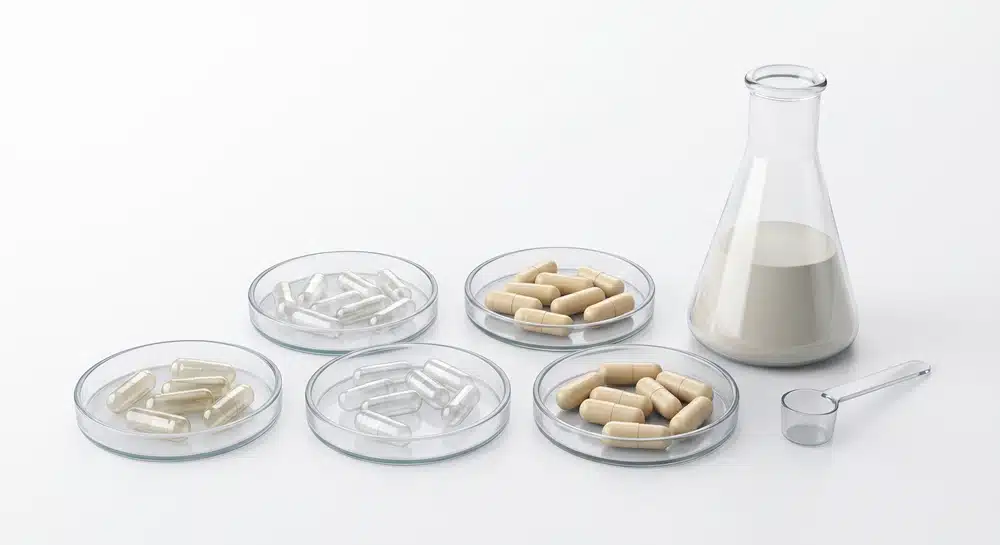
Gelatin vs HPMC Capsules: Key Differences for Supplement Brands
| Factor | Gelatin Capsules | HPMC Capsules | Brand Decision |
|---|---|---|---|
| Source | Animal-derived collagen, commonly bovine or porcine | Plant cellulose-derived hypromellose | Choose HPMC when vegetarian, vegan, or animal-free positioning is important. |
| Moisture profile | Higher shell moisture; needs controlled humidity to stay flexible | Lower shell moisture; often better for moisture-sensitive formulas | Choose HPMC for hygroscopic powders, probiotics, and many botanical extracts. |
| Hygroscopic ingredient fit | Higher risk of brittleness if the fill pulls water from the shell | Usually more compatible with moisture-sensitive fills | Use a formula review before selecting the shell. |
| Oxygen barrier | Often stronger than standard HPMC | May require stronger secondary packaging for oxygen-sensitive fills | Gelatin or pullulan may be better for oxygen-sensitive formulas. |
| Cross-linking risk | Can be more reactive with aldehydes, reducing sugars, and certain storage conditions | Generally less prone to gelatin-style cross-linking | Review excipients, flavors, botanical extracts, and stability data. |
| Dietary positioning | Not vegetarian or vegan unless a specific animal-source claim is acceptable | Commonly used for vegetarian and vegan capsule products | Request vegan, halal, kosher, and non-GMO documentation where needed. |
| Cost | Usually lower | Usually higher | Gelatin may fit high-volume, cost-sensitive SKUs. |
| Manufacturing familiarity | Very mature and widely used | Widely used, but machine settings and supplier specs still matter | Confirm capsule filling speed, defect rate, and stability expectations. |
| Label and certification fit | May require animal-source and BSE/TSE documentation | Better fit for plant-based and clean-label positioning | Do not assume certification; verify documents before purchase. |
| Best use cases | Standard vitamins, minerals, non-hygroscopic powders, selected oil or liquid-fill projects | Probiotics, herbal extracts, amino acids, creatine, clean-label capsules, vegan capsule products | Match shell to formula chemistry, market positioning, and packaging. |
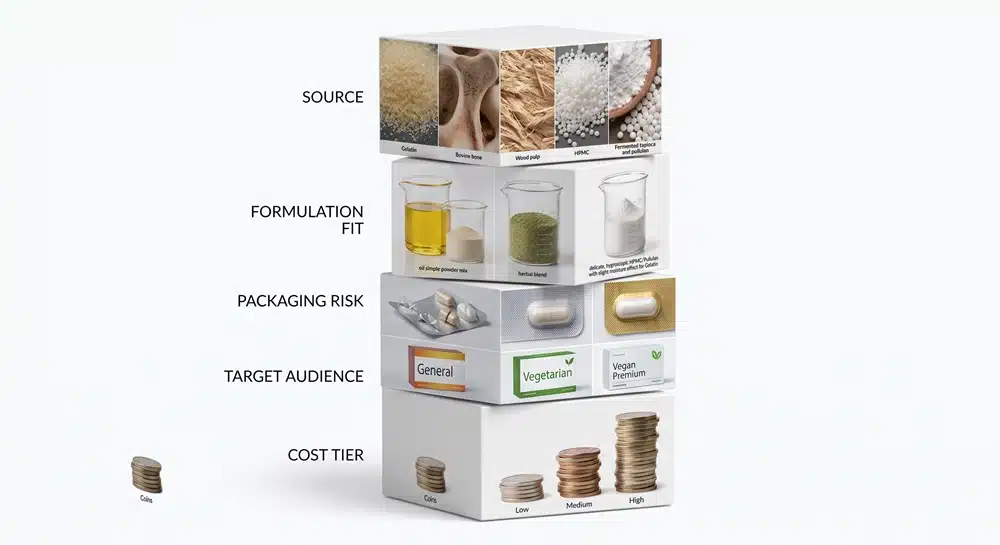
Why Moisture Resistance Matters in Capsule Formulation
Moisture is one of the most important reasons supplement brands compare HPMC capsules and gelatin capsules. A capsule shell is not just a container. It interacts with the fill material, storage humidity, temperature, packaging, and the time between filling and consumption.
Moisture sensitivity vs moisture resistance
Moisture sensitivity describes how easily a capsule shell or ingredient is affected by water. Moisture resistance describes how well the capsule system helps maintain physical integrity and product quality under expected storage conditions. HPMC capsules are often described as more moisture resistant than gelatin capsules because they usually contain less water and are less dependent on water for shell flexibility.Gelatin capsules can perform well when stored and filled under appropriate humidity conditions. The problem appears when the fill material is strongly hygroscopic or when the finished product moves through hot, dry, or humid supply chains. A gelatin shell that loses too much moisture can become brittle. A shell exposed to too much moisture can soften or deform. These risks are not only technical problems; they can affect customer experience, breakage rate, return rate, and brand trust.
Hygroscopic ingredients that often favor HPMC
HPMC capsules are often a better starting point when the formula contains ingredients that readily absorb moisture. Examples include:
- Probiotics and live culture blends
- Concentrated herbal extracts
- Creatine and selected amino acids
- Mineral salts that are sensitive to humidity
- Enzyme blends
- Some botanical powders with residual sugars or reactive compounds
- Moisture-sensitive custom blends with low water activity targets
This does not mean every formula in these categories must use HPMC. The correct decision should be based on the full formula, ingredient grade, fill weight, particle size, packaging, target market, transit conditions, and stability expectations. For a commercial project, ask your manufacturer to review the formula before locking the capsule shell.
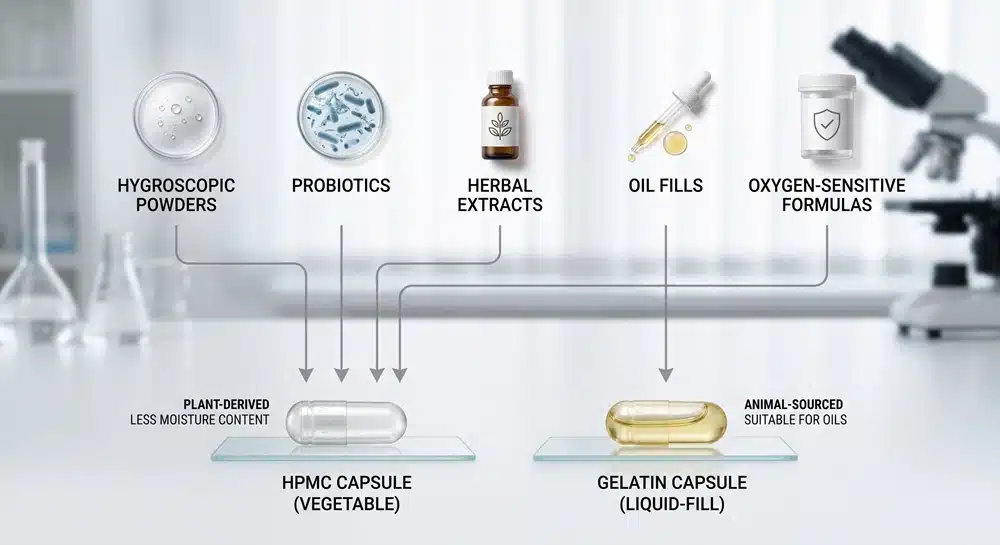
When Gelatin Capsules Are Still the Better Choice
Gelatin capsules remain widely used because they are cost-effective, familiar to manufacturers, and suitable for many standard supplement formulas. A brand may choose gelatin capsules when:
- The formula is not strongly hygroscopic.
- The product is positioned for a general audience rather than vegan or vegetarian consumers.
- The project is highly price-sensitive.
- The formula benefits from gelatin’s oxygen barrier properties.
- The manufacturing line is already validated around gelatin capsules.
- The target market accepts bovine, porcine, or fish-derived gelatin with proper documentation.
For gelatin capsule projects, brands should confirm the animal source, BSE/TSE documentation, allergen statements, halal or kosher status if required, shell moisture specification, disintegration or dissolution specification, and recommended storage conditions. Gelatin is not a poor-quality option; it is simply not the best fit for every modern supplement formula.
When HPMC Capsules Are Usually the Better Choice
HPMC capsules are usually a stronger fit when the product needs plant-based positioning or when the formula is moisture-sensitive. A brand may choose HPMC capsules when:
- The formula contains hygroscopic powders.
- The brand wants vegetarian, vegan, or animal-free positioning.
- The product includes probiotics or botanical extracts that require careful moisture control.
- The product will be shipped through hot, dry, or humid climates.
- The formula has compatibility concerns with gelatin.
- The brand is willing to accept a higher capsule shell cost for better positioning or stability.
HPMC is also useful when a brand wants one capsule format that can serve multiple consumer groups. Still, “HPMC” is not enough as a quality specification. You should also check capsule grade, gelling system, colorant system, disintegration profile, fill compatibility, documentation, and packaging recommendations.
Formula Compatibility Matrix: Which Capsule Should You Choose?
| Formula Scenario | Recommended Starting Point | Why | What to Verify |
|---|---|---|---|
| Hygroscopic herbal extract | HPMC | Lower shell moisture may reduce brittleness risk. | Water activity, stability, packaging, desiccant use. |
| Probiotic capsule | HPMC | Lower moisture exposure may be helpful for sensitive live cultures. | Strain stability, overage, bottle barrier, storage claims. |
| Standard vitamin or mineral powder | Gelatin or HPMC | Both may work depending on brand positioning and cost. | Fill flow, shell compatibility, market claim, cost target. |
| Oxygen-sensitive ingredient | Gelatin, pullulan, or specialized packaging | Standard HPMC may need stronger oxygen protection. | Oxygen transmission, opaque shell, induction seal, bottle barrier. |
| Vegan or vegetarian product line | HPMC or pullulan | Animal-free shell supports label positioning. | Vegan documentation, halal/kosher, non-GMO statement. |
| High-volume budget SKU | Gelatin | Lower capsule cost can protect margin. | Consumer acceptance, animal source, storage controls. |
| Organic or premium natural positioning | Pullulan or carefully reviewed HPMC | Some markets may not treat HPMC as a natural or organic material. | Jurisdiction rules, certification body requirements, label review. |
| Liquid or semi-solid fill | Gelatin softgel, hard gelatin, or specialized banded HPMC | Liquid fill requires sealing and leakage control. | Banding, leakage testing, oxidation risk, fill compatibility. |
Quality Specifications to Check Before You Order Capsules
Before buying gelatin or HPMC capsules, supplement brands should review the capsule shell as a functional component of the finished product, not a generic packaging item. Ask your supplier or manufacturer for documentation before sampling or bulk production.
- Material specification: gelatin source or HPMC grade, gelling system, colorant system, and capsule size.
- Moisture specification: target shell moisture range and recommended storage conditions.
- Disintegration or dissolution specification: method, limits, and whether the test reflects your target market requirements.
- Microbial limits: total plate count, yeast and mold, pathogens, and applicable acceptance criteria.
- Contaminant review: heavy metals, residual solvents where applicable, and ingredient-specific risks.
- Animal-source documentation: for gelatin, request bovine, porcine, fish, BSE/TSE, halal, kosher, or allergen documents as needed.
- Plant-based documentation: for HPMC, request vegan, vegetarian, non-GMO, halal, kosher, and allergen statements if relevant.
- Manufacturing documentation: COA, specification sheet, SDS/TDS, batch record support, and GMP-related documentation.
- Packaging recommendation: bottle type, induction seal, desiccant, oxygen absorber, and label storage statement.
If you need help matching capsule shell, formula, packaging, and label positioning, review Gensei’s custom private label supplements service or contact the team for a project-specific review.
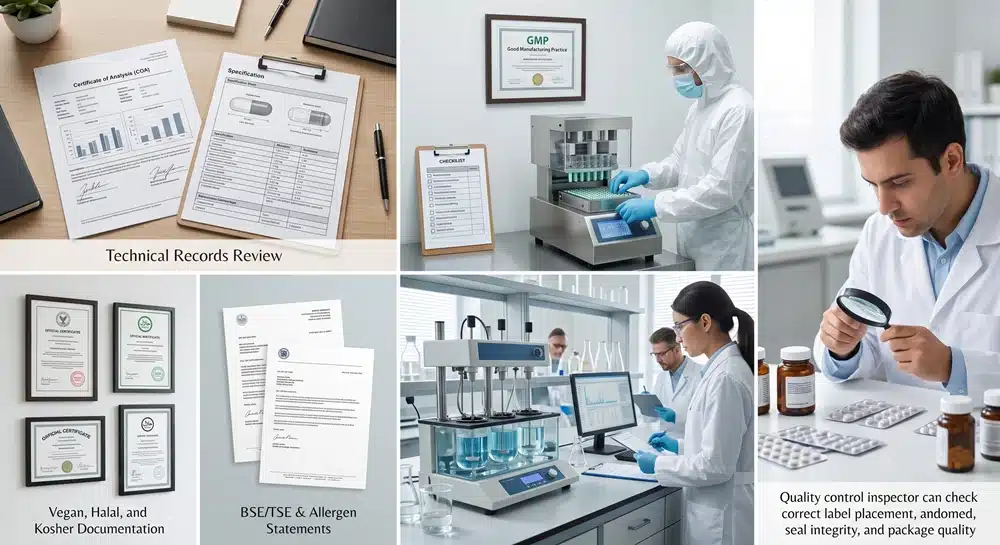
Packaging and Storage Considerations
The capsule material is only one part of the finished product stability system. A well-selected shell can still fail if packaging and storage are poorly matched to the formula. For moisture-sensitive formulas, consider high-barrier bottles, induction seals, desiccants, humidity-controlled filling rooms, and storage instructions that match the target supply chain.
For oxygen-sensitive formulas, consider opaque capsules, high-barrier packaging, oxygen absorbers where appropriate, and a stability plan that checks potency, appearance, odor, fill condition, and disintegration over time. Do not rely on capsule shell material alone to solve all stability risks.
How Gensei Helps Brands Choose Capsule Materials
Gensei supports supplement brands with capsule material selection, custom formula review, capsule filling, packaging, and quality documentation. A practical project review should include:
- Formula ingredient list and target serving size
- Moisture sensitivity and hygroscopicity concerns
- Target market, including vegan, halal, kosher, or clean-label positioning
- Capsule size, color, transparency, and branding needs
- Packaging format, bottle type, desiccant plan, and shipping market
- MOQ, sample requirements, lead time, and quality documents
For new capsule projects, start with a formula and capsule shell review before confirming packaging. You can send your formula, target market, and expected order quantity through the Gensei contact page.
RFP Questions to Ask Your Capsule Manufacturer
Use these questions before requesting a quotation for gelatin or HPMC capsule manufacturing:
- Which capsule materials can you support for this formula: gelatin, HPMC, pullulan, or other options?
- What is the recommended capsule shell for this formula and why?
- What is the shell moisture specification for each capsule option?
- Can you review whether the fill material is hygroscopic or moisture-sensitive?
- What packaging system do you recommend for moisture or oxygen control?
- Can you provide COA, specification sheet, SDS/TDS, allergen statement, and relevant certification documents?
- For gelatin capsules, can you provide animal source, BSE/TSE, halal, and kosher documentation if needed?
- For HPMC capsules, can you provide vegan, vegetarian, non-GMO, halal, and kosher documentation if needed?
- What capsule sizes and colors are feasible for this fill weight and brand design?
- What tests will be included for the finished batch?
- What are the MOQ, sampling timeline, bulk lead time, and packaging options?
- What stability or compatibility checks do you recommend before launch?
FAQ
Are HPMC capsules more moisture resistant than gelatin capsules?
Usually, yes. HPMC capsules generally have lower shell moisture and are often better suited to moisture-sensitive or hygroscopic formulas. Gelatin capsules can still work well for formulas that are not strongly moisture-sensitive and are stored under appropriate conditions.
Why can gelatin capsules become brittle?
Gelatin capsules rely on shell moisture for flexibility. If storage conditions are too dry or if the fill material pulls moisture from the shell, gelatin capsules may become brittle. This is why formula compatibility and packaging review are important before choosing gelatin for hygroscopic ingredients.
Are HPMC capsules better for probiotics?
HPMC capsules are commonly selected for probiotic products because lower shell moisture can be helpful for moisture-sensitive live cultures. The final decision should also consider strain stability, overage, packaging barrier, storage temperature, and shelf-life testing.
Are HPMC capsules vegan?
HPMC capsules are plant cellulose-derived and are commonly used for vegetarian and vegan products. However, brands should not rely on the material name alone. Always request supplier documentation for vegan, vegetarian, halal, kosher, non-GMO, and allergen status when those claims matter.
Are gelatin capsules bad?
No. Gelatin capsules are widely used and can be a strong choice for many standard supplement formulas. They are usually cost-effective, familiar to manufacturers, and useful where vegan positioning is not required. The key is matching gelatin to the right formula and storage conditions.
Which capsule is better for oil-based formulas?
Gelatin is often used for liquid or oil-based capsule formats, especially softgels. Specialized HPMC options may also exist, but liquid-fill projects require extra review for sealing, leakage, oxygen exposure, and manufacturing feasibility.
What documents should I request before choosing a capsule supplier?
Request the capsule specification sheet, COA, SDS or TDS, moisture specification, disintegration or dissolution information, microbial limits, allergen statement, and relevant certification documents. For gelatin, ask for animal-source and BSE/TSE documentation. For HPMC, ask for vegan or vegetarian documentation if relevant.
References
- Moisture diffusion and permeability characteristics of hydroxypropylmethylcellulose and hard gelatin capsules
- Moisture sorption and desorption properties of gelatin, HPMC and pullulan hard capsules
- Are your capsules vegetarian or nonvegetarian?
- 21 CFR Part 111 – Current Good Manufacturing Practice in Manufacturing, Packaging, Labeling, or Holding Operations for Dietary Supplements
- FDA: Questions and Answers on Dietary Supplements
- FTC: Health Products Compliance Guidance

Warren Wan is a seasoned expert with extensive experience in the dietary supplement supply chain, possessing rich practical experience in the research, development, process control, and global sourcing of core ingredients such as collagen peptides, bone broth protein, and keratin. As the author of this column, he is dedicated to stripping away the marketing packaging, transforming obscure ingredient science and production quality control standards into easy-to-understand, hardcore science popularization, helping readers understand the truth behind the labels and make more rational health choices.


