This guide separates established facts from preclinical findings and marketing claims. It is written for consumers evaluating sheep placenta supplements and for supplement brands comparing raw-material specifications.
What Is Sheep Placenta Extract?
Sheep placenta extract is produced from placental tissue collected from sheep after birth and processed into a powder, liquid or hydrolyzed fraction. “Ovine placenta extract” is a scientific-style synonym; ovine means relating to sheep.
The term does not describe one standardized ingredient. A label may refer to freeze-dried whole tissue, a water-soluble extract, a concentrated extract, or a hydrolyzed peptide material. Those forms can differ in protein content, peptide size, solubility, residual lipids and measurable hormones. Consequently, research or safety information for one preparation should not automatically be applied to another.
Sheep Placenta Powder, Extract and Peptides: Key Differences
| Form | What it generally means | Useful specification questions | Common formulation issue |
|---|---|---|---|
| Freeze-dried whole placenta powder | Dehydrated and milled placental tissue with a broad tissue profile | Species identity, protein, moisture, fat, microbiology, hormones and origin | Odor, color, flowability and larger serving mass |
| Placenta extract powder | A processed fraction made using water or another declared extraction system | Extraction method, input-to-extract ratio, carrier, yield and marker specification | “10:1” or “100:1” ratios do not prove active content or clinical equivalence |
| Hydrolyzed placenta peptides | Protein material enzymatically or chemically broken into smaller peptides | Degree of hydrolysis, molecular-weight distribution, peptide/protein assay and solubility | Peptide claims require a defined method and batch data |
| Topical cosmetic extract | An ingredient intended for creams, masks or serums | INCI identity, preservative system, microbial limits, stability and cosmetic-market compliance | Topical and oral evidence are not interchangeable |
What Does Research on Sheep Placenta Extract Show?
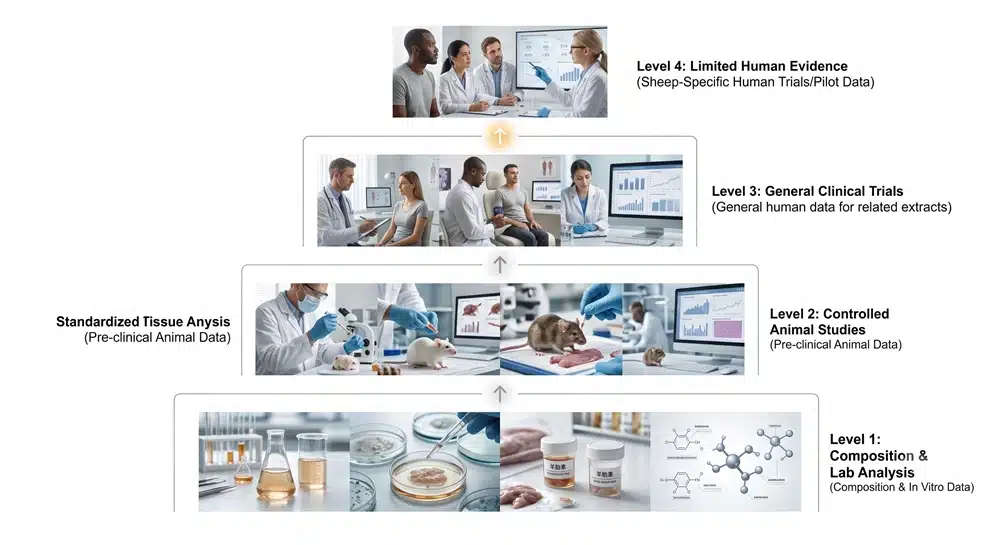
Evidence summary: Sheep-specific studies located for this review are mainly laboratory or animal studies. Some human trials have evaluated porcine or equine placenta extracts, but those products, species and processing methods are not equivalent to sheep placenta extract. They cannot establish that a sheep placenta supplement will produce the same result.
| Evidence type | What has been studied | What it can tell us | Key limitation |
|---|---|---|---|
| Laboratory and compositional work | Proteins, peptides and biological activity in processed placental materials | Possible mechanisms and candidate compounds | Does not demonstrate a consumer benefit |
| Sheep placenta animal studies | Markers related to oxidative stress, metabolism or aging models | Whether further research may be justified | Animal outcomes do not prove efficacy or safety in humans |
| Human trials using other animal species | Selected skin outcomes with porcine or equine placental extracts | Preliminary information for the exact tested preparation | Not evidence for every placenta source, dose or manufacturing process |
| Long-term human safety data | Limited for standardized oral sheep placenta preparations | No reliable basis for broad long-term safety assurances | Product variability and incomplete hormone/residue characterization |
For a claim to be responsible, it should match the identity, dose, route, population and endpoints of the supporting research. Terms such as “clinically proven,” “reverses aging” or “regenerates cells” should not be used unless the finished product is supported by appropriate human evidence and the wording is legally permitted in the target market.
Potential Sheep Placenta Benefits: Claims vs Evidence
Skin appearance and hydration
Placenta products are often marketed for skin hydration, elasticity and the appearance of wrinkles. The strongest responsible conclusion is that placental extracts are being researched for skin-related outcomes; however, robust human evidence specific to oral sheep placenta extract remains limited. A product should not promise wrinkle removal, collagen regeneration or a younger appearance without direct substantiation.
General vitality and healthy aging
“Energy,” “vitality” and “healthy aging” are broad outcomes that are easily overstated. Preclinical findings do not demonstrate that a supplement improves energy or slows human aging. Brands should use precise, supportable structure/function wording and avoid disease or longevity claims.
Hormonal balance and menopause
Hormonal-balance claims are particularly sensitive. Placental tissue is biologically involved in hormone production, and the hormone profile of a finished extract depends on raw material and processing. Claims that a sheep placenta supplement balances estrogen, treats hot flashes or improves fertility should not be made without product-specific evidence and regulatory review.
Immune, wound-healing or disease claims
Statements that sheep placenta treats inflammation, heals wounds, repairs organs, prevents disease or improves immune disorders are drug-style claims in many markets. They should be removed from consumer supplement content. Laboratory or animal findings may be described only with clear study-type qualifiers and without translating them into promised human outcomes.
Does Sheep Placenta Extract Contain Estrogen or Progesterone?
Placental tissue is an endocrine-active tissue, but the amount of any steroid hormone in a finished ingredient cannot be determined from the product name. Processing may reduce, concentrate or variably retain different compounds. Therefore, “hormone-free” and “contains natural hormones” are both claims that require an appropriate analytical method, reporting limit and batch-specific result.
For oral supplement use, buyers should request a risk-based steroid-hormone panel and confirm the laboratory method and limit of quantification. FDA’s new dietary ingredient guidance illustrates why historical exposure to very small hormone amounts in ordinary foods would not automatically support the safety of a highly concentrated animal extract containing much larger amounts.
Sheep Placenta Side Effects and Safety Considerations
No universal oral dosage has been established for sheep placenta extract, and safety cannot be generalized across whole tissue, concentrated extracts and hydrolyzed materials. Reported or plausible concerns include digestive discomfort, sensitivity to animal-derived ingredients, contamination or adulteration, and exposure to biologically active constituents that were not adequately characterized.
- Pregnancy and breastfeeding: Avoid use unless a qualified healthcare professional specifically recommends it; safety data are insufficient.
- Children: Do not use without pediatric medical guidance.
- Hormone-sensitive conditions or hormone-related medication: Seek medical advice before use because the final product’s hormone profile may be unknown.
- Allergy or intolerance: Avoid if sensitive to sheep-derived or other animal-derived ingredients.
- Unexpected symptoms: Stop use and consult a healthcare professional if an adverse reaction occurs.
Consumers should not assume that “natural,” “New Zealand sourced,” “freeze-dried” or “GMP manufactured” proves clinical efficacy. Those descriptors may address source or manufacturing, but they do not replace a batch COA, safety assessment or claim substantiation.
Sheep Placenta vs Collagen: They Are Not the Same Ingredient
| Factor | Sheep placenta extract | Collagen peptides |
|---|---|---|
| Raw material | Processed placental tissue from sheep | Hydrolyzed collagen-rich tissue from bovine, marine, porcine, chicken or other sources |
| Main material profile | Variable mixture of proteins, peptides, lipids and other tissue constituents | Predominantly collagen-derived peptides with a characteristic amino acid profile |
| Standardization | Often inconsistent; extract ratio alone is insufficient | Commonly specified by protein, hydroxyproline, molecular weight and solubility |
| Human evidence | Limited for standardized oral sheep placenta products | More human research exists for specific collagen peptide products and outcomes |
| Key safety review | Species identity, tissue sourcing, hormones, microbiology and residues | Species allergen, heavy metals, microbiology, molecular profile and contaminants |
| Best fit | Niche animal-tissue ingredient requiring careful regulatory and evidence review | Protein/peptide formulas where the specific collagen source and evidence fit the intended positioning |
A formula that combines sheep placenta and collagen should declare each ingredient separately and should not imply that placenta is simply a superior type of collagen.
Quality Specifications Supplement Buyers Should Check
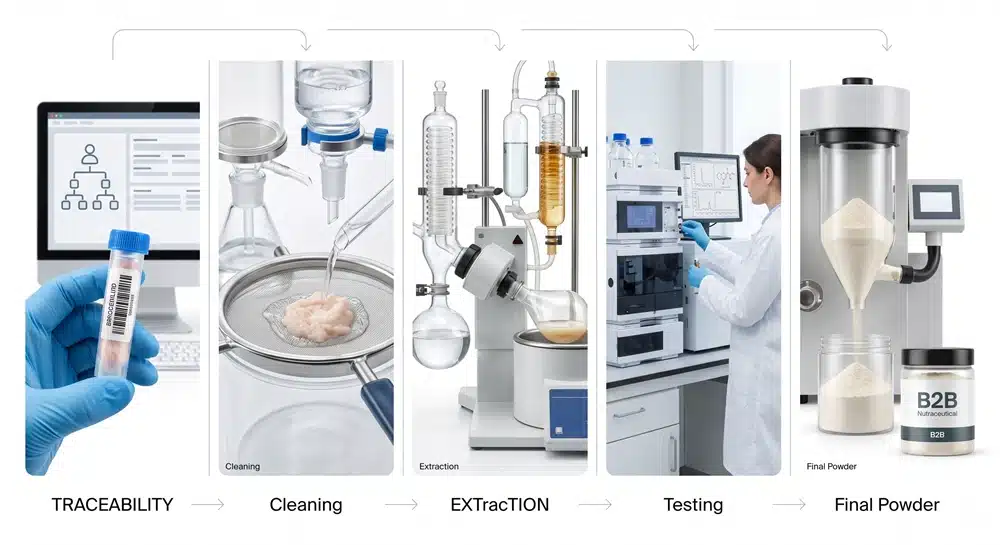
Ingredient buyers should evaluate sheep placenta extract as a complex animal-derived material, not as a generic powder. Start with the specification, manufacturing flow and batch data.
- Identity and source: Scientific species, country of origin, tissue type, collection controls and species-authentication method.
- Processing definition: Whole powder, extract or hydrolysate; extraction solvent; concentration ratio; carrier; enzyme; drying process and yield.
- Composition: Protein or peptide assay, amino acid profile, molecular-weight distribution where relevant, moisture, ash and lipid content.
- Hormone-residue review: Analytes tested, method, reporting limit and batch result; do not accept an unsupported “hormone-free” statement.
- Contaminants: Heavy metals, microbiological limits, specified pathogens, veterinary drug residues and other destination-market tests based on risk assessment.
- Traceability and animal health: Supplier qualification, raw-material traceability, animal health documentation and controls for transmissible animal-disease risks appropriate to the source.
- Stability: Shelf-life data, packaging barrier, storage condition and finished-form compatibility.
- Regulatory file: COA, specification, TDS, SDS, allergen statement, manufacturing flow, country-of-origin statement and evidence supporting legal use in the destination market.
Questions to Put in an RFQ
- Is the material whole freeze-dried tissue, an extract or a hydrolyzed peptide ingredient?
- What analytical marker defines the commercial grade?
- How is sheep species identity confirmed?
- Which steroid hormones or hormone residues are tested, by what method and at what limit of quantification?
- Which pathogen, veterinary residue and heavy-metal tests appear on the batch COA?
- What safety evidence supports the proposed daily intake and target population?
- Was the ingredient marketed in the United States before October 15, 1994, or has its new dietary ingredient status been evaluated?
- Which finished-product claims have been reviewed for the destination country?
Gensei can support brands with specialty supplement ingredient sourcing, custom supplement formulation, capsule manufacturing, powder supplement manufacturing and supplement quality-control planning. Availability and regulatory suitability of a specific animal-derived ingredient must be confirmed for the destination market and actual batch.
Frequently Asked Questions
What is sheep placenta extract used for?
It is used in some dietary supplements and topical cosmetics marketed for beauty, vitality or healthy-aging positioning. These are intended-use categories, not proof of benefit. The evidence and regulatory rules depend on the exact ingredient, route and claim.
What are the proven benefits of sheep placenta supplements?
Robust human evidence specific to standardized oral sheep placenta supplements is limited. Sheep-specific animal studies can generate hypotheses but do not establish a proven consumer benefit.
Is sheep placenta good for skin?
Placental extracts have been studied for skin-related outcomes, including human research using other animal species. This does not prove that every sheep placenta capsule or cream improves skin. Product-specific formulation, dose, route and evidence matter.
Does sheep placenta contain collagen?
Placental tissue contains structural proteins, but a sheep placenta extract is not the same as a standardized collagen peptide ingredient. A product should not use the terms interchangeably.
Does sheep placenta extract contain estrogen?
The final level cannot be inferred from the ingredient name. Only a suitable analytical test with a stated reporting limit can establish whether specified hormones are detectable in a batch.
What are possible sheep placenta side effects?
Human safety information is limited and products vary. Possible concerns include digestive discomfort, allergic or sensitivity reactions, contamination and exposure to incompletely characterized bioactive constituents. People in higher-risk groups should seek medical advice.
Is sheep placenta extract FDA approved?
Dietary supplements are not approved by FDA before marketing in the same way as drugs. The responsible company must ensure ingredient legality, safety, manufacturing compliance and truthful, substantiated labeling.
How should a supplement brand choose an ovine placenta extract supplier?
Compare identity, source traceability, processing definition, protein or peptide specifications, hormone-residue data, contaminants, stability, regulatory status and batch documentation. Do not choose by extract ratio or marketing language alone.
References
- FDA: Questions and Answers on Dietary Supplements
- FDA: Structure/Function Claims
- FDA: Revised Draft Guidance for New Dietary Ingredient Notifications and Related Issues
- FTC: Health Products Compliance Guidance
- He et al. Effect of sheep placenta extract in a D-galactose-induced aging mouse model (2025)
- Chou et al. Evaluation of antiaging effect of sheep placenta extract using SAMP8 mice (2022)
- Nagae et al. Oral equine placental extract and human skin quality (2022)
- Nagae et al. Porcine placenta extract supplement and skin quality (2020)
Medical disclaimer: This article is for general educational and ingredient-evaluation purposes. It is not medical advice and does not diagnose, treat, cure or prevent disease.

Warren Wan is a seasoned expert with extensive experience in the dietary supplement supply chain, possessing rich practical experience in the research, development, process control, and global sourcing of core ingredients such as collagen peptides, bone broth protein, and keratin. As the author of this column, he is dedicated to stripping away the marketing packaging, transforming obscure ingredient science and production quality control standards into easy-to-understand, hardcore science popularization, helping readers understand the truth behind the labels and make more rational health choices.