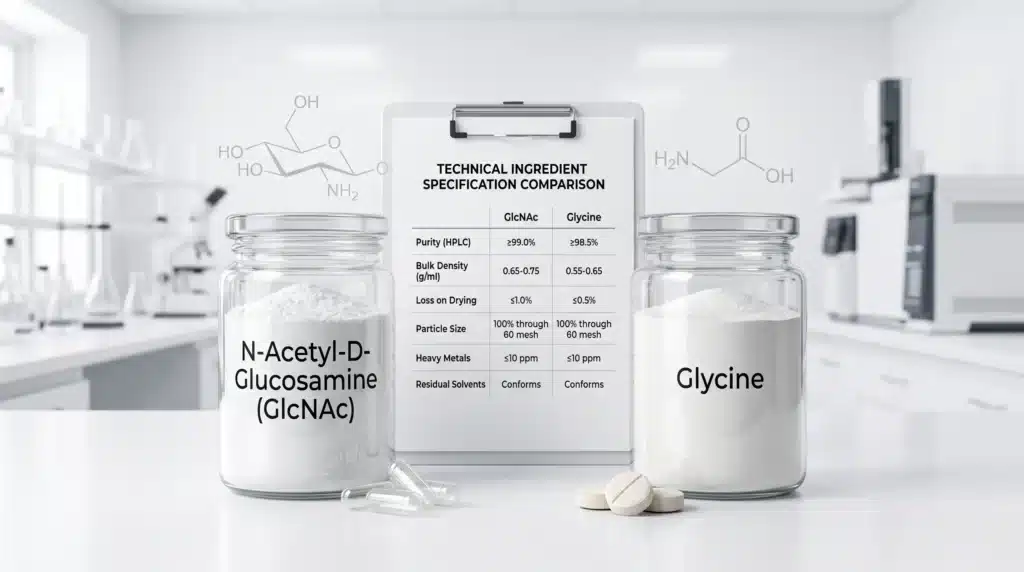
N-Acetyl-D-Glucosamine (GlcNAc or NAG) and glycine are not interchangeable ingredients. GlcNAc is an acetylated amino sugar, while glycine is the simplest protein-forming amino acid. In supplement formulation, GlcNAc is commonly positioned in joint-support and connective-tissue concepts, whereas glycine is used as an amino-acid ingredient and as a building block associated with proteins such as collagen and glutathione.
For brands comparing the two, the practical decision should be based on the intended formula, evidence, source, and allergen status, serving size, dosage form, sensory profile, quality specification, and label-claim strategy—not on the assumption that both ingredients perform the same biological role.
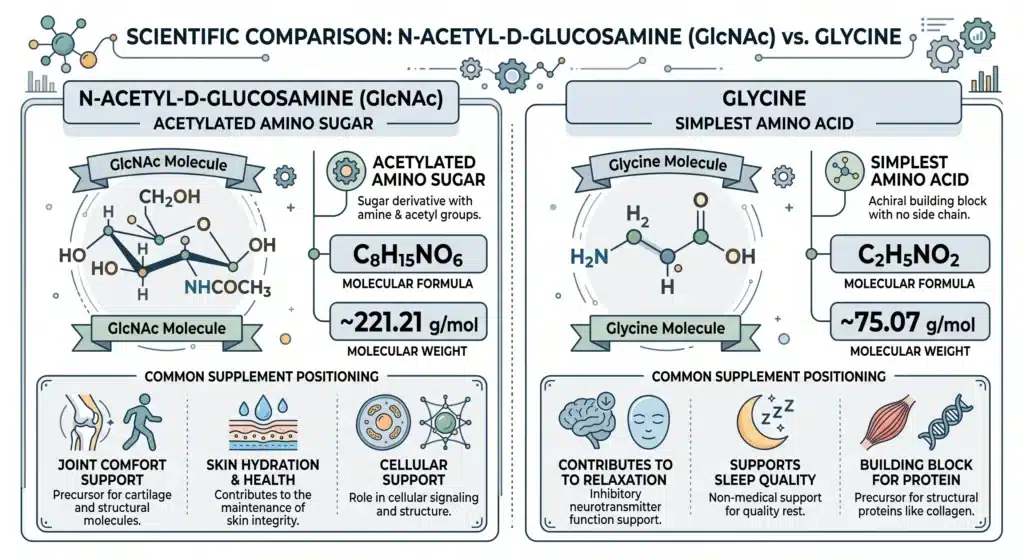
N-Acetyl-D-Glucosamine vs Glycine: Key Differences
|
Factor |
N-Acetyl-D-Glucosamine (GlcNAc / NAG) |
Glycine |
|
Ingredient class |
Acetylated amino sugar |
Proteinogenic amino acid |
|
Molecular formula |
C8H15NO6 |
C2H5NO2 |
|
Molecular weight |
221.21 g/mol |
75.07 g/mol |
|
Biochemical identity |
N-acetylated derivative of glucosamine and a common monosaccharide unit in glycoconjugates |
The simplest amino acid and the only achiral proteinogenic amino acid |
|
Common supplement positioning |
Joint-support and connective-tissue formulas |
Amino-acid, collagen-related, sleep-positioned, and general nutrition formulas |
|
Source review |
Shellfish or fermentation source should be verified by supplier documentation |
Source and manufacturing route should be verified by supplier documentation |
|
Primary B2B checks |
Identity, assay, source, allergen status, particle size, heavy metals, microbiology |
Identity, assay, particle size, solubility, sensory properties, heavy metals, microbiology |
What Is N-Acetyl-D-Glucosamine?
N-Acetyl-D-Glucosamine is commonly abbreviated as GlcNAc or NAG. It is an acetylated amino sugar with a molecular formula of C8H15NO6 and a molecular weight of 221.21 g/mol. It occurs as a structural unit in biological glycoconjugates and is chemically distinct from free glycine.
It is also important to distinguish N-Acetyl-D-Glucosamine from other commercial glucosamine forms such as glucosamine hydrochloride and glucosamine sulfate. The names are related, but the ingredients are not identical and should not be treated as dose-for-dose substitutes.
For brands sourcing raw material, review the actual specification for N-Acetyl-D-Glucosamine powder, including source, assay, allergen statement, mesh size, heavy metals, microbiology, and batch documentation.
What Is Glycine?
Glycine is the simplest proteinogenic amino acid. Its molecular formula is C2H5NO2 and its molecular weight is 75.07 g/mol. Glycine is incorporated into proteins, is prominent in collagen, participates in glutathione synthesis, and also functions in neurotransmission.
These biochemical roles do not mean that every oral glycine supplement has been clinically proven to deliver every outcome associated with glycine metabolism. Human supplementation studies vary substantially in population, dose, duration, and outcome.
For formulation or raw-material qualification, compare the actual glycine ingredient specification rather than relying on generic amino-acid descriptions.
Glycine vs Glucosamine: Are They the Same?
No. Glycine and glucosamine are chemically different compounds. Glycine is an amino acid. Glucosamine is an amino sugar. N-Acetyl-D-Glucosamine is an acetylated form related to glucosamine, but it is still not glycine.
The terms can be confusing because “glycine,” “glycinate,” “glucosamine,” and “N-acetyl-D-glucosamine” may all appear in supplement ingredient lists. A glycinate is generally a salt or complex involving glycine, while glucosamine is a different amino sugar. Ingredient identity should always be confirmed by the full chemical name, CAS number, specification, and COA.
N-Acetyl-D-Glucosamine for Joint-Support Formulas
N-Acetyl-D-Glucosamine has been studied as a dietary supplement ingredient in joint-health research. In one randomized, double-blind, placebo-controlled study in healthy adults without arthritis symptoms, 500 mg/day and 1,000 mg/day of a GlcNAc-containing test supplement were evaluated for 16 weeks using biomarkers related to type II collagen metabolism.
The study reported changes in cartilage-metabolism biomarker ratios compared with placebo. These findings are best described as ingredient-specific evidence on biomarkers in healthy adults. They should not be rewritten as proof that N-Acetyl-D-Glucosamine treats osteoarthritis, regenerates cartilage, repairs damaged joints, or prevents joint disease.
For joint-support product development, NAG can be evaluated alongside other joint health ingredients based on the target consumer, serving size, source preference, allergen requirements, dosage form, and claim strategy.
What Does the Evidence Say About Glycine Supplementation?
Glycine has broad biochemical relevance, but clinical outcomes from supplementation should be described carefully. A systematic review of glycine administration in human adults included studies across multiple physiological systems and found that the evidence varied substantially by population and outcome.
Some small studies in healthy adults have reported sleep-related outcomes after glycine supplementation, but the systematic review noted small sample sizes and a high risk of bias in the healthy-population sleep studies. For this reason, a general glycine ingredient should not be marketed as a guaranteed treatment for insomnia, anxiety, cardiovascular disease, neurological disorders, or other diseases.
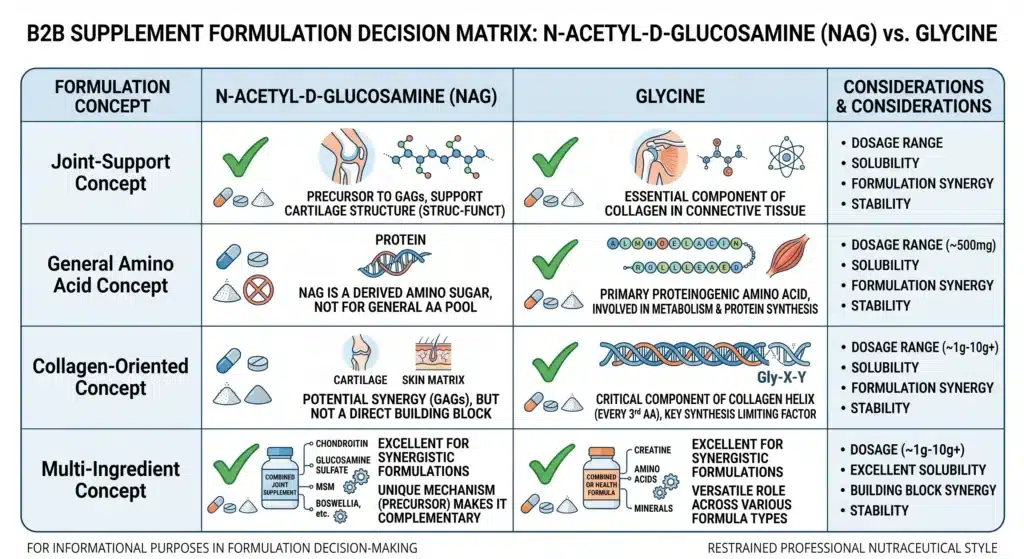
N-Acetyl-D-Glucosamine vs Glycine for Joint Health: Which Fits Better?
For a joint-support supplement, the two ingredients serve different roles. N-Acetyl-D-Glucosamine has ingredient-specific human research examining cartilage-metabolism biomarkers, while glycine is primarily a fundamental amino acid and a major structural component of collagen-rich proteins.
|
Formulation Goal |
More Direct Ingredient Fit |
Key Note |
|
GlcNAc-focused joint-support formula |
N-Acetyl-D-Glucosamine |
Use evidence and claims that match the specific ingredient and serving level |
|
General amino-acid formula |
Glycine |
Glycine functions as a proteinogenic amino acid and can support broader amino-acid positioning |
|
Collagen-oriented concept |
Glycine may complement the concept |
Free glycine is not the same as collagen peptides and should not be presented as a direct replacement |
|
Multi-ingredient joint formula |
Potentially either or both |
Evaluate total serving size, taste, source, evidence, stability, and claim language |
Can N-Acetyl-D-Glucosamine and Glycine Be Used Together?
They can be evaluated in the same multi-ingredient supplement because they are different ingredient classes and can serve different formulation purposes. However, combining ingredients does not automatically create stronger evidence or justify stronger health claims.
Before combining them, confirm the target daily serving, source and allergen status, powder flow, solubility, taste, capsule or tablet load, finished-product stability, and the evidence supporting each proposed label or advertising claim. Brands planning a finished joint formula can review joint supplement manufacturing requirements early in development.
Safety and Label-Claim Considerations
Safety assessment should be ingredient-specific. For N-Acetyl-D-Glucosamine, the source and potential shellfish allergen relevance should be confirmed by batch or supplier documentation. Fermentation-derived options may have a different source profile. For glycine, brands should verify identity, purity, manufacturing route, and intended food or supplement grade.
There is no universal dosage in this article that should be copied to every NAG or glycine product. Study doses are evidence examples, not automatic formulation recommendations. Finished-product serving levels should be determined from the specific raw material, target market, evidence package, dosage form, co-ingredients, tolerability, and regulatory review.
For U.S. dietary supplements, structure/function claims must be truthful and not misleading, and marketers must have substantiation for objective health claims. Avoid disease-treatment language such as “treats arthritis,” “repairs cartilage damage,” “treats anxiety,” “prevents diabetes,” or “cures insomnia.”
B2B Quality Specifications to Check
|
Specification |
N-Acetyl-D-Glucosamine |
Glycine |
|
Identity |
Confirm GlcNAc / NAG identity and CAS |
Confirm glycine identity and CAS |
|
Assay/purity |
Review supplier specification and batch COA |
Review supplier specification and batch COA |
|
Source |
Confirm shellfish, fermentation, or other declared source |
Confirm manufacturing route and source declaration as required |
|
Allergen status |
Important for shellfish-derived material |
Review supplier allergen statement |
|
Particle size/mesh |
Important for blending, tableting, capsules, and gummies |
Important for blending, flow, and finished dosage form |
|
Solubility/dispersion |
Check for intended powder, liquid, or gummy process |
Check for powders, beverages, and other formats |
|
Sensory profile |
Review taste, color, and odor |
Review sweetness, taste, color, and odor |
|
Heavy metals |
Lead, arsenic, cadmium, mercury as applicable |
Lead, arsenic, cadmium, mercury as applicable |
|
Microbiology |
Total plate count, yeast/mold, pathogens |
Total plate count, yeast/mold, pathogens |
|
Documents |
COA, TDS/specification, SDS, allergen/source statement |
COA, TDS/specification, SDS, allergen/source statement |
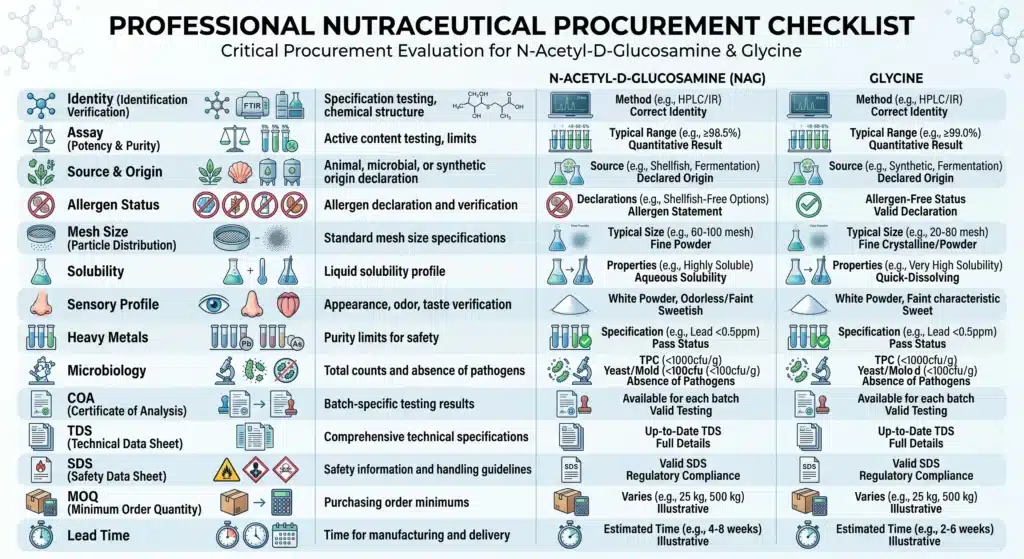
How Supplement Brands Should Choose Between NAG and Glycine
- Define the product objective. Decide whether the formula is primarily joint-support, amino-acid nutrition, collagen-related, sleep-positioned, or a multi-benefit concept.
- Confirm the exact ingredient identity. Do not use “glucosamine,” “NAG,” “glycine,” and “glycinate” interchangeably.
- Match evidence to the exact raw material. Clinical results from one ingredient form or multi-ingredient product should not automatically be generalized to another.
- Review source and allergen requirements. This is especially important for N-Acetyl-D-Glucosamine.
- Evaluate the dosage form. Capsule fill, tablet compression, gummy taste, powder solubility, and serving size can change the practical choice.
- Request batch documents before commercial approval. Review COA, specification/TDS, SDS, source declaration, allergen statement, heavy metals, and microbiology.
- Run a separate claim review. Ingredient biochemistry is not the same as finished-product clinical substantiation.
Questions to Ask a Supplier Before Ordering
- What is the exact chemical identity, CAS number, assay, and testing method?
- What is the raw-material source and manufacturing route?
- Is the N-Acetyl-D-Glucosamine shellfish-derived or fermentation-derived?
- What allergen and non-GMO statements are available?
- What are the particle size, solubility, bulk density, and sensory characteristics?
- What heavy-metal and microbiological limits are tested by batch?
- Can you provide a representative COA, TDS/specification sheet, and SDS?
- What are the sample MOQ, commercial MOQ, packaging, lead time, storage, and shelf life?
- Can the ingredient be supported in the intended capsule, tablet, gummy, sachet, or powder blend?
FAQ
What is N-Acetyl-D-Glucosamine?
N-Acetyl-D-Glucosamine is an acetylated amino sugar commonly abbreviated as GlcNAc or NAG. It is chemically different from glycine and from other commercial glucosamine forms such as glucosamine hydrochloride and glucosamine sulfate.
Is N-Acetyl-D-Glucosamine the same as glucosamine?
No. N-Acetyl-D-Glucosamine is a related but distinct chemical form. Product labels, research evidence, serving levels, and specifications should be reviewed for the exact form used.
Is glycine the same as glucosamine?
No. Glycine is an amino acid, while glucosamine is an amino sugar. They differ in chemical structure, molecular weight, metabolic roles, and supplement applications.
Is glycinate the same as glucosamine?
No. “Glycinate” generally describes a salt or complex involving glycine. It should not be confused with glucosamine or N-Acetyl-D-Glucosamine.
Which is better for joint health: N-Acetyl-D-Glucosamine or glycine?
They are not direct substitutes. N-Acetyl-D-Glucosamine has ingredient-specific human research examining cartilage-metabolism biomarkers, while glycine is a fundamental amino acid and a major component of collagen. The better choice depends on the formula, evidence, serving size, source requirements, and intended claims.
Can N-Acetyl-D-Glucosamine and glycine be combined?
They can be evaluated together in a multi-ingredient formula, but the combination should be reviewed for total serving size, source and allergen status, dosage-form performance, sensory characteristics, stability, and claim substantiation.
Is N-Acetyl-D-Glucosamine shellfish-derived?
It can be, but source varies by supplier and process. Buyers should confirm whether the actual batch is shellfish-derived, fermentation-derived, or from another declared source and obtain the relevant allergen statement.
What documents should B2B buyers request?
Request a batch COA, product specification or TDS, SDS, source declaration, allergen statement, heavy-metal results, microbiological limits, and other destination-market documents required for the finished supplement.
Conclusion
N-Acetyl-D-Glucosamine and glycine are chemically and functionally different ingredients. NAG is an acetylated amino sugar with specific relevance to GlcNAc-based supplement concepts, while glycine is a fundamental amino acid with broad roles in proteins and metabolism. Supplement brands should choose between them—or formulate them together—only after reviewing the exact evidence, source, specification, dosage form, serving level, and compliant claim language.
For B2B sourcing or finished-product development, request a COA, sample, or formulation review before approving the commercial formula.
References
- PubChem. N-Acetyl-D-Glucosamine (CID 439174).
- PubChem. Glycine (CID 750).
- Nagaoka I, et al. Evaluation of the effect of N-acetyl-glucosamine administration on biomarkers for cartilage metabolism in healthy individuals without symptoms of arthritis: a randomized double-blind placebo-controlled clinical study.
- Soh J, et al. The effect of glycine administration on the characteristics of physiological systems in human adults: a systematic review.
- U.S. Food and Drug Administration. Structure/Function Claims.
6. Federal Trade Commission. Health Products Compliance Guidance.

Warren Wan is a seasoned expert with extensive experience in the dietary supplement supply chain, possessing rich practical experience in the research, development, process control, and global sourcing of core ingredients such as collagen peptides, bone broth protein, and keratin. As the author of this column, he is dedicated to stripping away the marketing packaging, transforming obscure ingredient science and production quality control standards into easy-to-understand, hardcore science popularization, helping readers understand the truth behind the labels and make more rational health choices.