L-Citrulline and L-Arginine are two nitric oxide precursor amino acids used in pre-workout powders, capsule formulas, and cardiovascular support supplements. For consumers, the key question is which one supports nitric oxide availability more efficiently. For supplement brands, the more important question is which ingredient is easier to formulate, stabilize, package, and substantiate without making disease claims.
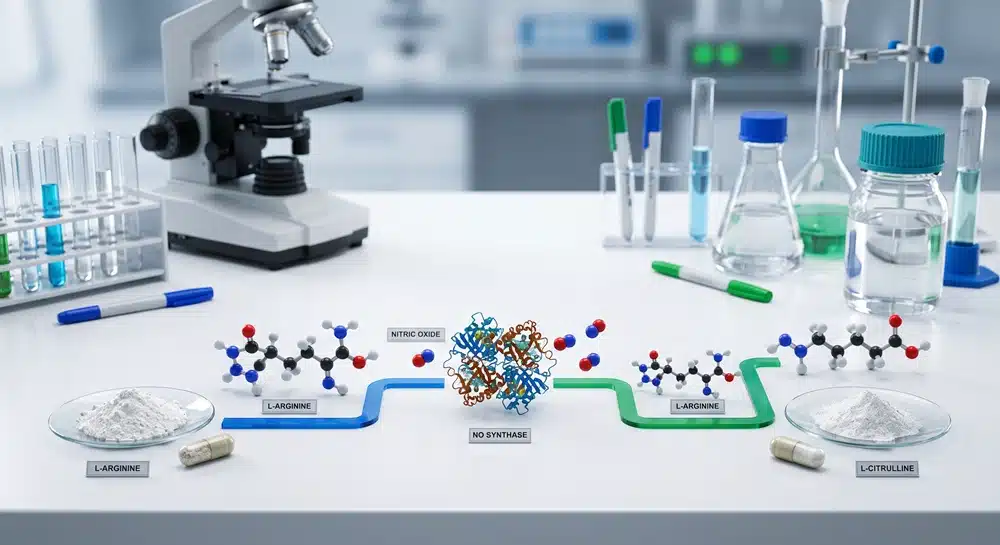
This guide compares L-Citrulline vs L-Arginine from both a biological and manufacturing perspective: absorption, nitric oxide pathway, dosage-form fit, powder hygroscopicity, citrulline malate ratio verification, and compliant supplement positioning.
What Are Amino Acids and Why Do They Matter?
L-Citrulline and L-Arginine are non-essential amino acids used as nitric oxide precursors in sports nutrition. Oral L-Arginine directly enters the nitric oxide synthase pathway but is partly degraded by first-pass metabolism, while L-Citrulline is converted into L-Arginine mainly after absorption, supporting a more sustained plasma arginine response.
Amino acids are the building blocks of proteins and metabolic pathways. In supplement formulation, amino acids are not only nutritional inputs; they also determine serving size, taste, solubility, moisture behavior, blend uniformity, and packaging strategy.
For sports nutrition brands, L-Citrulline and L-Arginine matter because both participate in nitric oxide biology. Nitric oxide supports vascular relaxation and healthy circulation within normal ranges. This is structure/function positioning, not a disease treatment claim.
What Is L-Citrulline?
L-Citrulline is a non-essential amino acid originally named from Citrullus vulgaris, the Latin name for watermelon. In supplements, it is commonly used as free-form L-Citrulline or as Citrulline Malate, especially in pre-workout powders.
L-Citrulline does not directly create nitric oxide. Instead, it is absorbed and converted into L-Arginine, which can then serve as a nitric oxide synthase substrate. Because citrulline is less affected by first-pass intestinal and hepatic metabolism than arginine, it can be more efficient for sustained arginine availability.
Formulation role of L-Citrulline
L-Citrulline is best suited for pre-workout powders, pump formulas, endurance products, and gram-level serving formats. It is usually more practical in powders than capsules because effective serving sizes can be too large for capsule-only products.
What Is L-Arginine?
L-Arginine is a semi-essential amino acid and a direct substrate for nitric oxide synthase. It appears naturally in protein-rich foods and is also used in supplement forms such as L-Arginine base, L-Arginine HCl, AAKG, and arginine nitrate.
The advantage of L-Arginine is direct pathway relevance. The disadvantage is oral efficiency: a portion of oral arginine is metabolized in the intestine and liver before it can contribute to systemic arginine availability. For this reason, many performance formulas use L-Citrulline, or combine L-Citrulline with L-Arginine.
Formulation role of L-Arginine
L-Arginine can fit capsule, tablet, and powder products, but high-dose formulas require careful handling. L-Arginine base can be more challenging in high-humidity environments because it may cake, bridge in hoppers, or reduce filling accuracy.
L-Citrulline vs L-Arginine: Key Differences
The biological comparison is only one part of the decision. Supplement brands should also compare ingredient form, manufacturing behavior, serving size, taste, and claim compliance.
| Attribute | L-Citrulline | L-Arginine | Formulation Implication |
|---|---|---|---|
| NO pathway role | Indirect precursor; converted to L-Arginine before nitric oxide synthesis | Direct substrate for nitric oxide synthase | Citrulline is better for sustained arginine availability; arginine fits fast-response or combo formulas. |
| First-pass metabolism | Less affected by gut and liver extraction | Significant intestinal and hepatic first-pass metabolism | Label dose should not be interpreted as equal biological availability. |
| Common sports nutrition form | L-Citrulline or Citrulline Malate 2:1 | L-Arginine base, L-Arginine HCl, AAKG, or arginine nitrate | Ingredient form affects taste, cost, pH, solubility, and label claims. |
| Powder handling | Can absorb moisture, especially in flavored powder systems | Often more hygroscopic and more challenging in high-dose powders | Requires RH control, free-flowing excipients, and moisture-protective packaging. |
| Best dosage forms | Pre-workout powders, stick packs, capsules, tablets | Capsules, tablets, powder blends, combination NO formulas | High clinical-style doses usually favor powders; capsules are better for lower-dose blends. |
| Compliance note | Use structure/function language such as “supports nitric oxide production” | Use structure/function language such as “supports healthy circulation” | Avoid disease claims such as treating ED, hypertension, or cardiovascular disease. |
Formulation Challenges: Moisture, Flowability, and Shelf-Life Control in NO Booster Powders
The hardest part of manufacturing L-Citrulline and L-Arginine supplements is not explaining nitric oxide. It is keeping high-dose amino acid powders stable, free-flowing, and label-compliant during blending, filling, and shelf storage.
Both ingredients can absorb environmental moisture, but L-Arginine base is usually more difficult to handle in high-speed production because it can become sticky, bridge inside hoppers, and reduce capsule or sachet filling accuracy. In a sports nutrition plant, relative humidity, powder temperature, bulk density, particle size distribution, and excipient selection determine whether a formula runs smoothly or shuts down the line.
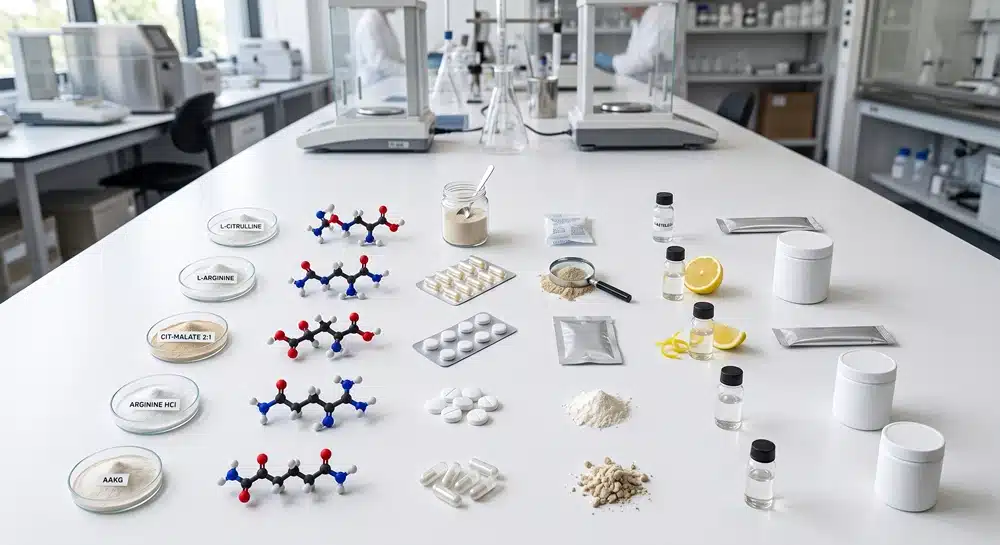
For custom pre-workout powders, a manufacturer should evaluate: water activity, loss on drying, sieve profile, bulk density, angle of repose, blend uniformity, and moisture uptake after 7-14 days in the selected packaging format. For moisture-sensitive amino acid blends, foil stick packs, induction-sealed HDPE bottles, and desiccant-controlled jars are safer than low-barrier pouches.
For brands developing large-serving NO booster powders, Gensei can align the amino acid grade, flavor system, free-flowing excipients, and barrier packaging through powder supplement manufacturing, custom private label supplement formulation, and moisture-protective supplement packaging.Citrulline Malate Is Not the Same as Pure L-Citrulline
Citrulline malate is frequently used in pre-workout formulas, but it should not be treated as a synonym for pure L-Citrulline. A 2:1 citrulline malate material contains roughly two parts citrulline and one part malate by ratio, while a 1:1 material contains a lower citrulline fraction per gram. This changes the true active amino acid delivery, taste acidity, cost per effective dose, and label accuracy.
For B2B buyers, the critical quality-control question is not only “Is this citrulline malate?” but “Which ratio is it, and how is the ratio verified?” Supplier COA review should be supported by identity testing and component analysis, such as HPLC-based amino acid verification and acid content evaluation.
Can L-Citrulline and L-Arginine Be Taken Together?
L-Citrulline and L-Arginine can be combined in nitric oxide support formulas because they may provide both direct arginine input and sustained arginine availability. Human research has evaluated combined oral citrulline and arginine intake and reported stronger plasma arginine response than either ingredient alone in certain conditions.
For supplement brands, the combination should be treated as a formulation decision rather than a marketing slogan. A combined formula must consider serving size, GI tolerance, flavor load, powder flow, moisture protection, and claim language.
How to Choose Between L-Citrulline, L-Arginine, or Both
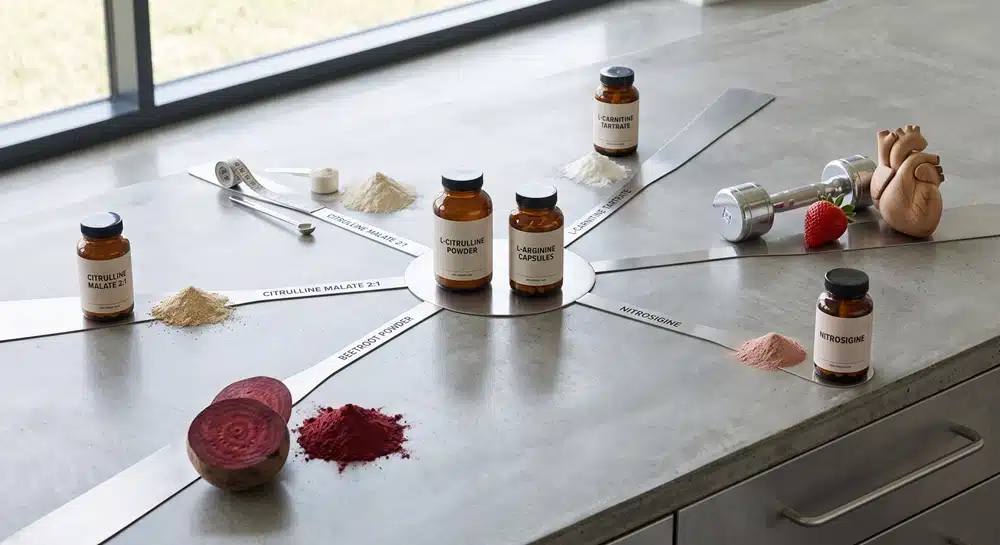
Choose L-Citrulline when the formula is designed for sustained nitric oxide support, pre-workout pump positioning, or gram-level powder servings. Choose L-Arginine when the formula requires direct arginine input, a lower-cost amino acid base, or a blended NO support mechanism. Choose both when the product concept needs a fast-plus-sustained nitric oxide support story and the serving size can support both ingredients.
Powder format is usually the most practical option for high-dose L-Citrulline or Citrulline Malate products. Capsules may fit lower-dose blends, but a gram-level citrulline formula can require an impractical capsule count. Tablets can work for selected formulas, but compression behavior, moisture, and sticking risk must be reviewed before scale-up.
Compliance Notes for Supplement Brands
Supplement content should avoid disease claims. Instead of stating that L-Citrulline or L-Arginine treats erectile dysfunction, hypertension, angina, or cardiovascular disease, use compliant structure/function language such as “supports nitric oxide production,” “supports healthy circulation,” “supports vascular endothelial function,” or “supports exercise performance.”
Brands should verify that product pages, labels, ads, and influencer scripts do not convert structure/function support into disease treatment claims. This is especially important for nitric oxide ingredients because many consumer search terms contain medical intent.
FAQs
Conclusion
L-Citrulline is generally the better choice for sustained nitric oxide support because it more efficiently raises arginine availability after absorption. L-Arginine remains useful when a formula needs direct arginine input or a combined fast-plus-sustained pathway. For supplement brands, the best choice depends not only on biology but also on dosage form, serving size, powder stability, moisture control, quality testing, and compliant positioning.
References
- Suzuki, T., et al. (2017). “The effects on plasma L-arginine levels of combined oral L-citrulline and L-arginine supplementation in healthy males.” Bioscience, Biotechnology, and Biochemistry. Available at: https://academic.oup.com/bbb/article/81/2/372/5955995
- Schwedhelm, E., et al. (2008). “Pharmacokinetic and pharmacodynamic properties of oral L-citrulline and L-arginine.” British Journal of Clinical Pharmacology. Available at: https://pmc.ncbi.nlm.nih.gov/articles/PMC2291275/
- Agarwal, U., et al. (2017). “Supplemental Citrulline Is More Efficient Than Arginine in Increasing Systemic Arginine Availability.” The Journal of Nutrition. Available at: https://pmc.ncbi.nlm.nih.gov/articles/PMC5368575/
- Gough, L. A., et al. (2021). “A critical review of citrulline malate supplementation and exercise performance.” European Journal of Applied Physiology. Available at: https://pmc.ncbi.nlm.nih.gov/articles/PMC8571142/
- Park, J., et al. (2023). “Dietary Arginine and Citrulline Supplements for Cardiovascular Health and Athletic Performance.” Nutrients. Available at: https://pmc.ncbi.nlm.nih.gov/articles/PMC10005484/
- U.S. Food and Drug Administration (FDA). “Structure/Function Claims.” Available at: https://www.fda.gov/food/nutrition-food-labeling-and-critical-foods/structurefunction-claims
- United States Pharmacopeia (USP). “Dietary supplement compendium note: HPLC method discriminating L-citrulline from related amino acids.” Available at: https://www.usp.org/sites/default/files/usp/document/our-work/DS/dsc_dec2016.pdf
- Collagensei. “Powder Supplement Manufacturer.” Available at: https://collagensei.com/powder-supplement-manufacturer/
- Collagensei. “Capsule Supplement Manufacturer.” Available at: https://collagensei.com/capsule-supplement-manufacturer/
- Collagensei. “Tablet Supplement Manufacturer.” Available at: https://collagensei.com/tablet-supplements-manufacturer/
- Collagensei. “Food Supplement Packaging.” Available at: https://collagensei.com/food-supplement-packaging/
- Collagensei. “Sports Nutrition Contract Manufacturing.” Available at: https://collagensei.com/sports-nutrition-contract-manufacturing/
- Collagensei. “Bulk Amino Acids Raw Material Supplier.” Available at: https://collagensei.com/bulk-amino-acids-raw-material-supplier/
- Collagensei. “Custom Private Label Supplements Manufacturer.” Available at: https://collagensei.com/custom-private-label-supplement/

Warren Wan is a seasoned expert with extensive experience in the dietary supplement supply chain, possessing rich practical experience in the research, development, process control, and global sourcing of core ingredients such as collagen peptides, bone broth protein, and keratin. As the author of this column, he is dedicated to stripping away the marketing packaging, transforming obscure ingredient science and production quality control standards into easy-to-understand, hardcore science popularization, helping readers understand the truth behind the labels and make more rational health choices.