This guide is for consumers, formulators, supplement brands and procurement teams comparing these oils for softgels or other dietary supplement products. It does not present either oil as a treatment for eczema, PMS, menopause, arthritis, asthma, diabetes, weight loss or another medical condition.
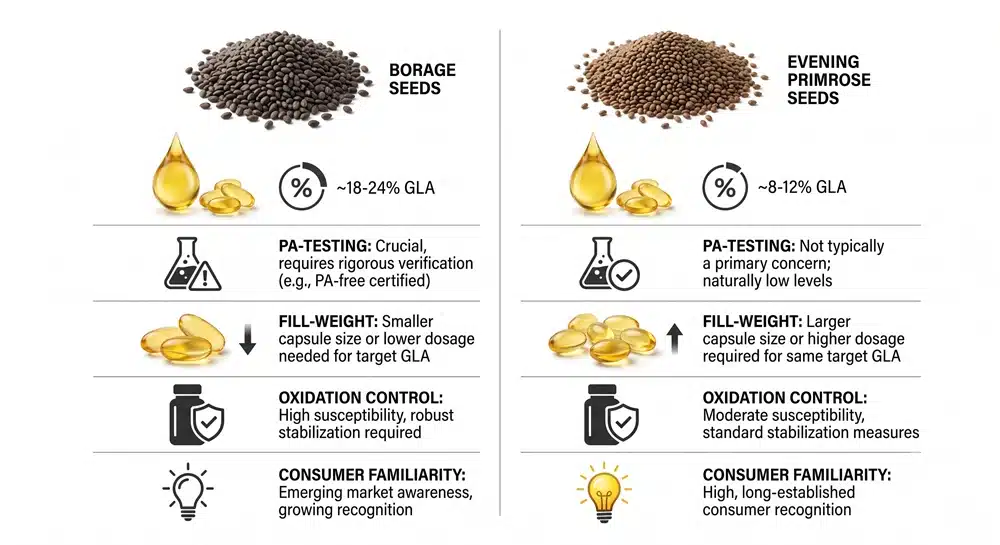
Borage Seed Oil vs Evening Primrose Oil at a Glance
| Factor | Borage Seed Oil | Evening Primrose Oil |
|---|---|---|
| Botanical source | Borago officinalis seed; also marketed as starflower oil | Oenothera biennis seed |
| Typical GLA specification | Often approximately 18%–26%, depending on cultivar, process and lot specification | Often approximately 7%–10%, depending on cultivar, process and lot specification |
| Oil required for the same GLA target | Usually less | Usually more |
| Distinctive safety/quality issue | Documented control and testing of relevant pyrrolizidine alkaloids | No borage-specific PA issue, but normal identity, oxidation and contaminant controls still apply |
| Commercial advantage | Higher GLA concentration can reduce fill weight | Strong consumer recognition and established market positioning |
| Key formulation risks | PA documentation, oxidation, source variation, odor and softgel stability | Oxidation, GLA variability, larger fill weight and softgel stability |
What Is Borage Seed Oil?
Borage seed oil is extracted from the seeds of Borago officinalis. Starflower oil is a common market name for the same seed oil. Its main formulation value is its relatively high GLA content.
In supplement specifications, “borage oil” should identify the botanical name, seed as the plant part, extraction and refining process, country of origin, fatty-acid profile and lot-specific quality results. It should not be confused with borage leaf, flower or crude herbal preparations.
What Is Evening Primrose Oil?
Evening primrose oil is extracted from the seeds of Oenothera biennis. It contains linoleic acid and a smaller GLA fraction than most commercial borage seed oils. It is widely sold in liquid oil and softgel formats.
Consumer familiarity does not establish effectiveness for a health condition. The finished product still requires a verified fatty-acid profile, oxidation controls, stability data and claims review.
Is Borage Oil the Same as Starflower Oil?
Yes. “Starflower oil” commonly refers to borage seed oil. A marketing name is not enough for purchasing, however. Procurement documents should still specify Borago officinalis, seed oil, extraction/refining process and the required GLA and PA specifications.
GLA Content: Why Percentage Alone Is Not Enough
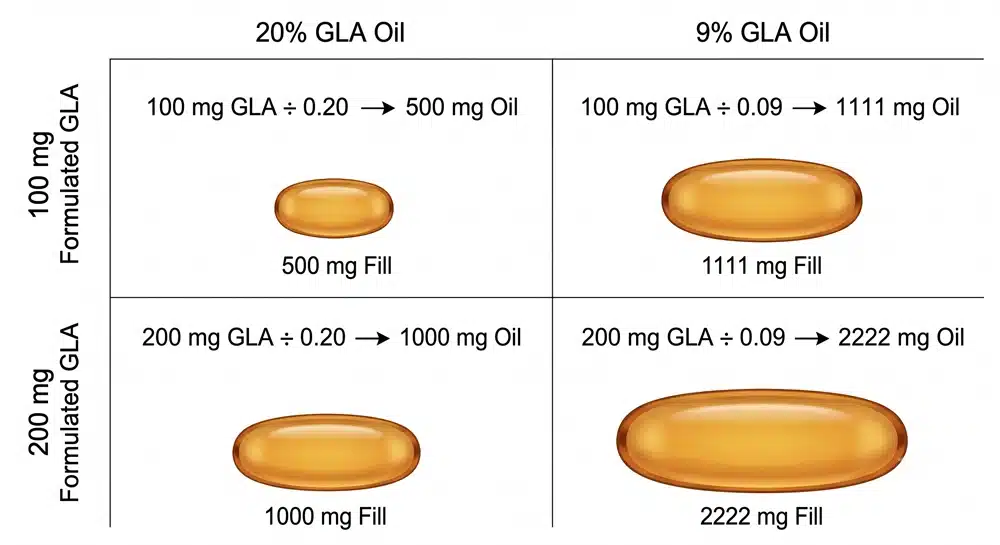
A higher GLA percentage means that less total oil may be needed to deliver the same formulated GLA amount. It does not prove that the oil works faster, produces stronger clinical outcomes or is better for a specific disease.
| Formulation Example | Oil at 20% GLA | Oil at 9% GLA |
|---|---|---|
| 100 mg formulated GLA | 500 mg oil | Approximately 1,111 mg oil |
| 200 mg formulated GLA | 1,000 mg oil | Approximately 2,222 mg oil |
| Softgel implication | Potentially smaller fill or fewer units | Larger fill or more units may be required |
These calculations are formulation examples, not consumer dose recommendations. Use the actual lot-specific fatty-acid result and account for overages, fill-weight tolerance, serving count and shelf-life changes.
Which Oil Is Better for Each Product Goal?
| Product Goal | Likely Starting Option | Reason |
|---|---|---|
| Higher GLA in a smaller oil fill | Borage seed oil with qualified PA documentation | Higher GLA concentration may reduce total fill weight |
| Familiar consumer-facing women’s wellness softgel | Evening primrose oil | Established ingredient recognition, subject to conservative claims |
| Low-oxidation premium softgel | Either oil meeting the full oxidation and stability specification | Freshness and packaging are more important than the ingredient name alone |
| PA-sensitive market or buyer | Evening primrose oil, or borage oil with validated lot-level PA results | Reduces ambiguity in supplier qualification |
| Combined GLA oil formula | Only with a clear formulation rationale | Combining similar oils may duplicate GLA without adding meaningful differentiation |
Evidence and Health-Claim Boundaries
Skin and Eczema
Oral evening primrose oil and borage oil have been studied for eczema, but a Cochrane review found no clinically useful benefit compared with placebo. Do not market either oil as an eczema, psoriasis, rosacea or acne treatment.
PMS, Menopause and “Hormone Balance”
Evening primrose oil is frequently marketed for PMS and menopause, but authoritative reviews describe the evidence as insufficient or inconclusive. “Balances hormones” is vague and may imply treatment. Use only specific, substantiated structure/function language.
Inflammation, Joints and Other Conditions
GLA participates in fatty-acid metabolism, but that fact alone does not support claims to treat arthritis, asthma, neuropathy, chronic pain or cardiovascular disease. Research must match the exact ingredient, dose, population and finished formula.
Weight and Estrogen Questions
Neither oil is established as a weight-loss, belly-fat or estrogen-increasing supplement. These questions should be answered directly without suggesting a predictable hormonal or body-composition effect.
Safety: Pyrrolizidine Alkaloids and Borage Oil
Borage plants can contain toxic unsaturated pyrrolizidine alkaloids. Processing and refining can reduce contaminants, but “PA-free” should not be accepted as an undefined sales phrase. Buyers need a method, analyte panel, reporting limit and lot-specific result.
- Specify the target PA and PA-N-oxide analytes included in the panel.
- Request the analytical method and validation or laboratory scope.
- Record the limit of detection and limit of quantification.
- Require a lot-specific numerical result or clearly defined “not detected” result.
- Match the release specification to the target market and intended daily exposure.
- Maintain traceability from seed source through refined oil and finished product.
Brands sourcing oil can review a qualified borage oil ingredient specification, but the actual purchase decision must use current batch documents rather than website language.
General Safety and Interaction Review
- Both oils may cause gastrointestinal effects such as nausea, loose stools or abdominal discomfort.
- People taking prescription medicines, especially medicines affecting bleeding or seizure control, should ask a healthcare professional before use.
- Pregnancy and breastfeeding require product-specific professional review; do not rely on a generic “safe” statement.
- People with liver disease, seizure disorders, upcoming surgery or complex medical conditions should seek individualized advice.
- Combining the two oils may duplicate GLA exposure without proven additional benefit.
Softgel Formulation Considerations
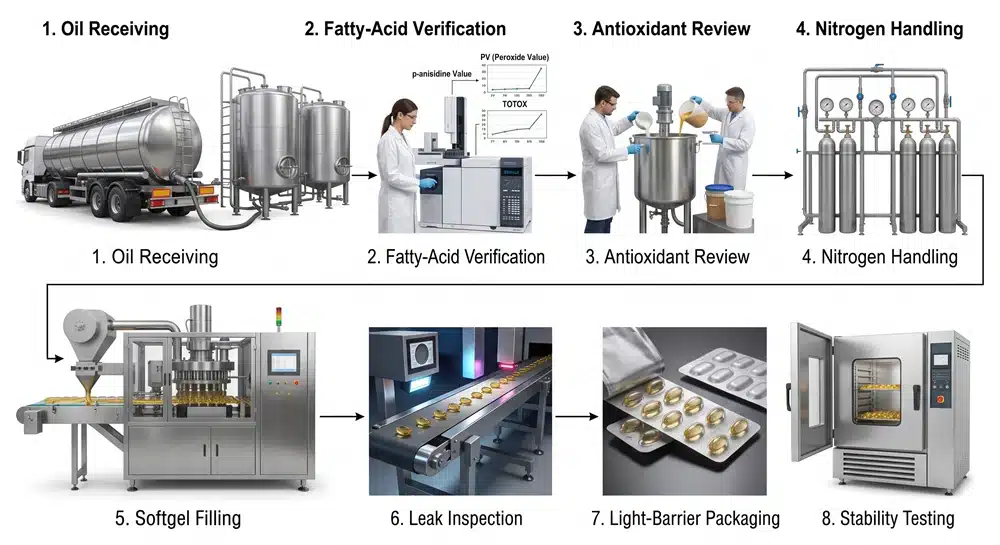
Both oils fit liquid-filled softgel systems. A higher GLA percentage can reduce fill weight, but oxidation control and shell compatibility determine whether the product remains stable and acceptable.
- Verify the lot-specific fatty-acid profile and GLA percentage.
- Set peroxide value, p-anisidine value and TOTOX limits where appropriate.
- Review acid value, moisture, odor, color and clarity.
- Define antioxidant additions and processing aids.
- Control oxygen exposure with suitable handling, nitrogen and headspace strategy.
- Test shell-fill compatibility, leakage, seam quality and migration.
- Use light- and oxygen-barrier packaging.
- Run real-time and accelerated stability in the final package.
For dosage-form development, see GENSEI’s softgel capsule manufacturing capabilities.
Quality Specification Checklist
| Quality Area | What to Verify | Why It Matters |
|---|---|---|
| Botanical identity | Species, seed as plant part, origin and process | Confirms the correct ingredient |
| Fatty-acid profile | GLA, linoleic acid, oleic acid and other major fatty acids | Verifies identity and formulated potency |
| PA control for borage | Method, analytes, LOD/LOQ, lot result and release limit | Controls the distinctive borage safety risk |
| Oxidation | Peroxide value, p-anisidine value and TOTOX where appropriate | Supports freshness and shelf-life decisions |
| Other contaminants | Pesticides, heavy metals, residual solvents and microbiology as applicable | Supports ingredient release and market compliance |
| Physical properties | Color, odor, clarity, density and viscosity | Affects filling, sensory quality and consistency |
| Added materials | Tocopherols, antioxidants, carriers and processing aids | Ensures complete formula and label review |
| Documentation | Lot COA, specification, TDS/SDS, traceability and change control | Supports supplier qualification and audit readiness |
| Finished product | Fill weight, leaks, disintegration, stability and packaging compatibility | Raw-oil quality alone does not assure softgel quality |
Connect raw-material release criteria to finished-product supplement quality control and documented change-control procedures.
RFP Questions for an Oil Supplier or Softgel Manufacturer
- What botanical species, plant part and country of origin apply?
- Is the oil cold-pressed, solvent-extracted, refined, deodorized or otherwise processed?
- What minimum and typical GLA percentages are guaranteed?
- Can you provide three recent lot-specific fatty-acid profiles and COAs?
- For borage oil, which PA and PA-N-oxide analytes are tested?
- What method, laboratory, LOD, LOQ and release limit are used for PA testing?
- What are the peroxide, p-anisidine, TOTOX and acid-value specifications?
- Which antioxidants, carriers or processing aids are present?
- What pesticide, heavy-metal, residual-solvent and microbiological tests are included?
- What packaging, storage and shelf-life conditions are supported?
- What are the MOQ, sample quantity, lead time and change-control terms?
- Can the manufacturer support pilot softgels and final-package stability?
- How are skin, women’s-health, inflammation and hormone-related claims reviewed?
Frequently Asked Questions
Which is better, borage oil or evening primrose oil?
Borage oil is usually more concentrated in GLA and may require less oil for the same formulated GLA amount. Evening primrose oil may be preferred for consumer familiarity. The better ingredient is the one that meets the required safety, oxidation, stability and documentation specifications.
Can you take borage oil and evening primrose oil together?
They provide overlapping fatty acids, so combining them may duplicate GLA exposure without proven additional benefit. A healthcare professional should review the total formula and medicines.
Does borage oil increase estrogen?
There is no reliable evidence that borage oil predictably increases estrogen. Do not market it as a hormone treatment.
Does borage oil cause weight gain?
No good evidence shows a specific weight-gain effect. Like all oils, it provides calories, but body weight depends on the overall diet and many other factors.
What should “PA-free borage oil” mean?
It should mean that a defined analytical panel was tested using a documented method and reporting limit, with a lot-specific result that meets the buyer’s release specification. A marketing phrase alone is insufficient.
Is cold-pressed oil always better?
No. Cold pressing may support a particular source story, but refining or deodorization may be needed to control odor, contaminants or stability. Quality should be judged by the complete specification and batch results.
Final Takeaway
Borage seed oil and evening primrose oil are both GLA-containing seed oils, but a higher GLA percentage is a formulation advantage—not proof of superior clinical results. Responsible selection requires verified fatty-acid profiles, PA control for borage oil, oxidation limits, softgel compatibility, final-package stability and conservative claims.
Brands can contact GENSEI with the target GLA amount, PA specification, dosage form, package, market and order quantity to request a sample, COA or quotation.
References
- NCCIH: Evening Primrose Oil—Usefulness and Safety
- NCCIH: Skin Conditions and Complementary Health Approaches—What the Science Says
- PubMed: Oral Evening Primrose Oil and Borage Oil for Eczema—Cochrane Review
- EMA: Pyrrolizidine Alkaloids in Herbal Medicinal Products—Scientific Guideline
- EFSA: Risks for Human Health Related to Pyrrolizidine Alkaloids in Food
- FDA: Structure/Function Claims
- FTC: Health Products Compliance Guidance
- 21 CFR Part 111: Dietary Supplement Current Good Manufacturing Practice

Warren Wan is a seasoned expert with extensive experience in the dietary supplement supply chain, possessing rich practical experience in the research, development, process control, and global sourcing of core ingredients such as collagen peptides, bone broth protein, and keratin. As the author of this column, he is dedicated to stripping away the marketing packaging, transforming obscure ingredient science and production quality control standards into easy-to-understand, hardcore science popularization, helping readers understand the truth behind the labels and make more rational health choices.