
Haben Sie schon einmal im Supermarkt vor den Regalen voller Knochenbrühe gestanden und sich gefragt, welche Sie nehmen sollen? Das kenne ich nur zu gut: hin- und hergerissen zwischen Hühner- und Rinderknochenbrühe, auf der Suche nach dem Wundermittel für meine Gesundheitsziele. Knochenbrühe ist zum Liebling der Wellness-Szene geworden und wird für alles Mögliche gepriesen – von der Linderung von Halsschmerzen bis hin zu strahlender Haut. Aber wie soll man sich entscheiden, wenn es um Hühner- oder Rinderknochenbrühe geht? Tauchen wir ein in die brodelnde Welt der Knochenbrühe und erkunden wir, was jede davon einzigartig macht, welche gesundheitlichen Vorteile sie bieten und ob du vielleicht am besten von beiden etwas zu dir nimmst. Spoiler: Es gibt keine allgemeingültige Antwort, aber ich werde dir helfen, herauszufinden, was für dich am besten ist.
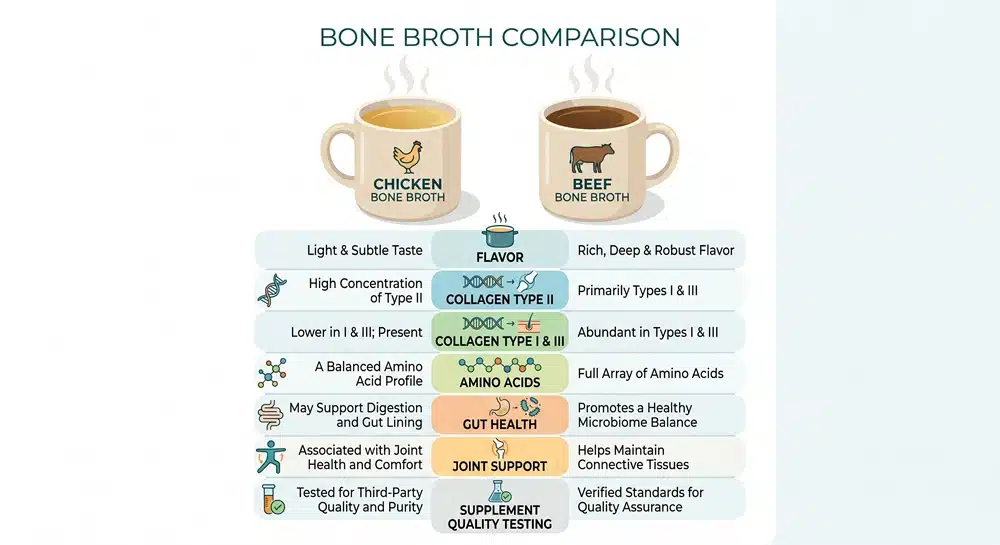
Kurze Antwort: Hühnerknochenbrühe ist in der Regel die bessere Wahl, wenn es um einen milderen Geschmack, eine schnellere Zubereitung und auf Knorpel ausgerichtete Rezepturen geht, während Rinderknochenbrühe meist besser geeignet ist, wenn ein vollmundigerer Geschmack und Rinderkollagen im Vordergrund stehen. Die “beste” Brühe hängt jedoch weniger von der tierischen Herkunft allein ab, sondern vielmehr vom Aminosäureprofil, dem Proteingehalt, dem Natriumgehalt, den Schwermetalltests und davon, ob es sich bei dem Produkt um flüssige Brühe, Pulver oder hydrolysiertes Knochenbrüheprotein handelt.
Was ist Knochenbrühe?
Knochenbrühe ist wie eine warme Umarmung in einer Tasse, die durch das Kochen von Tierknochen - z. B. Huhn, Rind, Schwein oder sogar Fisch - mit Gemüse, Kräutern und einem Spritzer Essig über 12 bis 24 Stunden oder länger hergestellt wird. Durch diesen langsamen Prozess wird ein Schatz an Nährstoffen freigesetzt: Kollagen, Aminosäuren, Gelatine und Mineralien wie Kalzium und Magnesium. Im Gegensatz zu normaler Brühe, die aus Fleisch hergestellt wird und nur ein paar Stunden köchelt, ist Knochenbrühe durch ihre lange Kochzeit ein wahres Kraftpaket an Nährstoffen. Es ist auch nicht einfach nur eine Brühe - Brühe kocht 4-6 Stunden, während Knochenbrühe die Extra-Meile geht, um jedes bisschen des Guten zu extrahieren.
Warum der Hype? Knochenbrühe ist ein vielseitiges Nahrungsergänzungsmittelbestandteil, das in allen möglichen Gerichten verwendet wird, von Suppen bis hin zu Smoothies. Aufgrund seiner muskelaufbauenden Aminosäuren ist es ein fester Bestandteil der Sporternährung und wird oft für seine Rolle bei Ergänzungsmittel für die Gelenkgesundheit. Egal, ob Sie sie zur Linderung einer Erkältung trinken oder als Grundlage für einen deftigen Eintopf verwenden, Knochenbrühe ist in der Küche unverzichtbar.
Die Grundlagen: Hühnerknochenbrühe vs. Rinderknochenbrühe
Kommen wir zum Kern der Sache: Wie sieht es mit dem Nährwert von Hühner- und Rinderknochenbrühe aus? Beide sind vollgepackt mit Nährstoffen, aber ihre Profile unterscheiden sich in einer Weise, die Ihre Wahl beeinflussen könnte.
Ernährungswissenschaftlicher Vergleich
Die Nährstoffzusammensetzung von Knochenbrühe ist nicht feststehend. Sie hängt von der Art des Knochenabschnitts, dem Knorpelanteil, der Koch- oder Hydrolysezeit, dem Konzentrationsverhältnis, der Natriumzugabe sowie davon ab, ob es sich beim Endprodukt um eine trinkfertige Brühe oder um ein sprühgetrocknetes Knochenbrühe-Proteinpulver handelt. Der folgende Vergleich fasst die gängigen Unterschiede zusammen, doch sollten Hersteller von Nahrungsergänzungsmitteln die endgültige Entscheidung anhand eines chargenspezifischen Analysezertifikats (COA) überprüfen, insbesondere hinsichtlich Aminosäuren, Eiweiß, Natrium, Asche und Schwermetallen.
| Faktor | Hühnerknochenbrühe | Rinderknochenbrühe | Bester Anwendungsfall |
|---|---|---|---|
| Typischer Geschmack | Leichter, reiner, einfacher in Suppen, Soßen und Trinkprodukten zu verwenden. | Vollmundiger, intensiver, würziger – ideal für herzhafte Gerichte und die Positionierung als Premium-Brühe. | Hähnchen wegen seiner Vielseitigkeit; Rindfleisch wegen seines intensiven Geschmacks. |
| Häufige Anordnung von Kollagen | Wird häufig mit Typ-II-Kollagen aus Knorpel in Verbindung gebracht, wenn Hühnerfüße, das Brustbein oder knorpelreiche Teile verwendet werden. | Wird häufig mit Kollagen der Typen I und III aus Rinderknochen und Bindegewebe in Verbindung gebracht. | Hühnerfleisch zur Behandlung von Gelenken und Knorpeln; Rindfleisch zur Versorgung von Haut, Darm und Kollagenpeptiden. |
| Eiweiß pro Tasse | Meistens etwa 9–12 g pro Tasse, dies variiert jedoch je nach Rezept und Konzentration. | Meistens etwa 8–10 g pro Tasse, dies variiert jedoch je nach Rezept und Konzentration. | Überprüfen Sie stets die Nährwertangaben oder das Analysezertifikat. |
| Aminosäurenprofil | In veröffentlichten Daten zu handelsüblichen Proben wurde festgestellt, dass Hühnerbrühe einen etwas höheren Gehalt an Glycin, Prolin, Hydroxyprolin, Leucin, Isoleucin und Valin aufweist als Rinderbrühe. | Veröffentlichte Daten aus handelsüblichen Proben ergaben, dass Rinderbrühe einen etwas höheren Gehalt an Hydroxylysin aufweist. | Verlassen Sie sich nicht ausschließlich auf tierische Quellen; fordern Sie ein Aminosäure-Analysezertifikat an. |
| Mineralstoffe und Natrium | Das hängt stark von der Zusammensetzung, dem Salzzusatz, der Konzentration und der Filtration ab. | Das hängt stark von der Zusammensetzung, dem Salzzusatz, der Konzentration und der Filtration ab. | Überprüfen Sie den Natrium-, Asche-, Kalzium-, Magnesium- und Kaliumgehalt pro Portion. |
| Bedenken hinsichtlich der industriellen Qualität | Mikrobiologie, Natrium, Sprühtrocknungsstabilität, Rückverfolgbarkeit der Geflügelherkunft sowie Angaben zu Allergenen und auf dem Etikett. | Schwermetalluntersuchungen, Rückverfolgbarkeit von Rindfleisch, Angaben zur Weidehaltung, Sprühtrocknungsstabilität und Mikrobiologie. | Beides erfordert eine Analyse des Stoffausweises (COA) sowie eine Prüfung auf Verunreinigungen auf Chargenebene. |
- Eiweiß: Hühnerknochenbrühe hat einen etwas höheren Eiweißgehalt, etwa 12 Gramm pro 250 ml im Vergleich zu 10 Gramm bei Rindfleisch. Dies macht sie zu einer guten Wahl für diejenigen, die sich auf die Muskelerholung konzentrieren, insbesondere in der Sporternährung.
- Kollagen: Rinderknochenbrühe, die oft aus dichteren Knochen hergestellt wird, enthält in der Regel mehr Kollagen, insbesondere der Typen I und III, die für die Haut und Darmgesundheit. Hühnerknochenbrühe ist reich an Typ-II-Kollagen, einem der Hauptbestandteile von Nahrungsergänzungsmitteln für die Gelenkgesundheit.
- Aminosäuren: Hühnerbrühe hat einen höheren Anteil an verzweigtkettigen Aminosäuren (BCAA) wie Leucin, die das Muskelwachstum fördern. Rinderbrühe hingegen enthält mehr Glycin und Prolin, die die Darmreparatur und den Schlaf fördern.
- Elektrolyte: Hühnerknochenbrühe enthält mehr feuchtigkeitsspendende Elektrolyte wie Kalium und Magnesium, was sie zu einem idealen Flüssigkeitslieferanten macht.
- Fettsäuren: Rinderknochenbrühe von grasgefütterten Rindern hat oft ein besseres Omega-3-zu-Omega-6-Verhältnis, was im Vergleich zu Hühnerbrühe von getreidegefütterten Vögeln Entzündungen verringern kann.
Beide sind kalorienarm, in der Regel 30-60 pro Tasse, je nach Zubereitung. Selbstgemachte Brühen enthalten möglicherweise weniger Zusatzstoffe, während gekaufte Brühen einen unterschiedlichen Natrium- und Proteingehalt aufweisen können.
Warum die Aminosäure-Analyse wichtiger ist als die tierische Herkunft
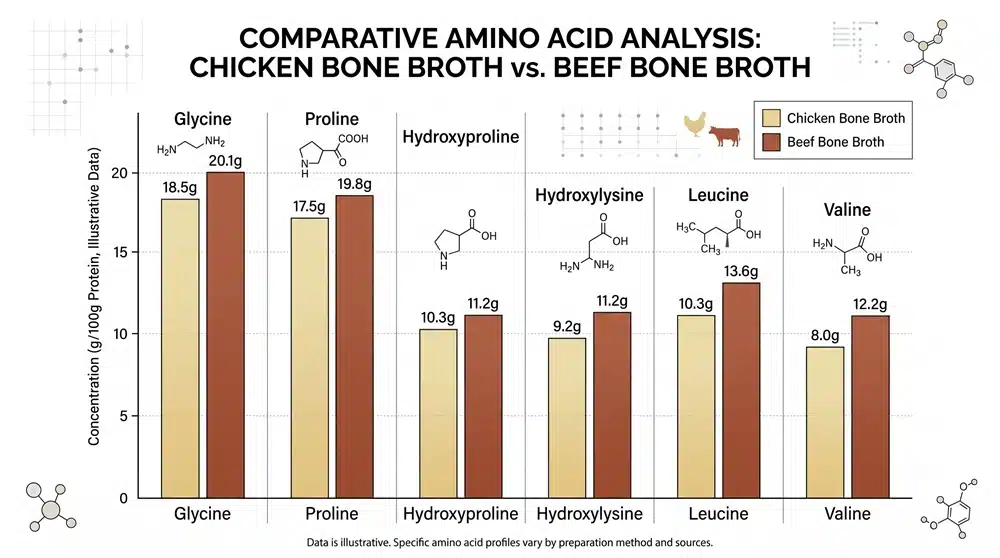
In vielen Artikeln wird der Vergleich vereinfacht, indem behauptet wird: “Hühnerbrühe ist gut für die Gelenke” und “Rinderbrühe ist gut für Darm und Haut”. Das ist zwar als grobe Orientierung hilfreich, reicht aber für die Zusammensetzung von Nahrungsergänzungsmitteln nicht aus. Eine 2019 von Shaw und Flynn durchgeführte Analyse handelsüblicher Knochenbrühen quantifizierte 19 Aminosäuren in Proben von Rind-, Hühner- und Putenknochenbrühe und zeigte, dass das endgültige Aminosäureprofil von gängigen Marketingannahmen abweichen kann.
So wiesen beispielsweise in den analysierten handelsüblichen Proben Hühnerknochenbrühe etwas höhere Gehalte an Glycin, Prolin, Hydroxyprolin, Leucin, Isoleucin und Valin auf als Rinderknochenbrühe, während Rinderknochenbrühe einen etwas höheren Gehalt an Hydroxylysin aufwies. Das bedeutet nicht, dass jede Hühnerbrühe besser ist. Es bedeutet vielmehr, dass die tierische Herkunft allein kein verlässliches Kriterium ist. Für Hersteller von Nahrungsergänzungsmitteln lautet die richtige Frage nicht nur “Huhn oder Rind?”, sondern “Was geht aus dem chargenspezifischen Analysezertifikat (COA) hervor?”
| Aminosäure, mg/g Produkt | Rinderknochenbrühe | Hühnerknochenbrühe | Praktische Auslegung |
|---|---|---|---|
| Glycin | 3,709 ± 0,059 | 4,063 ± 0,027 | Der Gehalt an Hühnerfleisch war in dieser Stichprobe höher; bitte anhand des Analysezertifikats überprüfen. |
| Proline | 2,211 ± 0,034 | 2,440 ± 0,078 | In dieser Stichprobe war der Anteil an Hühnerfleisch höher; dies ist für die Kollagenverteilung von Bedeutung. |
| Hydroxyprolin | 1,967 ± 0,314 | 2,158 ± 0,017 | In dieser Stichprobe wies Hühnerfleisch einen höheren Gehalt auf; dies ist als Kollagenmarker nützlich. |
| Hydroxylysin | 0,285 ± 0,006 | 0,276 ± 0,003 | Der Rindfleischanteil war in dieser Stichprobe etwas höher. |
| Leucin | 0,726 ± 0,011 | 1,053 ± 0,036 | Hühnerfleisch hatte zwar einen höheren Gehalt, aber Knochenbrühe ist dennoch kein vollwertiges Sportprotein. |
| Valin | 0,487 ± 0,008 | 0,645 ± 0,022 | Der Gehalt an Hühnerfleisch war höher, was die Notwendigkeit einer vollständigen Aminosäureanalyse untermauert. |
Quellenangabe: Die Werte stammen aus Shaw & Flynn (2019) und basieren auf Proben von handelsüblicher Knochenbrühe. Sie sollten als Beispiel aus einer veröffentlichten Analyse zitiert werden, nicht als allgemeingültige Garantie für jedes Produkt.
Gemeinsamkeiten und Unterschiede in Hühner- vs. Rinderknochenbrühe Vorteile für die Gesundheit?

Beide Brühen haben einen gemeinsamen Kern von Vorteilen, aber ihre einzigartigen Nährstoffprofile geben jeder einige deutliche Vorteile.
Geteilte Vorteile
- Gesundheit des Darms: Die Gelatine und die Aminosäuren in beiden Brühen tragen zur Reparatur der Darmschleimhaut bei und können so Probleme wie das Leaky-Gut-Syndrom lindern. Dies macht sie zu wertvollen Nahrungsergänzungsmitteln für die Verdauungsgesundheit.
- Gelenkgesundheit: Kollagen unterstützt den Knorpel und das Bindegewebe, was Gelenkschmerzen und Steifheit verringern kann.
- Gesundheit der Haut: Kollagen erhöht die Elastizität und den Feuchtigkeitsgehalt der Haut und kann Falten reduzieren.
- Unterstützung des Immunsystems: Nährstoffe wie Aminosäuren und Mineralien stärken das Immunsystem und helfen bei der Bekämpfung von Erkältungen und Infektionen.
Einzigartige Vorteile
Hühnerknochenbrühe:
- Gelenkgesundheit: Reich an Hühnerkollagen Typ II, ist es besonders wirksam für die Gesundheit der Gelenke. Eine Studie veröffentlicht in Nährstoffe stellte fest, dass Typ-II-Kollagen Knieschmerzen bei Patienten mit Arthrose lindern kann.
- Gesundheit der Haut: Der gleiche Kollagentyp kann die Hautfeuchtigkeit verbessern und Falten reduzieren, was ihn zu einem natürlichen Schönheitsbooster macht.
- Erholung der Muskeln: Der höhere BCAA-Gehalt unterstützt das Muskelwachstum und die Muskelreparatur, ideal für Sportler und Sporternährungsbewusste.
Rinderknochenbrühe:
- Gesundheit des Darms: Ein höherer Glycingehalt fördert die Produktion von Magensäure und die Reparatur der Darmschleimhaut, was es zu einem Top-Produkt für das Wohlbefinden der Verdauung macht.
- Schlaf und Laune: Glycin kann die Einschlafzeit verkürzen und die Schlafqualität verbessern, während es gleichzeitig den Serotoninspiegel erhöht und so für eine bessere Stimmung sorgt.
- Energieniveaus: Die dichteren Knochen liefern mehr Mineralien, die die Energie und die allgemeine Ernährung verbessern können.
Diese Vorteile hängen von Faktoren wie Knochenqualität und Kochzeit ab. Mit Gras gefütterte oder auf der Weide gehaltene Knochen ergeben oft eine nährstoffreichere Brühe.
Geschmack und kulinarische Verwendungsmöglichkeiten von Hühner- und Rinderknochenbrühe
Der Geschmack kann ein entscheidender Faktor bei der Wahl zwischen Hühner- und Rinderknochenbrühe. So sehen sie im Vergleich aus:
- Hühnerknochenbrühe: Sein leichter, delikater Geschmack macht ihn zu einem Chamäleon in der Küche. Verwenden Sie ihn in Suppen, Soßen, Risottos oder sogar Smoothies, um einen Nährstoffschub zu erhalten, ohne andere Zutaten zu überlagern. Mit einer Prise Salz und Pfeffer lässt er sich auch gut trinken.
- Rinderknochenbrühe: Er ist kräftig und herzhaft und eignet sich perfekt für kräftige Gerichte wie Rindfleischeintopf, Chili oder französische Zwiebelsuppe. Sein reichhaltigerer Geschmack ist vielleicht weniger vielseitig für leichtere Rezepte, aber er glänzt in Komfortgerichten.
Ich habe festgestellt, dass Hühnerknochenbrühe mein Favorit für schnelle Suppen unter der Woche ist, während Rinderknochenbrühe meine Wochenendrezepte im Langsamkocher aufwertet. Ihre Wahl hängt davon ab, ob Sie ein subtiles oder starkes Geschmacksprofil bevorzugen.
Ist es besser, sie gemeinsam zu verwenden?
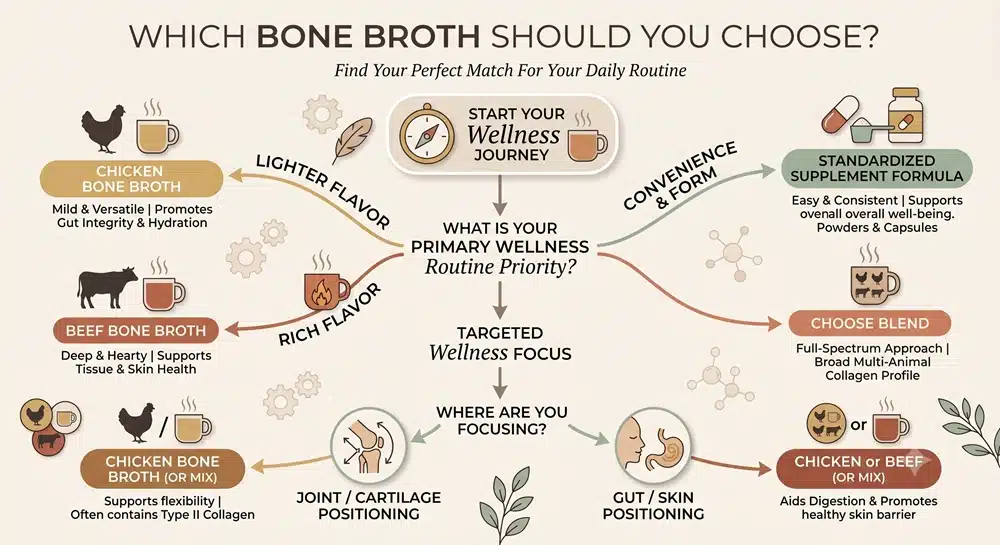
Warum wählen, wenn man beides haben kann? Die Kombination von Hühner- und Rinderknochenbrühe kann eine ausgewogene Mischung von Nährstoffen bieten. So erhalten Sie beispielsweise das gelenkunterstützende Typ-II-Kollagen vom Huhn und das darmheilende Glycin vom Rind. Dieser Ansatz ist wie die Schaffung eines benutzerdefinierte Formel für Ihre Gesundheit, die das Beste aus beiden Welten vereint.
In der Praxis kann man Hühnerknochenbrühe für leichtere Gerichte und Rinderknochenbrühe für deftigere Gerichte verwenden oder sie in Rezepten mischen, um einen nuancierten Geschmack zu erzielen. Einige Unternehmen bieten sogar gemischte Knochenbrüheprodukte an, die oft mit dem Hinweis vermarktet werden, dass sie Kollagenpeptid aus Rinderknochen für zusätzliche gesundheitliche Vorteile.
Letztlich hängt die Entscheidung von Ihren Zielen ab. Wenn es Ihnen um die Gesundheit der Gelenke geht, sollten Sie sich für Huhn entscheiden. Für die Darmgesundheit oder einen besseren Schlaf sollten Sie Rindfleisch wählen. Wenn Sie wie ich die Abwechslung lieben, sollten Sie beides in Ihrer Speisekammer haben, um verschiedene Rezepte und gesundheitliche Bedürfnisse zu erfüllen.
Aus Sicht des Herstellers: Wie man die Qualität von Knochenbrühepulver bewertet
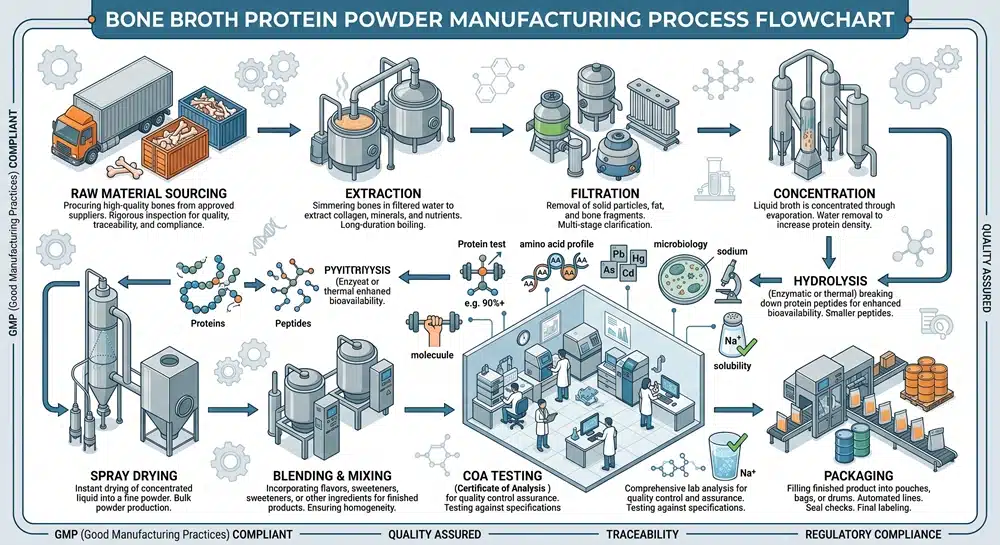
Für Verbraucher hängt die Wahl zwischen Hühner- und Rinderknochenbrühe möglicherweise vom Geschmack und den gesundheitlichen Zielen ab. Für Hersteller von Nahrungsergänzungsmitteln ist die Entscheidung eher technischer Natur. Ein hochwertiges Knochenbrühepulver sollte anhand der Rückverfolgbarkeit der Herkunft, des Aminosäureprofils, des Proteingehalts, des Aschegehalts, des Natriumgehalts, der Löslichkeit, der Geschmacksmaskierung, der mikrobiologischen Grenzwerte und der Schwermetalluntersuchungen bewertet werden.
In der industriellen Produktion werden Knochen und Bindegewebe extrahiert, gefiltert, konzentriert und häufig durch Sprühtrocknung zu Pulver verarbeitet. Ein gut kontrollierter Prozess sollte die Proteinqualität bewahren und gleichzeitig überschüssiges Fett entfernen, Gerüche unterdrücken und die Stabilität des fertigen Pulvers in Behältern, Beuteln, Kapseln oder funktionellen Getränkemischungen gewährleisten.
| Qualitätsmetrik | Was Sie den Lieferanten fragen sollten | Warum es wichtig ist |
|---|---|---|
| Rohstoffquelle | Rinder aus Weidehaltung, Hühner aus Freilandhaltung, Angabe „ohne Antibiotika“, Herkunftsland, Tiergesundheitsnachweise. | Unterstützt Angaben auf dem Etikett, Rückverfolgbarkeit und die Positionierung als Premiumprodukt. |
| Protein- und Aminosäureprofil | Proteingehalt nach Kjeldahl oder Dumas; vollständiges Aminosäure-Analysezertifikat einschließlich Glycin, Prolin, Hydroxyprolin, Leucin, Valin und Isoleucin. | Verhindert vage Angaben zu Kollagen und trägt zur Genauigkeit der Rezeptur bei. |
| Asche und Natrium | Gesamtaschegehalt, Natrium pro Portion, Kalzium, Magnesium, Kalium, Phosphor. | Ein hoher Asche- oder Natriumgehalt kann ein Produkt zwar “mineralreich” erscheinen lassen, jedoch die Verbraucherfreundlichkeit beeinträchtigen. |
| Hydrolyse und Löslichkeit | Hydrolysegrad, Molekulargewichtsverteilung, Instantisierung, Dispergierbarkeit und Sedimentationsprüfung. | Unverzichtbar für anrührfertige Pulver, Portionsbeutel, Kaffeeweißer, Suppen und Stickpacks. |
| Schwermetalle | ICP-MS-Untersuchungen auf Chargenebene auf Blei, Cadmium, Arsen und Quecksilber. | Tierknochen können auf natürliche Weise Umweltschadstoffe anreichern, daher sind Tests für die Vertrauensbildung unerlässlich. |
| Mikrobiologie | Gesamtkeimzahl, Hefen und Schimmelpilze, E. coli, Salmonellen, Staphylococcus aureus und Coliforme. | Erforderlich für haltbare Pulver und für die weltweite Exportdokumentation. |
| Sensorisches Profil | Farbe, Geruch, Geschmack, Nachgeschmack und Maskierbarkeit. | Gibt an, ob die Zutat in Vanille-, Schokoladen-, Kaffee-, Suppen- oder herzhaften Rezepturen verwendet werden kann. |
Eigene Knochenbrühe herstellen
Möchten Sie sich selbst an der Herstellung von Knochenbrühe versuchen? Es ist einfacher als Sie denken, aber es braucht Zeit. Hier ist eine kurze Anleitung:
Hühnerknochenbrühe-Rezept
- Inhaltsstoffe2-3 Pfund Hühnerknochen (Karkasse, Hälse, Füße), 1 Zwiebel, 2 Karotten, 2 Stangen Sellerie, 2 Esslöffel Apfelessig, Kräuter (Lorbeerblätter, Thymian), Wasser.
- Schritte: Knochen in einen Topf oder langsamen Kocher geben, Gemüse, Essig und Kräuter hinzufügen. Mit Wasser bedecken. Zum Kochen bringen, dann 12-24 Stunden köcheln lassen. Abseihen und aufbewahren.
Rezept für Rinderknochenbrühe
- Inhaltsstoffe2-3 Pfund Rinderknochen (Mark, Haxen), 1 Zwiebel, 2 Karotten, 2 Selleriestangen, 2 Esslöffel Apfelessig, Kräuter, Wasser.
- Schritte: Optional die Knochen bei 400°F 30 Minuten lang rösten. In einen Topf geben, Gemüse, Essig und Kräuter hinzufügen. Mit Wasser bedecken. 24-48 Stunden köcheln lassen. Abseihen und aufbewahren.
Die Verwendung von qualitativ hochwertigen, mit Gras gefütterten oder auf der Weide gehaltenen Knochen gewährleistet eine nährstoffreiche Brühe ohne Zusatzstoffe.
Hausgemachte Brühe vs. industriell hergestelltes Knochenbrühe-Proteinpulver
Selbstgemachte Knochenbrühe eignet sich hervorragend zum Kochen und zum täglichen Genuss, ist jedoch nicht standardisiert. Zwei zu Hause zubereitete Chargen können sich hinsichtlich Proteingehalt, Natriumgehalt, Gelatinefestigkeit, Fettgehalt, Geschmack und Aminosäurekonzentration unterscheiden. Industriell hergestelltes Knochenbrühe-Proteinpulver ist auf Konsistenz ausgelegt: Der Hersteller kann jede Charge prüfen, den Feuchtigkeitsgehalt kontrollieren, das mikrobiologische Risiko verringern und ein Analysezertifikat (COA) für Proteine, Aminosäuren, Schwermetalle und mikrobiologische Parameter vorlegen.
- Wählen Sie selbstgemachte Brühe wenn Sie frischen Geschmack, kulinarische Vielseitigkeit und ein Kochritual mit Vollwertkost suchen.
- Wählen Sie Knochenbrühepulver wenn Sie eine genau dosierte Proteinmenge, eine lange Haltbarkeit, eine reproduzierbare Rezeptur und eine einfachere Anwendung in Nahrungsergänzungsmitteln benötigen.
- Wählen Sie eine Mischung aus Hähnchen und Rindfleisch Wenn das Ziel darin besteht, einen umfassenderen Überblick über die Positionierung von Kollagen zu geben: Hühnerfleisch für die Vermittlung von Informationen zu Knorpel und Typ-II-Kollagen und Rindfleisch für die Positionierung von Rinder-Typ-I- und -III-Kollagen.
FAQs
Was ist besser: Hühner- oder Rinderknochenbrühe?
Keine der beiden Varianten ist grundsätzlich besser. Hühnerknochenbrühe hat in der Regel einen milderen Geschmack und eignet sich gut für Rezepturen, bei denen der Schwerpunkt auf Knorpel liegt, während Rinderknochenbrühe reichhaltiger ist und sich gut für die Zufuhr von Rinderkollagen eignet. Für Hersteller von Nahrungsergänzungsmitteln hängt die bessere Wahl vom Analysezertifikat (COA) ab: Ergebnisse zu Protein, Aminosäuren, Natrium, Asche, mikrobiologischen Werten und Schwermetallen.
Welche Knochenbrühe hat das meiste Kollagen?
Rinderknochenbrühe wird oft als kollagenreich beworben, da Rinderknochen und Bindegewebe reichhaltige Quellen für Kollagen Typ I und III sind. Der Kollagengehalt in flüssiger Brühe ist jedoch sehr unterschiedlich. Auch Hühnerbrühe, die aus Füßen, Brustbein oder knorpelreichen Teilen hergestellt wird, kann einen hohen Gehalt an aus Kollagen gewonnenen Aminosäuren aufweisen. Überprüfen Sie die Angaben zu Eiweiß und Hydroxyprolin im Analysezertifikat (COA).
Ist Hühnerknochenbrühe besser zur Gewichtsabnahme geeignet?
Hühnerknochenbrühe kann bei Diäten zur Gewichtsregulierung hilfreich sein, da sie leicht, wärmend und herzhaft ist, oft kalorienarm ist und gleichzeitig etwas Eiweiß liefert. Sie führt jedoch nicht direkt zu einem Fettabbau. Die Gewichtsregulierung hängt nach wie vor von der Gesamtkalorienzufuhr, der Eiweißzufuhr, der körperlichen Aktivität und der konsequenten Einhaltung der Ernährungspläne ab.
Kann ich Hühnerknochenbrühe anstelle von Rinderknochenbrühe verwenden?
Ja, bei vielen Suppen, Soßen, Getreidegerichten und Getränken kann Hühnerknochenbrühe Rinderknochenbrühe ersetzen. Dabei ist mit einem milderen Geschmack und einer weniger ausgeprägten Röstnote zu rechnen. Bei kräftigen Gerichten wie Rindergulasch, Chili, Bratensoße oder französischer Zwiebelsuppe sorgt Rinderknochenbrühe in der Regel für ein vollmundigeres Aroma.
Ist Knochenbrühe dasselbe wie normale Hühner- oder Rinderbrühe?
Nicht ganz. Normale Brühe wird in der Regel kürzer gekocht und enthält möglicherweise mehr Fleisch als Knochen. Knochenbrühe wird typischerweise viel länger mit Knochen und Bindegewebe gekocht, wodurch mehr Gelatine und aus Kollagen gewonnene Aminosäuren extrahiert werden können. Die genauen Nährwerte hängen jedoch nach wie vor vom jeweiligen Rezept ab.
Sollte Knochenbrühepulver auf Schwermetalle untersucht werden?
Ja. Da Knochen Umweltstoffe anreichern können, sollten die Zutaten für Knochenbrühe auf Blei, Cadmium, Arsen und Quecksilber untersucht werden. Bei Nahrungsergänzungsmitteln sollten Sie ein chargenspezifisches Analysezertifikat (COA) anfordern, das vorzugsweise auf validierten Methoden wie ICP-MS basiert und zusätzlich mikrobiologische sowie Proteindaten enthält.
Ist Knochenbrühe ein vollständiges Protein?
Knochenbrühe kann zwar Protein liefern, doch aus Kollagen gewonnenes Protein enthält von Natur aus nur geringe Mengen bestimmter essenzieller Aminosäuren, insbesondere Tryptophan. Sie sollte keine vollwertigen Proteinquellen wie Molke, Rindfleischprotein, Eier, Milchprodukte, Fisch oder Hülsenfrüchte ersetzen, wenn das Ziel eine vollwertige Ernährung zum Muskelaufbau ist.
Können Marken Hühner- und Rinderknochenbrühe mischen?
Ja. Eine 1:1-Mischung oder eine maßgeschneiderte Mischung kann ein umfassenderes Bild der Kollagenzusammensetzung vermitteln, indem sie die Eigenschaften von Hühnerknorpel bzw. Typ-II-Kollagen mit denen von Rinderkollagen der Typen I und III kombiniert. Bei Eigenmarkenprodukten sollten Sie vor der endgültigen Festlegung der Rezeptur die Zielwerte für Geschmack, Löslichkeit, Natriumgehalt und Aminosäuren überprüfen.
Schlussfolgerung
Im Showdown von Hühnerknochenbrühe vs. RinderknochenbrüheEs gibt keinen klaren Gewinner - beide sind ernährungsphysiologische Kraftpakete mit einzigartigen Stärken. Hühnerknochenbrühe ist Ihr Verbündeter für die Gesundheit der Gelenke, eine strahlende Haut und die Regeneration der Muskeln, während Rinderknochenbrühe für die Gesundheit des Darms, Schlaf und Energie sorgt. Ob Sie sich für eine, beide oder eine Mischung entscheiden, hängt von Ihrem Geschmack, Ihren Gesundheitszielen und Ihrem Kochstil ab. Nehmen Sie also einen Becher, experimentieren Sie mit beiden und finden Sie heraus, welche Knochenbrühe Ihren Körper und Ihre Geschmacksknospen zum Singen bringt.
Referenzen
[1] Current target page – Chicken Bone Broth vs Beef Bone Broth: https://collagensei.com/chicken-bone-broth-vs-beef-bone-broth/
[2] Harvard Health – Savoring the benefits of bone broth: https://www.health.harvard.edu/diet-and-nutrition/savoring-the-benefits-of-bone-broth-worth-a-taste
[3] Shaw & Flynn, 2019 – Amino acid content of beef, chicken, and turkey bone broth: https://www.westmont.edu/sites/default/files/users/user1231/V19No4/Nick%20Flynn_final.pdf
[4] Alcock et al., 2019 – Bone broth unlikely to provide reliable concentrations of collagen precursors: https://pubmed.ncbi.nlm.nih.gov/29893587/
[5] Verywell Health – Bone broth benefits and limitations: https://www.verywellhealth.com/bone-broth-7967614
[6] FDA – Environmental contaminants in food and dietary supplements: https://www.fda.gov/food/chemical-contaminants-pesticides/environmental-contaminants-food
[7] FDA – Testing results for arsenic, lead, cadmium and mercury: https://www.fda.gov/food/environmental-contaminants-food/testing-results-arsenic-lead-cadmium-and-mercury
[8] NSF – Supplement and vitamin certification: https://www.nsf.org/consumer-resources/articles/supplement-vitamin-certification
[9] Hsu et al., 2017 – Essential and toxic metals in animal bone broths: https://pubmed.ncbi.nlm.nih.gov/28804437/
[10] Schwartz & Park, 2012 – Hydrolyzed chicken sternal cartilage extract: https://pubmed.ncbi.nlm.nih.gov/22956862/

Warren Wan ist ein versierter Experte mit umfassender Erfahrung in der Lieferkette für Nahrungsergänzungsmittel und verfügt über fundierte praktische Kenntnisse in den Bereichen Forschung, Entwicklung, Prozesskontrolle und weltweite Beschaffung von Kerninhaltsstoffen wie Kollagenpeptiden, Knochenbrüheprotein und Keratin. Als Autor dieser Kolumne hat er es sich zur Aufgabe gemacht, den Marketing-Hype zu durchschauen und komplexe wissenschaftliche Erkenntnisse über Inhaltsstoffe sowie Standards der Produktionsqualitätskontrolle in leicht verständliche, fundierte Wissenschaftspopularisierung zu verwandeln, um den Lesern zu helfen, die Wahrheit hinter den Etiketten zu erkennen und rationalere Gesundheitsentscheidungen zu treffen.