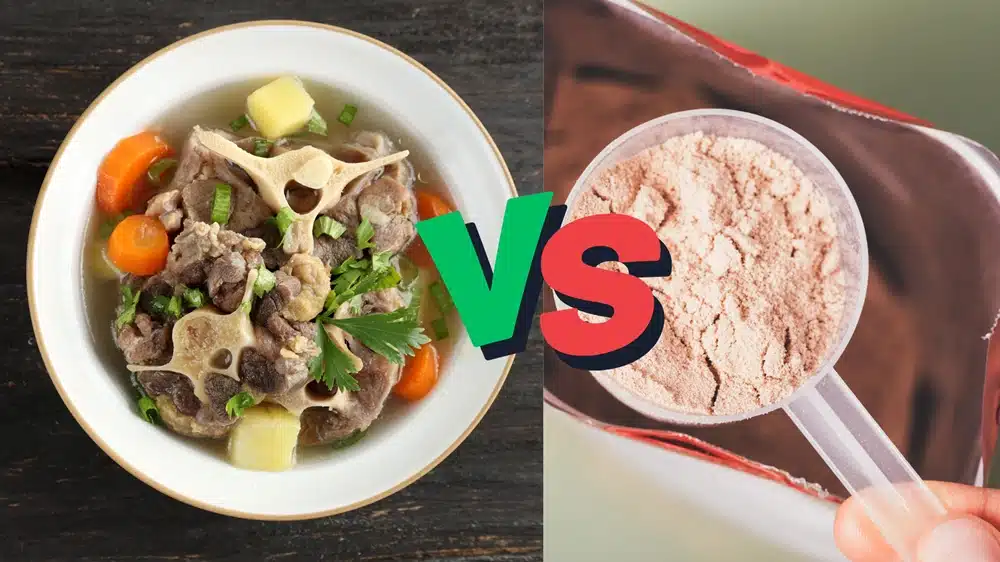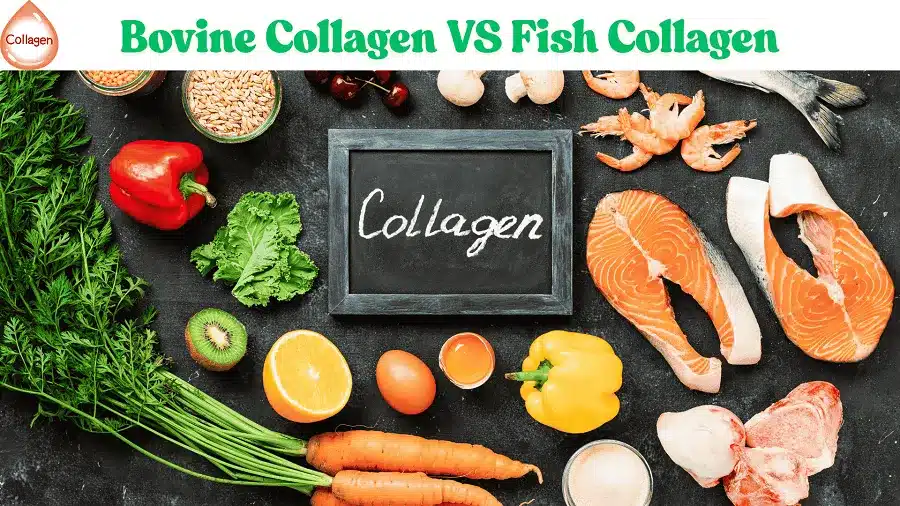
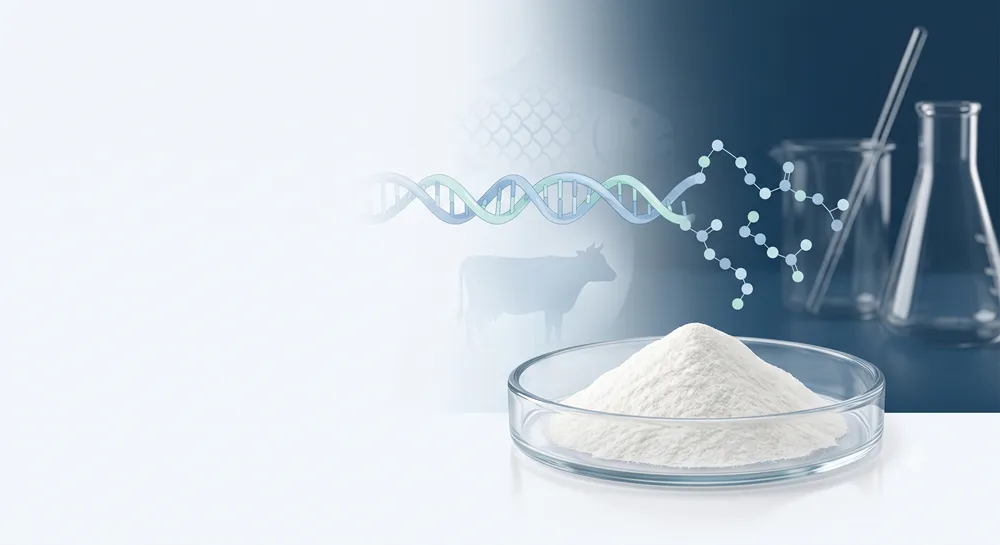
Collagen peptides are short chains of amino acids produced by breaking down collagen protein through a process called hydrolysis. They are commonly referred to as collagène hydrolysé ou collagen hydrolysate and are typically made from collagen-rich animal sources such as bovine hide, fish skin, porcine skin or poultry tissues.
Hydrolysis reduces large collagen proteins into smaller peptide fractions, creating an ingredient that is generally non-gelling, readily dispersible and suitable for powders, beverages, capsules, tablets, gummies and other nutritional products.
For consumers, that explains what the words “collagen peptides” on a supplement label mean.
For formulators and ingredient buyers, however, the name is only the beginning. Source, collagen type, molecular-weight distribution, protein content, solubility, taste, odor, testing and documentation can all differ between commercial collagen peptide ingredients.
Collagen Peptides at a Glance
| Question | Réponse rapide |
|---|---|
| What are collagen peptides? | Hydrolyzed fragments of collagen made up of shorter chains of amino acids. |
| Are collagen peptides the same as hydrolyzed collagen? | In most supplement contexts, yes. Hydrolysis is the process; collagen peptides are the resulting ingredient. |
| What are they made from? | Usually collagen-rich animal tissues from bovine, marine, porcine or poultry sources. |
| Are collagen peptides protein? | Yes, but their amino-acid profile differs from proteins such as whey, egg or soy. |
| Are collagen peptides vegan? | Conventional collagen peptides are animal-derived. Most “vegan collagen” products are collagen-support formulas rather than true collagen peptides. |
| Are all collagen peptides the same? | No. Source, peptide distribution, protein content, sensory properties, processing and quality specifications can vary significantly. |
| Where are they used? | Powders, drink mixes, capsules, tablets, gummies, functional foods and other nutritional formulations. |
Qu'est-ce que le collagène ?
Collagen is a structural protein found throughout animal connective tissues. In the human body, collagen contributes to the structure of skin, bones, cartilage, tendons, ligaments and other connective tissues.
Its structure is very different from that of a typical globular dietary protein.
Collagen is particularly rich in glycine, proline and hydroxyproline, amino acids associated with its characteristic triple-helix structure.
That large, highly organized structure is useful when collagen is functioning as structural material in tissue. But it is not the physical form typically selected for an instant collagen drink powder or most modern collagen supplements.
That is where hydrolysis comes in.
If you want a more detailed comparison of the intact protein and the hydrolyzed peptide form, see our guide to collagène vs peptides de collagène.
What Makes Collagen Peptides Different From Collagen?
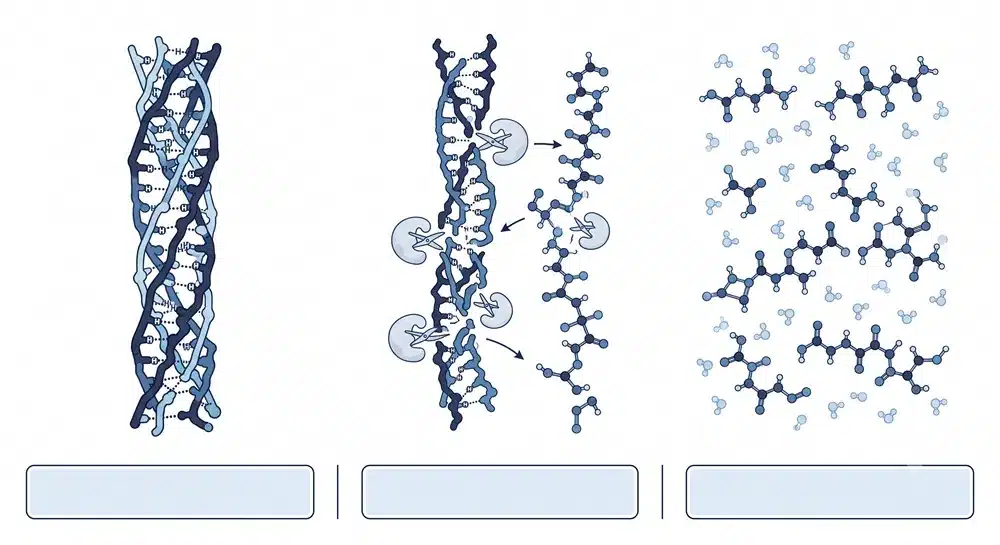
The simplest difference is protein structure and peptide size.
Native collagen contains long polypeptide chains arranged in a triple-helical structure.
Collagen peptides are produced when those larger collagen proteins are hydrolyzed into shorter peptide chains.
This change affects the physical behavior of the ingredient.
Commercial collagen peptides are generally selected for applications where formulators need properties such as:
- easier dispersion in liquids,
- little or no gelling,
- compatibility with powder and beverage systems,
- manageable taste and odor,
- and a defined peptide or molecular-weight profile.
However, “smaller” does not mean that every collagen peptide ingredient has the same molecular weight.
The final peptide distribution depends on the collagen source and the hydrolysis process, including enzyme selection and processing conditions. Research on collagen hydrolysates has shown that changes in peptide size can also influence properties such as solubility.
For a deeper terminology comparison, read Collagène hydrolysé ou peptides de collagène : s'agit-il de la même chose ?.
How Are Collagen Peptides Made?
Commercial collagen peptides are produced by converting collagen-rich raw material into a purified hydrolyzed peptide ingredient.
The exact manufacturing process varies by source and manufacturer, but a typical production pathway includes the following stages.
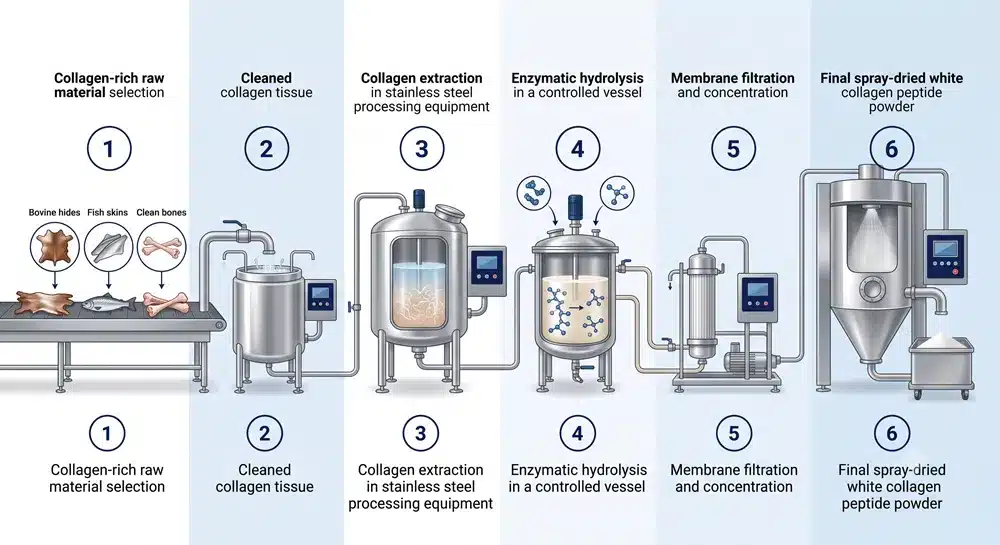
1. Raw Material Selection
Production starts with collagen-rich animal material.
Depending on the ingredient, this may include bovine hide, fish skin, porcine skin or selected poultry tissues.
Source selection matters because it affects ingredient positioning, collagen type, allergen considerations, religious or dietary requirements, supply-chain documentation and ultimately the finished product story.
2. Cleaning and Pretreatment
The raw material is cleaned and prepared to reduce unwanted fats, minerals and non-collagen components.
Pretreatment conditions depend heavily on the source material and extraction route.
3. Collagen Preparation or Extraction
Collagen-rich material is processed so that the structural protein can be further converted into a suitable hydrolysis substrate.
At this stage, the intact collagen structure is progressively altered.
4. Controlled Hydrolysis
This is the defining step in collagen peptide production.
Enzymes are commonly used to cleave longer protein chains into shorter peptide fractions.
The enzyme system, hydrolysis time, temperature, pH and other processing parameters can influence the resulting molecular-weight distribution and functional characteristics of the collagen hydrolysate.
Experimental work confirms that enzymatic treatment can produce distinctly different peptide-size distributions, while additional hydrolysis can alter the post-ingestion appearance of collagen-derived amino acids in the bloodstream.
5. Filtration and Purification
After hydrolysis, the liquid peptide solution is filtered and refined.
Depending on the process and product specification, manufacturers may use filtration, concentration and other purification steps before drying.
6. Drying and Powder Preparation
The purified collagen peptide solution is commonly dried into a stable powder.
The resulting ingredient may then be sieved, blended or further processed according to the intended application and specification.
For commercial buyers, the finished powder should be evaluated against the actual product specification and batch Certificate of Analysis rather than assumptions based only on the term “collagen peptides.”
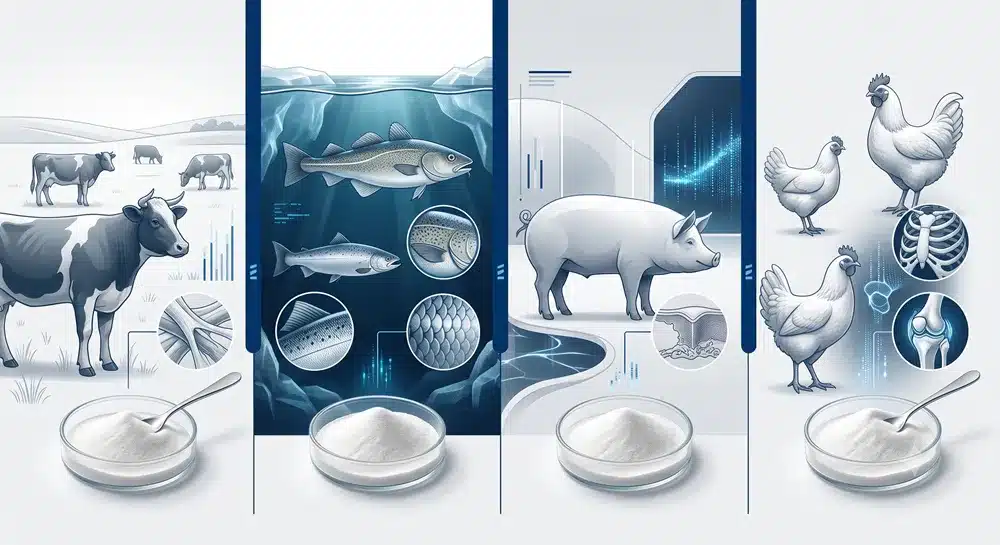
What Are Collagen Peptides Made From?
Collagen peptides are not one single raw material.
They can be produced from several collagen-rich animal sources, and each source creates a different sourcing and formulation context.
Research examining commercial collagen hydrolysates has included bovine, porcine and fish-derived materials, while other studies have produced peptide fractions from poultry collagen sources.
Peptides de collagène bovin
Bovine collagen peptides are commonly produced from cattle-derived collagen-rich tissues such as hide.
Commercial bovine collagen ingredients are frequently associated with Types I and III collagen positioning and are widely used in general collagen powders, beauty nutrition, sports nutrition and healthy-aging formulations.
Bovine collagen is attractive to many formulators because it can offer broad application flexibility and an established supply chain.
If you are evaluating a commercial bovine ingredient, see our Collagène bovin de type I et III page.
Peptides de collagène marin
Marine collagen peptides are made from fish-derived collagen-rich material, commonly fish skin and, depending on the ingredient, other fish tissues.
Marine collagen is commonly associated with Type I collagen and is particularly established in beauty-from-within, premium wellness and marine-source supplement positioning.
Fish source and species also introduce additional procurement questions, including allergen documentation, species declaration, sustainability requirements and sensory quality.
Gensei’s current Peptides de collagène marin page shows how a commercial marine collagen ingredient can be evaluated using batch protein data, molecular-weight specification, heavy-metal testing, microbiology and source documentation.
Porcine Collagen Peptides
Porcine skin is another established collagen source.
Its commercial suitability depends on the market and target customer because religious, cultural and labeling requirements can make porcine-derived ingredients unsuitable for some formulations.
That means ingredient source must always be confirmed rather than assuming all collagen peptide powders are interchangeable.
Poultry-Derived Collagen
Poultry tissues can also supply collagen ingredients.
Chicken cartilage and sternum-derived materials are particularly associated with Type II collagen and joint-focused formulations, although not every poultry collagen ingredient should automatically be treated as equivalent to a standard hydrolyzed bovine or marine collagen peptide powder.
If your goal is to compare these sources in more detail, read our guide to comparing collagen peptides by source and type.
Can Collagen Peptides Be Vegan?
Conventional collagen peptides are animal-derived because collagen is an animal structural protein.
This creates an important distinction between true collagen peptides and products marketed as “vegan collagen.”
Most plant-based collagen products do not contain collagen peptides. Instead, they provide nutrients or ingredients intended to support the body’s own collagen synthesis, such as amino acids, vitamin C, minerals or botanical compounds.
Newer fermentation and biomimetic technologies are creating additional animal-free possibilities, but these should be evaluated product by product rather than assumed to be equivalent to hydrolyzed animal collagen.
For a full comparison, see The Pros and Cons of Vegan vs Animal-Based Collagen.
What Are Collagen Peptides Made Of at the Molecular Level?
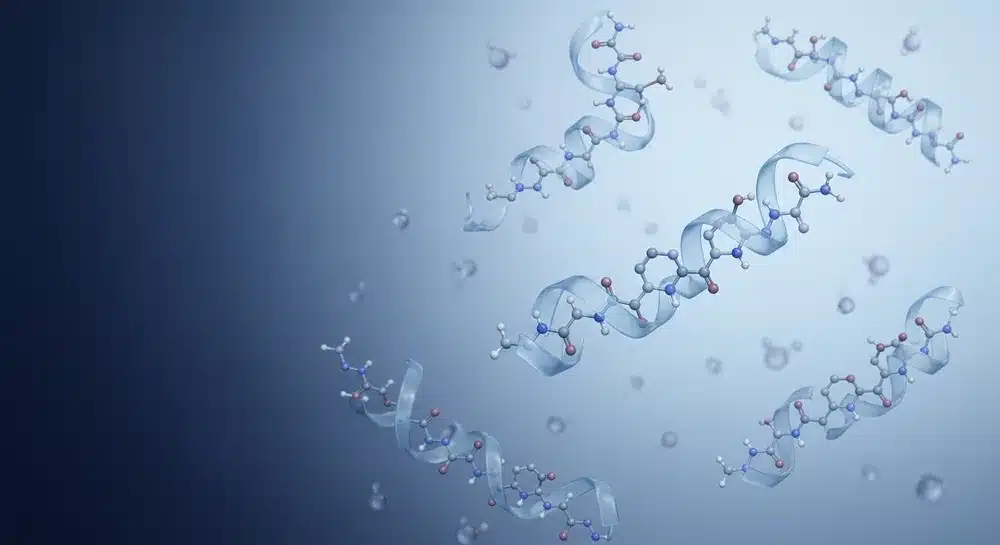
At the molecular level, collagen peptides are mixtures of shorter amino-acid chains derived from collagen.
They are not a single molecule with one fixed molecular formula.
Different collagen hydrolysates can contain different distributions of peptides and free amino acids depending on the source material and processing conditions.
Collagen-derived proteins are especially associated with:
Glycine — a major structural amino acid in collagen.
Proline — important to collagen’s characteristic sequence and structure.
Hydroxyproline — a collagen-associated amino acid that is frequently used in collagen research as a marker of collagen-derived peptides.
Human absorption studies show that after collagen hydrolysate is consumed, both free hydroxyproline and hydroxyproline-containing di- and tripeptides can be detected in plasma.
This is more accurate than saying that collagen powder simply travels intact from a scoop directly into the skin or joints.
What Are Bioactive Collagen Peptides?
“Bioactive collagen peptides” is a term used for collagen-derived peptide preparations that are positioned around particular peptide profiles or biological activity.
It should not be interpreted as a universal technical specification.
Two products described as bioactive collagen peptides may differ in source, average molecular weight, peptide distribution, dose, manufacturing process and supporting research.
That distinction is important because hydrolysis conditions influence which peptide fractions are produced.
Some collagen-derived di- and tripeptides can survive digestion and appear in human circulation after ingestion, but the quantity and profile can differ among preparations.
For consumers, the practical lesson is that “bioactive” should not automatically be treated as proof that one product is superior.
For brands and formulators, ask a more useful set of questions:
What peptide or molecular-weight profile is specified?
What dose was used in the supporting study?
Was the exact ingredient tested?
Does the supplier provide technical documentation supporting the positioning?
Collagen vs Gelatin vs Collagen Peptides
These terms are related, but they should not be treated as identical.
| Fonctionnalité | Collagène natif | Gélatine | Peptides de collagène |
|---|---|---|---|
| Protein structure | Large organized collagen structure | Denatured/partially hydrolyzed collagen | More extensively hydrolyzed peptide mixture |
| Molecular size | Large | Variable/intermediate | Lower peptide-size distribution |
| Gelling behavior | Not typically used as a standard gelling ingredient | Forms gels under suitable conditions | Generally non-gelling |
| Cold-water application | Limited for most supplement uses | Usually limited | Commonly selected for dispersible drink powders |
| Typical uses | Specialized collagen applications | Gummies, foods, capsules, texture systems | Powders, drinks, capsules, tablets and nutrition products |
The important point is that hydrolysis changes functionality as well as terminology.
If you want the full comparison of collagen hydrolysate, gelatin and collagen peptides, see Collagène hydrolysé ou peptides de collagène ?.
How Does the Body Digest and Absorb Collagen Peptides?
Collagen peptides are already hydrolyzed before consumption, but that does not mean they bypass digestion.
Once consumed, collagen-derived peptides continue through normal gastrointestinal digestion.
The resulting material can be absorbed as individual amino acids as well as some small peptides.
Human clinical studies have detected collagen-associated hydroxyproline-containing di- and tripeptides in plasma after collagen hydrolysate ingestion. A 2024 randomized crossover study comparing fish-, porcine- and bovine-derived collagen hydrolysates also found relevant circulating collagen-derived metabolites across the tested sources and molecular-weight profiles.
This is why statements such as “collagen goes directly to the skin” are misleading.
The biological process is more complex. Collagen hydrolysate supplies amino acids and peptide metabolites, which are then processed and used within the body’s broader metabolic system.
Are Collagen Peptides Protein?
Yes. Collagen peptides are protein-derived ingredients and contribute protein and amino acids.
However, their amino-acid profile is quite different from muscle-oriented complete proteins such as whey, egg or some balanced protein blends.
Collagen is particularly rich in glycine, proline and hydroxyproline, but it is not generally positioned as a complete replacement for a balanced dietary protein source.
That distinction matters when a product is being formulated for sports nutrition or when consumers are counting total protein intake.
We explain the issue in more detail in Les peptides de collagène comptent-ils comme des protéines ?.
What Are Collagen Peptides Used For?
Collagen peptides are used across a wide range of nutritional and functional formulations.
Common product categories include beauty-from-within supplements, joint and mobility products, healthy-aging formulas, sports and connective-tissue nutrition, daily collagen powders and multi-ingredient wellness products.
The level of evidence is not identical for every proposed benefit, every collagen source or every commercial ingredient.
For that reason, brands should avoid assuming that every health claim associated with “collagen” automatically applies to every collagen peptide product.
Ingredient-specific evidence, dose, population, source and finished-product claims should be evaluated separately.
Research has investigated collagen peptides for skin, joint, bone and exercise-related outcomes, although the evidence is not equally strong for every claimed benefit. Read our full guide to the benefits of collagen peptides and what current research actually supports.
What Forms Do Collagen Peptides Come In?
Because hydrolyzed collagen peptides are commonly supplied as powders, they can be incorporated into a variety of finished dosage forms.
Poudre de peptides de collagène
Powder is one of the most common formats because it can accommodate gram-level serving sizes and can be used in tubs, pouches, sachets and stick packs.
Formulators typically evaluate solubility, bulk density, flowability, flavor compatibility, odor and serving size.
Beverages and Drink Mixes
Collagen peptides are frequently used in ready-to-mix drink powders and functional beverage concepts.
The final formula should be tested for dissolution, sediment, appearance, flavor interaction and processing stability rather than assuming all collagen peptide powders behave identically.
Gélules et comprimés
Solid-dose formats can be useful for collagen combinations and targeted formulas, although the relatively high serving size of many collagen peptide products can limit how much collagen can realistically be delivered in a small number of capsules or tablets.
Bonbons gélifiés et comprimés à croquer
Collagen can also be included in gummy or chewable concepts, but ingredient loading, sensory profile, moisture and processing conditions need to be evaluated during product development.
How Do Collagen Sources and Specifications Differ?
A label that says “collagen peptides” does not tell you everything about the ingredient.
Commercial collagen peptide products can differ in:
| Spécifications | Pourquoi c'est important |
|---|---|
| Source | Bovine, marine, porcine or poultry positioning |
| Species / tissue origin | Traceability, allergen and market requirements |
| Type de collagène | Relevant to source and product positioning |
| Teneur en protéines | Basic composition and formulation calculations |
| Distribution des masses moléculaires | Helps characterize the peptide ingredient |
| Hydroxyproline / amino-acid profile | Supports identity and compositional review |
| Solubilité | Important for powders and beverages |
| Goût et odeur | Major consideration for consumer experience |
| Couleur | Can affect clear or lightly flavored formulas |
| Densité apparente | Relevant to serving size, flow and packaging |
| Microbiologie | Supplier qualification and quality control |
| Métaux lourds | Particularly important for ingredient safety |
| Allergen status | Especially relevant to fish-derived ingredients |
| COA and specification | Required for batch and supplier qualification |
Research also shows why molecular weight should not be treated only as a marketing number: altering collagen hydrolysate molecular weight can change properties such as solubility, while human absorption data do not support the simple assumption that the lowest molecular-weight product is automatically superior in every context.
For Formulators: What Defines a Good Collagen Peptide Ingredient?

For supplement brands, contract manufacturers and product developers, choosing a collagen ingredient should go beyond the words printed on the front of a specification sheet.
Start with the product you are trying to build.
A beauty powder, for example, may prioritize sensory quality, solubility, source story and compatibility with vitamin C or other beauty ingredients.
A marine collagen drink may need stronger control over fish odor, allergen documentation and species declaration.
A capsule or tablet project may care more about bulk density, serving-size feasibility and combination with other active ingredients.
A commercial sourcing review should therefore consider three layers at the same time:
Identité des ingrédients — source, collagen type, peptide profile and composition.
Formula performance — solubility, taste, odor, color, processing and dosage-form compatibility.
Qualification des fournisseurs — COA, specification, testing, traceability, packaging, MOQ, lead time and regulatory documentation.
If you are sourcing raw materials rather than simply learning about collagen, explore Gensei’s bulk collagen peptides supplier page.
You can also review source-specific options including Peptides de collagène marin et Collagène bovin de type I et III.
Frequently Asked Questions About Collagen Peptides
What are collagen peptides in simple terms?
Collagen peptides are collagen proteins that have been broken into shorter chains of amino acids through hydrolysis. They are the form commonly used in collagen powders, drink mixes and many nutritional supplements.
Le collagène hydrolysé, c'est la même chose que les peptides de collagène ?
Usually, yes. In supplement terminology, “hydrolyzed collagen,” “collagen hydrolysate” and “collagen peptides” commonly describe the same general ingredient category. Hydrolysis describes the processing step; collagen peptides describes the resulting peptide ingredient.
Read the full explanation in Collagène hydrolysé ou peptides de collagène ?.
What are collagen peptides made from?
Conventional collagen peptides are made from collagen-rich animal tissues. Common commercial sources include bovine, marine, porcine and poultry materials.
Are marine and bovine collagen peptides the same?
No. Both can be hydrolyzed collagen peptide ingredients, but their source, collagen-type positioning, allergen considerations, sensory characteristics, documentation and commercial specifications can differ.
See our full collagen source and type comparison.
Are collagen peptides vegan?
Conventional collagen peptides are not vegan because collagen is an animal protein. Many products labeled “vegan collagen” are actually collagen-support formulations rather than true collagen peptides.
Read our Vegan vs Animal-Based Collagen Guide for more detail.
Les peptides de collagène sont-ils considérés comme des protéines ?
Yes. Collagen peptides contribute protein and amino acids, but they have a different amino-acid profile from complete proteins such as whey and should not automatically be treated as an equivalent replacement.
See Les peptides de collagène comptent-ils comme des protéines ?.
Are all collagen peptide powders the same?
No. Collagen peptide powders can differ in animal source, collagen type, molecular-weight distribution, protein content, solubility, sensory profile, bulk density, quality specifications and testing.
This is particularly important for supplement manufacturers because two ingredients carrying the same general label can perform differently in a finished formula.
What should supplement brands request before buying collagen peptides?
At minimum, buyers should review the current product specification and batch COA together with relevant source, allergen, microbiological, heavy-metal and safety documentation.
For formulation projects, it is also useful to evaluate a sample for solubility, taste, odor, color, flowability and compatibility with the intended dosage form.
From Collagen Science to Commercial Ingredient Selection
Understanding what collagen peptides are is only the first step.
At the consumer level, collagen peptides are simply hydrolyzed fragments of collagen protein.
At the formulation level, they are complex commercial ingredients whose source, peptide profile, physical properties and quality documentation determine how well they fit a finished product.
That is why the better question is not simply:
“Are collagen peptides good?”
C'est :
“Which collagen peptide ingredient is appropriate for this specific product, dose, market and formulation?”
Continue exploring:
Comparer les peptides de collagène selon leur origine et leur type
Collagène ou peptides de collagène
Collagène hydrolysé ou peptides de collagène ?
Bulk Collagen Peptides Supplier
Références scientifiques
Virgilio N, et al. Absorption of bioactive peptides following collagen hydrolysate intake: a randomized, double-blind crossover study in healthy individuals. Frontiers in Nutrition. 2024.
Alcock RD, et al. Enzymatic Hydrolysis of a Collagen Hydrolysate Enhances Postprandial Absorption Rate—A Randomized Controlled Trial. Nutrients. 2019.
Yamauchi A, et al. Absorption and Urinary Excretion of Peptides after Collagen Tripeptide Ingestion in Humans.
Shigemura Y, et al. Dose-dependent changes in the levels of free and peptide forms of hydroxyproline in human plasma after collagen hydrolysate ingestion. Food Chemistry. 2014.

Warren Wan est un expert chevronné qui possède une vaste expérience dans la chaîne d’approvisionnement des compléments alimentaires, ainsi qu’une solide expertise pratique dans la recherche, le développement, le contrôle des processus et l’approvisionnement mondial d’ingrédients clés tels que les peptides de collagène, les protéines de bouillon d’os et la kératine. En tant qu'auteur de cette chronique, il s'attache à aller au-delà des discours marketing pour transformer les notions scientifiques obscures relatives aux ingrédients et les normes de contrôle qualité de la production en une vulgarisation scientifique rigoureuse et accessible, aidant ainsi les lecteurs à comprendre la vérité qui se cache derrière les étiquettes et à faire des choix plus rationnels en matière de santé.