Quick Answer
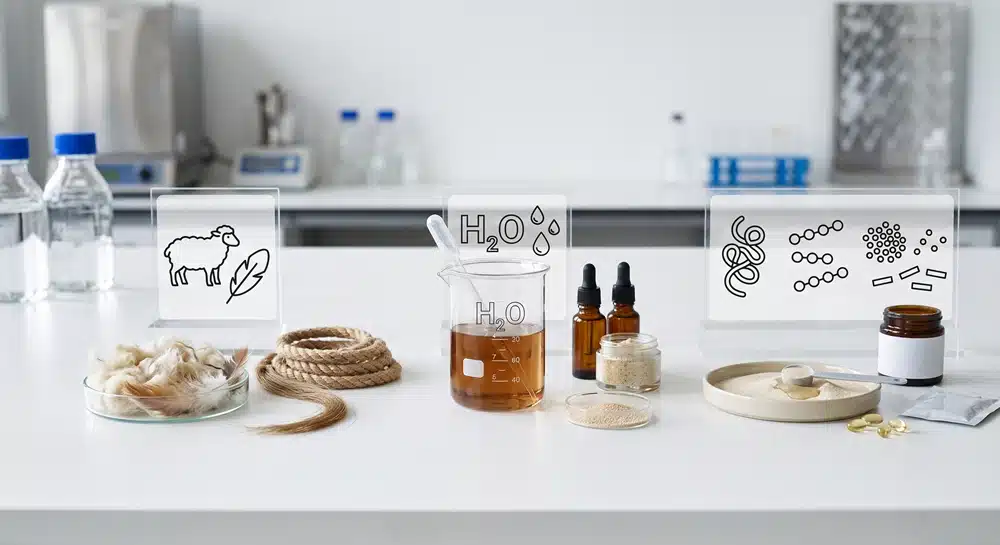
Keratin protein powder is a protein-based ingredient made from keratin-rich animal materials such as feathers or wool. Native keratin is highly cross-linked and difficult to dissolve, so supplement and formulation applications generally rely on hydrolyzed keratin or keratin peptides, in which the protein has been broken into smaller, more manageable fractions. For B2B buyers, the ingredient name alone is not enough: source, protein content, molecular-weight distribution, solubility, microbiological limits, heavy metals, odor, and supporting documentation all matter.
If you are evaluating keratin for a finished formula, compare the actual specification rather than assuming every “keratin powder” is equivalent. A hydrolyzed keratin peptide powder with defined peptide characteristics can behave very differently from a minimally processed keratin material.
What Is Keratin Protein Powder?
Keratin is a fibrous structural protein found in hair, nails, feathers, wool, horns, hooves, and the outer layers of skin. Its strength comes partly from extensive cross-linking, including disulfide bonds formed by sulfur-containing amino acids. That strong structure is useful biologically, but it also makes native keratin resistant to water and difficult to process.
The term “keratin protein powder” is used broadly in the market. Depending on the supplier, it may refer to extracted keratin, keratin hydrolysate, hydrolyzed keratin, soluble keratin, or smaller keratin-derived peptides. These terms should not be treated as interchangeable without reviewing the technical specification.
For supplement brands, the practical question is usually not whether an ingredient contains keratin, but whether the keratin has been processed into a form that fits the intended dosage form, stability requirements, sensory profile, documentation needs, and destination-market regulatory strategy.
Keratin Protein Powder vs Hydrolyzed Keratin: What Is the Difference?
| Factor | Native / Less-Hydrolyzed Keratin | Hydrolyzed Keratin / Keratin Peptides |
| Protein structure | Larger, highly cross-linked protein structures | Protein broken into smaller peptide fractions |
| Water behavior | Often poorly soluble or dispersible | Solubility/dispersibility is generally improved, depending on hydrolysis |
| Formulation flexibility | More limited | Better suited to many supplement or cosmetic systems |
| Typical applications | Specialty industrial, research, biomaterial, or selected formulations | Beauty-from-within, capsules, tablets, powders, topical hair-care and cosmetic systems |
| Key purchasing metrics | Source, purity, extraction method | Source, protein %, molecular-weight distribution, solubility, odor, microbiology, heavy metals |
Hydrolysis does not automatically make one keratin ingredient “better” than another. It changes the material. The degree and method of hydrolysis can affect molecular size, solubility, taste, odor, processing behavior, and the way the ingredient is positioned in a finished product.
Where Does Keratin Protein Powder Come From?
Commercial keratin can be recovered from keratin-rich animal by-products, including poultry feathers and wool. The exact source should always be verified from supplier documentation because source material affects traceability, labeling, allergen review, religious or ethical positioning, and destination-market suitability.
Do not assume that a material marketed simply as “keratin powder” is suitable for dietary supplements. Cosmetic-grade, feed-grade, research-grade, and food/supplement-intended materials may have different manufacturing controls and documentation packages.
Is Keratin Protein Powder Vegan?
True keratin is an animal structural protein. Products marketed as “vegan keratin” are generally plant-derived amino-acid or protein systems designed to mimic some functional properties of keratin rather than animal-derived keratin itself. For a vegan claim, brands should verify the ingredient composition and supporting certification instead of relying on the marketing name alone.
How Hydrolysis Changes Keratin
Native keratin is difficult to solubilize because of its dense, cross-linked structure. Hydrolysis processes disrupt part of that structure and can cleave larger proteins into smaller fragments. Chemical, enzymatic, microbial, hydrothermal, and other extraction approaches have been studied, and they can produce keratin hydrolysates with very different molecular-weight profiles.
For formulators, this is why molecular-weight distribution is more useful than vague statements such as “high absorption” or “high bioavailability.” A supplier should be able to explain how the ingredient is characterized and provide a specification appropriate to the intended application.
How Is Hydrolyzed Keratin Powder Used?
Dietary Supplements and Beauty-From-Within Formulas
Hydrolyzed keratin may be used in capsules, tablets, stick packs, powdered beauty blends, and multi-ingredient hair-skin-nail formulas. It is often paired with nutrients or proteins that fit the same product concept, but formulation decisions should be based on the finished serving size, evidence, sensory profile, and label-claim strategy rather than ingredient popularity alone.
Brands developing a dry blend can also evaluate powder supplement manufacturing requirements such as blend uniformity, flavor masking, flowability, fill weight, packaging, and stability.
Hair-Care and Cosmetic Applications
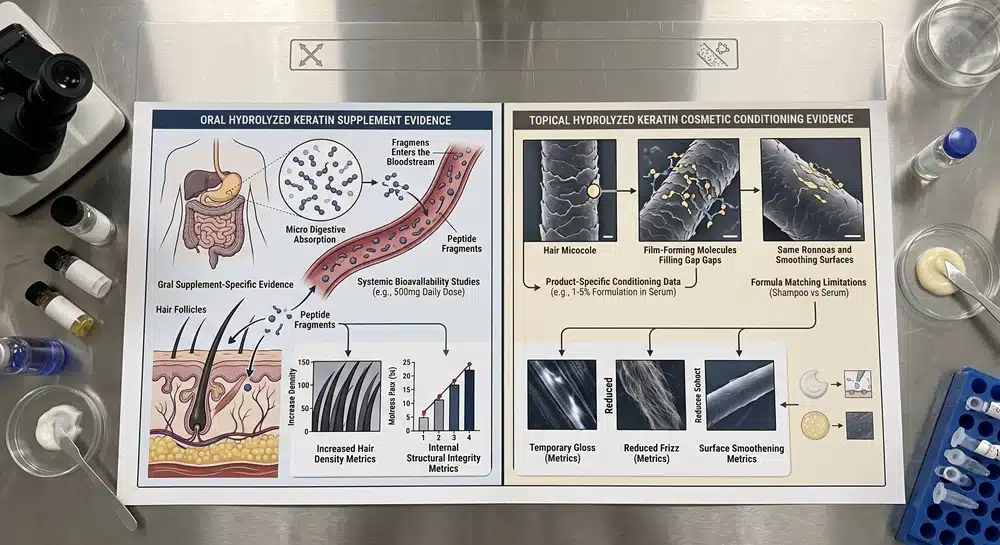
Keratin hydrolysates are also used topically in shampoos, conditioners, masks, leave-in products, and other hair-care systems. Research on keratin hydrolysates suggests that peptide size and formulation can influence how protein fractions interact with hair fibers. These cosmetic effects should not be described as permanent biological repair.
For a deeper topical-use discussion, see the guide to hydrolyzed keratin for hair.
What Does the Human Evidence Say About Oral Keratin?
Human evidence for oral keratin is still limited and should be interpreted ingredient by ingredient. One randomized, double-blind, placebo-controlled study in 50 women evaluated a specific branded formula containing 500 mg of keratin plus vitamins and minerals for 90 days and reported improvements in measured hair and nail parameters. A separate trial with the same branded multi-ingredient system examined skin outcomes.
These studies are useful signals, but they do not prove that every generic keratin powder will produce the same results. The studied product was a specific soluble keratin formulation combined with other nutrients. Therefore, marketers should avoid translating those results into universal claims for unrelated raw materials.
Evidence Strength by Application
| Application | Evidence Perspective | Recommended Content Language |
| Oral hair and nail support | Limited human evidence for specific soluble keratin formulations | “Studied in specific formulations”; avoid universal efficacy claims |
| Oral skin support | Limited human evidence; small study and formulation-specific | Use cautious, formulation-specific wording |
| Topical hair conditioning | Laboratory/cosmetic evidence supports interaction with hair fibers | Describe cosmetic conditioning, surface feel, breakage-related or manageability outcomes carefully |
| Disease treatment / hair-loss treatment | Not established for generic keratin powders | Do not claim to diagnose, treat, cure, or prevent disease |
Keratin Protein Powder vs Collagen Peptides
| Factor | Keratin Peptides | Collagen Peptides |
| Native structural role | Prominent in hair, nails and keratinized tissues | Major structural protein in connective tissues |
| Amino-acid profile | Relatively rich in sulfur-containing amino acids, depending on source | Typically rich in glycine, proline and hydroxyproline |
| Common product positioning | Hair, nail and beauty-focused concepts | Skin, beauty, protein and joint-focused concepts |
| Research base | Smaller and more ingredient-specific | Broader human research base across several applications |
| Formulation decision | Choose based on keratin source, peptide profile and concept | Choose based on collagen source, type, peptide profile and evidence |
Keratin and collagen are not interchangeable proteins, and neither is automatically “better.” A brand should choose according to the target consumer, product story, evidence package, dosage form, serving size, sensory requirements, and claim strategy. For a broader comparison, see hydrolyzed keratin and collagen.
How Much Keratin Should a Supplement Formula Use?
There is no universal dosage that applies to every keratin protein powder. Formulation levels should be based on the exact ingredient specification, supplier documentation, available human evidence, serving format, co-ingredients, tolerability, and destination-market regulatory review.
A clinical dose from one branded soluble keratin study should not automatically be copied to a different raw material. Brands should also avoid publishing a fixed “time to results” unless the claim is tied to evidence that actually matches the finished formulation.
Safety and Label-Claim Considerations
Safety review should begin with the source material and the intended market. Buyers should verify species/source, manufacturing controls, microbiological specifications, heavy metals, contaminants, allergen considerations, and whether the ingredient is suitable for the intended oral or topical use.
For U.S. dietary supplements, structure/function claims must be truthful and not misleading, and disease-treatment claims are not permitted for dietary supplements. Marketing claims should be supported by competent and reliable scientific evidence. Claims such as “treats hair loss,” “repairs damaged follicles,” or “clinically proven to regrow hair” should not be used unless the product has the legal status and evidence required for those statements.
Pregnant or breastfeeding consumers, children, people with allergies, and people using medications should be directed to an appropriate healthcare professional when a finished supplement label or marketing program raises individual safety questions.
Keratin Protein Powder Specifications B2B Buyers Should Check
| Specification | Why It Matters |
| Raw material source | Traceability, ethical positioning, labeling and regulatory review |
| Intended grade / use | Confirms whether the material is documented for oral supplement, cosmetic, feed or other use |
| Protein content | Helps compare ingredient concentration and lot consistency |
| Molecular-weight distribution | Important for defining hydrolysis level and formulation positioning |
| Solubility / dispersibility | Determines suitability for capsules, tablets, powders or liquid systems |
| Moisture | Relevant to stability and storage |
| Ash | General processing/purity indicator |
| Particle size | Affects blending, flow and processing |
| Taste and odor | Critical in powders and other sensory-sensitive formats |
| Heavy metals | Core safety and specification requirement |
| Total plate count | Microbiological quality |
| Yeast and mold | Microbiological quality |
| Pathogens | Supplier testing should define relevant pathogen limits |
| COA / TDS / SDS | Batch verification, technical review and quality documentation |
| Shelf life and storage | Supports stability, packaging and inventory planning |
How to Choose a Keratin Protein Powder Supplier
A credible keratin supplier should be able to answer technical questions beyond price per kilogram. Before requesting a commercial quote, ask for documentation that lets your quality, R&D, and regulatory teams evaluate the material.
- Confirm the actual keratin source and intended grade.
- Request a current COA, technical data sheet, and safety data sheet.
- Review protein content and the method used to report it.
- Ask how molecular-weight distribution is characterized.
- Check solubility, taste, odor, color, and particle-size expectations for your dosage form.
- Review heavy metals, microbiology, pathogen controls, allergens, and other destination-market requirements.
- Ask whether the supplier can provide representative samples for bench testing.
- Confirm MOQ, lead time, packaging, storage, shelf life, and change-control expectations.
- Review proposed finished-product claims separately from raw-material marketing language.
Can Keratin Protein Powder Be Formulated With Other Beauty Ingredients?
Yes, depending on the concept. Keratin may be paired with collagen peptides, vitamins, minerals, amino acids, or other beauty-positioned ingredients. However, adding more ingredients does not automatically create stronger evidence. The finished formula should have a clear rationale, workable serving size, compatible sensory profile, and claims that reflect the evidence for the actual product.
FAQ
What is keratin protein powder?
Keratin protein powder is a broad commercial term for powdered ingredients derived from keratin-rich materials. In supplement and cosmetic applications, the more practical forms are often hydrolyzed keratin or keratin peptides because native keratin is difficult to dissolve and process.
Is keratin protein powder the same as hydrolyzed keratin?
Not always. Hydrolyzed keratin has been processed to break larger keratin structures into smaller protein or peptide fractions. A generic “keratin powder” may not have the same solubility, molecular-weight profile, or formulation behavior.
Is hydrolyzed keratin water soluble?
Hydrolysis can improve solubility or dispersibility, but performance varies by process and specification. Buyers should request actual solubility data instead of assuming every hydrolyzed keratin behaves the same way.
What is keratin protein powder made from?
Commercial keratin can be produced from animal keratin sources such as poultry feathers or wool. The exact source should be confirmed from the supplier’s documentation.
Is keratin protein powder vegan?
True keratin is animal-derived. “Vegan keratin” products are generally plant-derived amino-acid or protein systems designed to mimic certain functional characteristics rather than conventional animal keratin.
What is the difference between keratin and collagen powder?
Keratin and collagen are different structural proteins with different amino-acid profiles, natural roles, product positioning, and evidence bases. Keratin is commonly positioned for hair and nail concepts, while collagen has a broader evidence base across skin, beauty, protein and joint applications.
Can keratin protein powder be used in dietary supplements?
Some keratin-derived ingredients are marketed for dietary supplement applications, but brands should verify the exact ingredient’s legal status, intended grade, safety documentation, and destination-market requirements before use.
What specifications should I check when buying hydrolyzed keratin powder?
At minimum, review source, intended grade, protein content, molecular-weight distribution, solubility, sensory properties, moisture, ash, particle size, heavy metals, microbiology, pathogens, COA, TDS, SDS, shelf life, storage, MOQ and lead time.
Conclusion: Evaluate the Specification, Not Just the Ingredient Name
Keratin protein powder can mean very different materials depending on source and processing. For supplement brands, the strongest sourcing decision starts with the specification: source, intended grade, protein content, molecular-weight profile, solubility, sensory properties, contaminant limits, documentation, and evidence that matches the proposed claims.
If you are developing a keratin-based beauty supplement or evaluating a new raw material, request a COA, sample, or formulation review before finalizing the formula, label, and commercial order.
References
- U.S. Food and Drug Administration. Structure/Function Claims. https://www.fda.gov/food/nutrition-food-labeling-and-critical-foods/structurefunction-claims
- Federal Trade Commission. Health Products Compliance Guidance. https://www.ftc.gov/business-guidance/resources/health-products-compliance-guidance
- Beer C, Wood S, Veghte RH. A clinical trial to investigate the effect of Cynatine HNS on hair and nail parameters. PubMed PMID: 25386609. https://pubmed.ncbi.nlm.nih.gov/25386609/
- Beer C, Wood S, Veghte RH. A randomized, double-blind, placebo-controlled clinical trial to investigate the effect of Cynatine HNS on skin characteristics. PubMed PMID: 23902431. https://pubmed.ncbi.nlm.nih.gov/23902431/
- Mokrejš P, et al. Preparation of Keratin Hydrolysate from Chicken Feathers and Its Application in Cosmetics. https://pmc.ncbi.nlm.nih.gov/articles/PMC5755479/
- Villa ALV, et al. Feather keratin hydrolysates obtained from microbial keratinases: effect on hair fiber. https://pmc.ncbi.nlm.nih.gov/articles/PMC3621039/
- Keratin from Animal By-Products: Structure, Characterization, Extraction and Application—A Review. https://pmc.ncbi.nlm.nih.gov/articles/PMC11280741/

Warren Wan is a seasoned expert with extensive experience in the dietary supplement supply chain, possessing rich practical experience in the research, development, process control, and global sourcing of core ingredients such as collagen peptides, bone broth protein, and keratin. As the author of this column, he is dedicated to stripping away the marketing packaging, transforming obscure ingredient science and production quality control standards into easy-to-understand, hardcore science popularization, helping readers understand the truth behind the labels and make more rational health choices.