This guide is for consumers comparing labels and for supplement brands, formulators and procurement teams selecting a methionine ingredient. Animal-feed studies are not direct evidence for human bioavailability or health outcomes. High-dose use, medical conditions and pregnancy or breastfeeding require qualified professional review.
Brands can use the evidence, specification and RFP sections below together with GENSEI’s bulk amino acid ingredients hub.
L-Methionine vs DL-Methionine at a Glance
| Factor | L-Methionine | DL-Methionine |
|---|---|---|
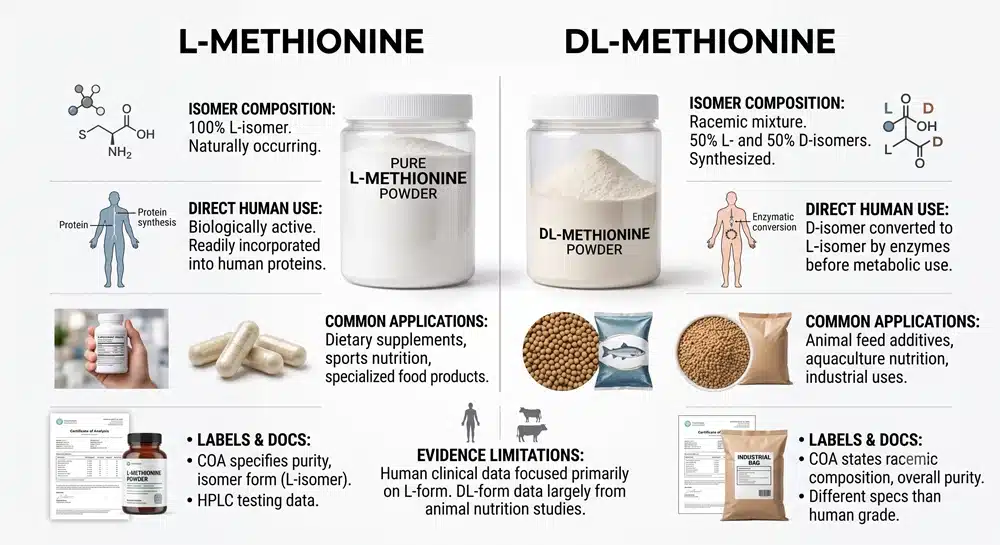
| Isomer composition | Single L-enantiomer | Racemic mixture containing approximately 50% L- and 50% D-methionine |
| Human metabolic use | Directly incorporated into proteins and used in sulfur-amino-acid metabolism | L fraction is directly usable; D fraction requires conversion before entering L-methionine pathways |
| Human evidence | The physiological dietary form found in proteins | Older human data indicate that the D fraction may be less efficiently utilized than animal-feed literature suggests |
| Common commercial positioning | Human nutrition, amino acid blends, foods and supplement formulas | Widely used in animal nutrition; also listed by FDA for specified food-substance functions |
| Label clarity | Usually declared as L-methionine | Should be identified as DL-methionine or racemethionine where applicable |
| Primary buyer question | Does the material meet identity, chiral-purity and finished-product requirements? | Is there a documented human-use rationale, applicable evidence and market-specific regulatory review? |
What Is L-Methionine?
L-methionine is an essential sulfur-containing amino acid. The human body cannot synthesize enough to meet normal requirements, so methionine must come from dietary protein or another appropriate nutritional source. It participates in protein synthesis and is a precursor to S-adenosylmethionine, cysteine and other sulfur-containing metabolites.
For commercial procurement, “L-methionine” should identify the L-enantiomer, but the name alone is not a complete specification. Buyers should verify assay, identity, specific rotation or enantiomeric purity, related substances, moisture, particle size and the reporting basis on the COA. Review the L-methionine powder specification page for sourcing context.
What Is DL-Methionine?
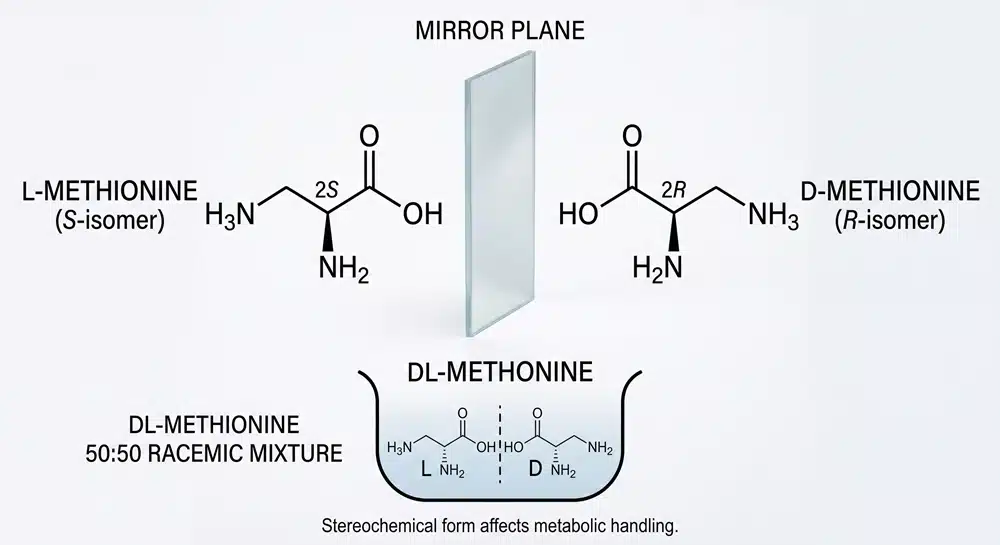
DL-methionine is a racemic mixture of D-methionine and L-methionine. The molecules have the same chemical formula but differ in three-dimensional orientation. The L portion can enter ordinary human methionine pathways directly. The D portion must first undergo enzymatic conversion before it can contribute to L-methionine metabolism.
DL-methionine is extensively studied and used in animal feed. Utilization differs among species, so poultry, swine or other animal data should not be used as direct evidence for adult human supplement bioavailability, dose or efficacy.
Is Methionine the Same as L-Methionine?
Not always. In nutrition science, “methionine” often refers to the L-amino acid found in proteins. In commercial documents, however, the word may be ambiguous. A material described only as “methionine” could be L-methionine, DL-methionine, a premix or another methionine source.
Brands should confirm the stereochemical form before approving a specification or label. A separate comparison of SAMe vs L-methionine is useful when the commercial ingredient is S-adenosyl-L-methionine rather than free methionine.
How Humans Use D-Methionine
Humans have enzymes that can convert selected D-amino acids into intermediates that may enter L-amino-acid metabolism. This does not mean that D-methionine and L-methionine have identical nutritional value at every dose, in every food matrix or for every endpoint.
An older controlled human study comparing L-, DL- and D-methionine supplementation of an oat-based diet reported better nitrogen-balance results with L-methionine and concluded that D-methionine appeared poorly utilized by the study participants. Human data are limited, so fixed claims such as “95% vs 80% bioavailability” should not be published without directly applicable human evidence.
Human Evidence vs Animal-Feed Evidence
| Evidence Type | What It Can Support | What It Cannot Support |
|---|---|---|
| Human metabolic or balance study | Human utilization under the tested diet, dose and endpoint | Universal percentage bioavailability for every supplement |
| Human safety study or review | Dose-related metabolic markers and tolerability in the studied population | Safety for all ages, pregnancy, disease states or long-term high-dose use |
| Poultry, swine or other feed study | Species-specific feed efficiency, growth and animal metabolism | Human supplement efficacy, absorption or dose equivalence |
| In vitro or enzyme study | Possible biochemical pathway or conversion mechanism | Clinical benefit or finished-product performance |
Which Form Is Better for Human Supplements?
For most human supplement projects, L-methionine is the clearer starting point because it is the physiological enantiomer directly used in human protein synthesis. DL-methionine may be appropriate in selected food or technical contexts, but it should not be chosen only because it is less expensive or performs well in animal-feed research.
| Product Scenario | Recommended Starting Point | Reason |
|---|---|---|
| Single-ingredient human supplement | L-methionine | Clear stereochemical identity and direct relevance to human metabolism |
| Multi-amino-acid blend | L-methionine | Simplifies formula rationale, specification and label communication |
| Food fortification | Market-specific review | Food permissions, technical function, use level and matrix must be assessed |
| Animal feed | Species-specific formulation decision | Animal nutrition has a separate evidence and regulatory framework |
| Cost-driven substitution | Do not substitute automatically | Lower raw-material cost does not prove equal human nutritional value |
Stability, Solubility and Manufacturing Differences
It is too broad to state that DL-methionine is inherently more stable and therefore preferred for dietary supplements. Stability and manufacturability depend on the actual grade, production process, particle size, moisture, excipients, processing conditions, package and finished-product shelf life.
Development should evaluate:
- Assay and stereochemical identity
- Particle size, bulk density and powder flow
- Blend uniformity at the target inclusion level
- Moisture, hygroscopic behavior and caking
- Odor, taste and flavor compatibility
- Interactions with vitamins, minerals, proteins and other amino acids
- Capsule fill volume, tablet compression or powder-dispersion behavior
- Finished-product potency and degradation through shelf life
Safety and Dose Considerations
Methionine is essential, but supplemental intake is not automatically beneficial at every dose. Human reviews and trials indicate that higher supplemental intakes can affect homocysteine and other metabolic markers. The available evidence does not establish a simple consumer dose that is appropriate for everyone.
People who are pregnant or breastfeeding, have liver or kidney disease, have an inborn error of metabolism, use prescription medicines or plan to use a high-dose single-amino-acid product should seek professional guidance. Brands should not market methionine supplements as treatments for liver disease, depression, poisoning, hair loss or another medical condition.
Methionine and Homocysteine
Methionine metabolism can produce homocysteine. Folate, vitamin B12, vitamin B6 and other nutrients participate in one-carbon and sulfur-amino-acid metabolism. This biochemical relationship does not justify claims that adding B vitamins to every methionine product prevents cardiovascular disease or eliminates risk.
When a higher-dose methionine formula is proposed, the brand should review total daily intake, target population, duration, co-nutrients, medication use, warning language and the quality of human safety evidence.
Quality Specification Checklist
| Specification | What to Verify | Why It Matters |
|---|---|---|
| Identity | Chemical name, CAS number and validated identity method | Distinguishes L-methionine, DL-methionine and other sources |
| Chiral identity | Specific rotation, enantiomeric purity or suitable chiral method | Confirms the declared stereochemical form |
| Assay | Target percentage, dry or as-is basis and analytical method | Supports formula and label calculations |
| Related substances | Process impurities, oxidation products and limits | Shows purity beyond a headline assay |
| Residual solvents | Process-specific panel and batch results | Confirms manufacturing residues are controlled |
| Elemental impurities | Lead, arsenic, cadmium and mercury | Supports raw-material and finished-product risk review |
| Microbiology | Total counts and specified organisms | Supports ingredient release |
| Physical properties | Particle size, bulk density, flow and appearance | Affects blending, encapsulation and compression |
| Origin and process | Fermentation or synthetic process, country of origin, allergen and GMO statements | Supports sourcing and marketing claims |
| Stability and change control | Storage, retest period, finished-product data and supplier-change notification | Protects identity and potency through shelf life |
Formulation Considerations for Supplement Brands
Capsules
Capsules can support single-ingredient and multi-amino-acid formulas. Formulators should verify powder flow, fill weight, capsule size, odor, moisture compatibility and dosage-unit uniformity. Review capsule supplement manufacturing when evaluating pilot and commercial feasibility.
Tablets
Tablets require compression, disintegration, hardness and stability validation. High active loading may need suitable binders, lubricants, glidants and protective packaging. The selected excipients must not interfere with assay or degradation control.
Powders
Powder blends need taste and odor management, segregation control, validated mixing time and serving-device accuracy. The finished serving should be assessed for uniformity rather than relying only on raw-material assay.
Protein and Amino Acid Blends
Methionine can adjust the amino acid profile of a formula, but the decision should be based on the complete protein or amino acid composition, serving size, target population and label rules. Avoid using a single “limiting amino acid” statement as proof that every product requires methionine supplementation.
RFP Questions for a Methionine Supplier or Manufacturer
- Is the material L-methionine, DL-methionine or another methionine source?
- Which identity and chiral-purity methods are used?
- What assay basis and molecular form apply?
- What production process and country of origin apply?
- Can you provide three recent lot-specific COAs?
- Which related substances, residual solvents, elemental impurities and microbiological tests are included?
- What are the particle size, bulk density, solubility and flow characteristics?
- What storage conditions, package and retest period are recommended?
- What human-use regulatory documentation is available for the target market?
- What are the MOQ, sample quantity, commercial lead time and change-control terms?
- Can you support capsule, tablet or powder pilot development?
- How are human-nutrition claims separated from animal-feed evidence during label review?
Where GENSEI Fits
GENSEI supports amino acid ingredient sourcing, documentation review, dosage-form feasibility and supplement manufacturing projects. The appropriate form should be selected according to the target market, dose, specification, finished dosage form and claim strategy.
Brands can request an L-methionine sample, COA or formulation quotation with the required form, assay, dose, dosage format, destination market, documentation and order quantity.
Frequently Asked Questions
What is the difference between L-methionine and DL-methionine?
L-methionine contains the L-enantiomer used directly in human protein synthesis. DL-methionine contains both L- and D-methionine, and the D portion requires conversion before it can enter L-methionine pathways.
Is DL-methionine safe for humans?
Its suitability depends on dose, product category, market, individual risk factors and the finished formula. FDA’s food-substance inventory lists specified food functions, but this is not proof that every dose or supplement application is appropriate.
Is L-methionine more bioavailable than DL-methionine?
Limited human evidence indicates that the D fraction may be less efficiently utilized in some nutritional settings. Avoid fixed percentage comparisons unless they come from a directly applicable human study.
Is methionine the same as L-methionine?
In biological discussions, methionine often means L-methionine. In supplier documents and labels, the exact stereochemical form should be confirmed.
Why is DL-methionine common in animal feed?
It is commercially established and many animal species can utilize D-methionine efficiently. Species-specific feed evidence should not be generalized to human supplements.
Can methionine supplements support hair or liver health?
Methionine participates in normal protein and sulfur-amino-acid metabolism, but ordinary supplements should not be marketed as treatments for hair loss or liver disease. Any structure/function claim requires substantiation for the finished product.
Final Takeaway
L-methionine and DL-methionine are chemically related but not identical nutritional ingredients. L-methionine is the physiological enantiomer directly used in human protein synthesis. DL-methionine contains a D fraction whose utilization differs by species and may be lower in humans. Human supplement brands should prioritize clear identity, human-relevant evidence, dose safety, chiral specifications and finished-product quality rather than animal-feed claims or unsupported bioavailability percentages.
References
- Comparative Value of L-, DL-, and D-Methionine Supplementation of an Oat-Based Diet for Humans
- Toxicity of Methionine in Humans
- The In Vivo Sparing of Methionine by Cysteine in Sulfur Amino Acid Requirements
- Tolerable Upper Intake Level for Individual Amino Acids in Humans: A Narrative Review
- FDA: Substances Added to Food Inventory
- FDA: Label Claims for Conventional Foods and Dietary Supplements
- FTC: Health Products Compliance Guidance
- 21 CFR Part 111: Dietary Supplement Current Good Manufacturing Practice

Warren Wan is a seasoned expert with extensive experience in the dietary supplement supply chain, possessing rich practical experience in the research, development, process control, and global sourcing of core ingredients such as collagen peptides, bone broth protein, and keratin. As the author of this column, he is dedicated to stripping away the marketing packaging, transforming obscure ingredient science and production quality control standards into easy-to-understand, hardcore science popularization, helping readers understand the truth behind the labels and make more rational health choices.