
Probiotic Supplement Manufacturer for Custom & Private Label Brands
Develop hard probiotic capsules, multi-strain blends, synbiotic concepts, and dry powder stick packs with practical engineering support for strain documentation, CFU overage planning, low water activity ($a_w$) blending, and moisture-barrier packaging.
Solid and dry powder food supplements only (excluding liquid formats). Formulation, shelf-life targets, and manufacturing feasibility are assessed per project.


Probiotic Food Supplements Built Around Your Brand Concept
Select a solid or dry powder formulation direction to begin your technical review. Every concept is evaluated for strain identity, excipient water activity, processing parameters, and target market compliance.
Ij48cmVjdCB3aWR0aD0iMTIwIiBoZWlnaHQ9IjQzIiByeD0iMjEuNSIgZmlsbD0iI2ZmZiIgc3Ryb2tlPSIjQkREMERDIiBzdHJva2Utd2lkdGg9IjMiLz48cGF0aCBkPSJNNjAgMEg5OFExMjAgMCAxMjAgMjEuNVExMjAgNDMgOTggNDNINjBaIiBmaWxsPSIjOUZDMERKIi8+PC9nPjwvc3ZnPg==)
Single-Strain Probiotic Capsules
Focused hard capsule formulations centered on one documented probiotic strain with controlled low-moisture excipient carriers and defined CFU targets.

Multi-Strain Probiotic Blends
Complementary multi-strain complexes combining Lactobacillus, Bifidobacterium, or spore-forming species, subject to strain ratio and stability review.

Probiotic + Prebiotic Formulas
Combine live probiotic cultures with low-moisture prebiotic fibers (such as inulin, FOS, or GOS) tailored for capsule or dry powder formats.

Probiotic Powders & Stick Packs
Single-serving dry powder sachets and stick packs engineered around powder flowability, fill weight precision, and high-barrier foil laminates.
Choose a Probiotic OEM / ODM Starting Point
Different supplement brands require different levels of R&D involvement. We evaluate your preferred route against strain availability, processing feasibility, barrier packaging, and order volume.
Private Label
Start with base solid or dry powder probiotic concepts, subject to confirmed strain availability, label specifications, and target market review.
Semi-Custom
Adapt a base formulation by adjusting probiotic strain ratios, target CFU count, prebiotic carriers, capsule shell types, or primary packaging.
Fully Custom OEM / ODM
Submit your custom bill of materials (BOM) or technical brief for strain sourcing, water activity evaluation, pilot sampling, and commercial runs.
From Strain Identity to a Practical CFU Target
Live probiotic formulations require strict control over strain documentation, input overage ratios, excipient water activity ($a_w$), and environmental humidity during blending and filling.

Define the Culture
Verify genus, species, and alphanumeric strain designations alongside supplier Certificates of Analysis (COA) and identity records.
Balance Input vs. Shelf Life
Clarify whether your label claim reflects CFU at manufacture or through end of shelf life (EOSL), establishing appropriate strain overage.
Control Carrier Moisture
Select low-$a_w$ excipients and prebiotic fibers to prevent free moisture from prematurely activating freeze-dried cultures during storage.
Plan Stability Evidence
Align enumeration methods, storage zone parameters, and protective packaging selection with your finished dosage form.
Protective Packaging for Moisture-Sensitive Formulas
Primary packaging functions as an active stability barrier for live cultures. Moisture vapor transmission rate (MVTR), headspace humidity, and transit temperatures directly influence viable counts.


Evaluate HDPE, PET, or amber glass bottles paired with molecular sieve or silica gel desiccants and heat-induction liners to restrict moisture ingress.
Single-serve powder stick packs and sachets utilize multi-layer aluminum foil structures engineered for low moisture and oxygen transmission.
Capsule encapsulation and powder sachet filling are scheduled under controlled room relative humidity (RH) to protect hygroscopic blends.
Align secondary carton packaging, storage instructions, and shipping conditions with the thermal tolerance of your selected strains.
Practical Solid & Powder Probiotic Formats
We focus exclusively on solid and dry powder probiotic formats where low water activity and protective barrier packaging can be reliably maintained.

Hard Capsules (HPMC / Delayed-Release)
Two-piece vegetarian HPMC or acid-resistant delayed-release capsules in sizes #00, #0, or #1, packed in bottles or blisters.
Capsule Manufacturing ↗
Dry Powder Blends
Uniform dry powder formulations combining freeze-dried cultures with prebiotic fibers or botanicals, evaluated for flow and dispersibility.
Powder Manufacturing ↗
Single-Serve Sachets & Stick Packs
Unit-dose foil stick packs and flat sachets (typically 1 g to 5 g fill weight) that protect individual servings from repeated air exposure.
Packaging Solutions ↗MOQ Drivers, Sampling & Production Planning
Probiotic minimum order quantities and lead times are driven by custom strain sourcing, blend batch sizes, and printed barrier packaging minimums. Exact commercial terms are confirmed per project.
| Project Format | Key MOQ Drivers | Pilot & Sampling Scope | Production Planning Focus |
|---|---|---|---|
| Single-Strain Capsules | Capsule shell type, bottle count & stock vs. custom strain sourcing | Capsule fill weight, shell size & carrier flow check | Low-$a_w$ carrier blending, RH control & desiccant bottle packing |
| Multi-Strain Blends | Premix batch size, number of strains & overage specification | Multi-strain compatibility, ratio & specification review | Culture sourcing lead time, cold-chain raw material storage & testing |
| Powder Sachets / Sticks | Printed laminate film roll minimum, fill weight & outer box count | Dry blend homogeneity, organoleptic & foil sealing trial | Foil laminate WVTR/OTR spec, auger/stick filling speed & carton packing |
Ingredient Review, Viability Testing & Batch Records
Analytical testing and batch documentation are structured around your agreed probiotic strains, finished product specifications, and target regulatory market prior to production.

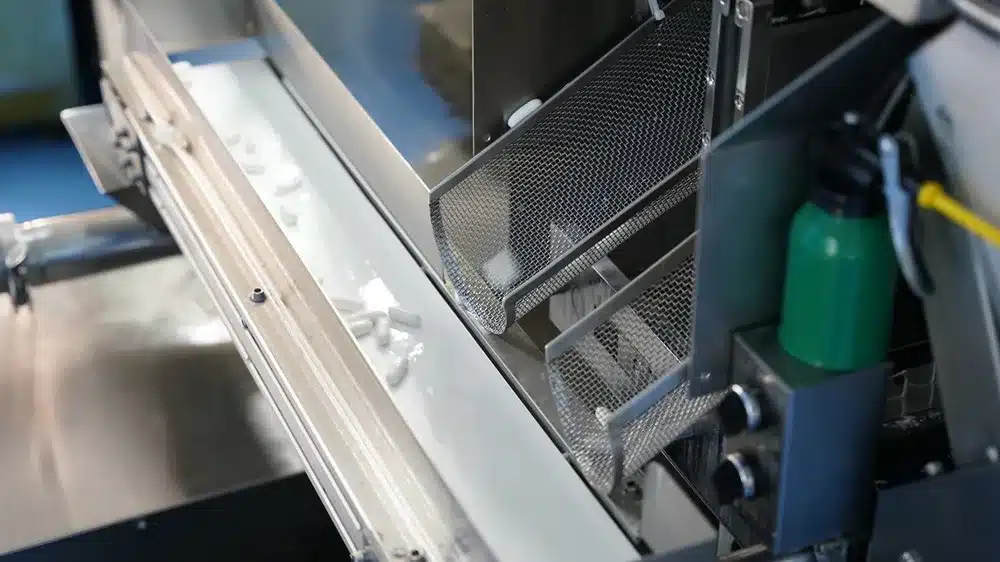
Review supplier strain identity certificates, raw material COAs, carrier specifications, and allergen or non-GMO statements where applicable.
Confirm enumeration testing protocols (plate count or agreed method) and finished-blend water activity ($a_w$) limits according to project scope.
Monitor environmental humidity, capsule weight variation, sachet fill accuracy, and foil or induction seal integrity during packaging runs.
Provide finished product Specifications, batch Certificates of Analysis (COA), and standard export manufacturing documentation per order.
Third-party laboratory assays and real-time or accelerated stability programs are arranged upon confirmation of method, testing fees, and timeline.
Five Steps from Brief to Finished Probiotic Supplement
Define your strain profile, target CFU, and barrier packaging requirements early so formulation, pilot sampling, and commercial production stay aligned.
Project Brief
Share target strains, CFU claim, solid/powder format, pack style, and destination market.
Feasibility Review
Evaluate strain documentation, overage design, low-$a_w$ excipients, and MOQ terms.
Sample Planning
Confirm pilot sample scope, capsule shell or stick pack dimensions, and trial evaluation.
Manufacture & Pack
Blend and fill under controlled humidity into approved bottles, blisters, or foil sticks.
QC & Dispatch
Complete agreed batch COA release checks and coordinate temperature-appropriate shipment.
Probiotic Supplement Manufacturing Questions
Direct answers to common technical and commercial questions from supplement brand founders, formulators, and sourcing managers.
Can you manufacture our custom multi-strain probiotic formula?
Yes. Share your bill of materials (BOM), strain designations, intended CFU per serving, dosage form, and target market. Our technical team evaluates strain sourcing, low-water-activity excipient compatibility, and processing feasibility case by case.
How do you handle CFU at manufacture vs. end of shelf life?
Viable counts naturally decline over time depending on strain sensitivity, carrier water activity ($a_w$), packaging barrier performance, and storage temperature. We review your label claim target and discuss appropriate input overage and packaging options—manufacturing input counts should not be treated as automatic end-of-shelf-life figures without matching stability design.
Do you offer private label or starter probiotic formulas?
GENSEI supports both private label starting concepts and custom OEM/ODM formulations in hard capsule and dry powder formats. Specific strain profiles, customization options, and minimum volumes are confirmed per inquiry.
Which probiotic dosage forms do you manufacture?
We focus strictly on solid and dry powder food supplement formats—specifically two-piece hard capsules (standard HPMC or delayed-release vegetarian shells), bulk dry powder blends, and single-serve foil sachets or stick packs. We do not manufacture liquid probiotic drops or beverages.
What packaging options help protect live probiotic cultures?
Depending on your formula's moisture sensitivity, we can evaluate desiccant-lined or desiccant-insert HDPE/PET and amber glass bottles with heat-induction seals, Alu-Alu blisters, or multi-layer aluminum foil stick packs with low moisture vapor transmission rates (MVTR).
What is the MOQ for probiotic OEM / ODM orders?
MOQ depends on whether your selected strains are stocked or custom-sourced, total blend weight, capsule count, or printed foil film minimums. Send your project brief below to receive an accurate, item-by-item quotation.
Request a Probiotic Supplement Manufacturing Quote
Tell us what you plan to manufacture. Our team will review your product concept, strain profile, target CFU, solid or powder format, and packaging requirements.
Probiotic OEM / ODM Inquiry
Project-specific technical & commercial review for food supplement brands.