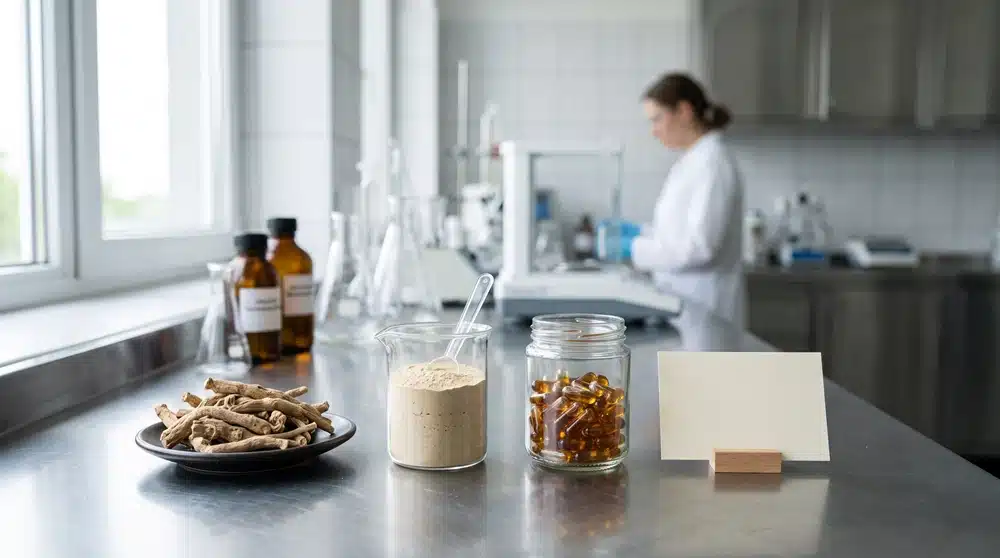
Réponse rapide : La poudre de racine d'ashwagandha et l'extrait d'ashwagandha proviennent tous deux de Withania somnifera, mais ce ne sont pas les mêmes produits. La poudre de racine est obtenue à partir de la racine séchée et moulue ; elle est généralement privilégiée pour les préparations à base de racine entière, les formules traditionnelles et les mélanges en poudre. L’extrait d’ashwagandha est transformé et concentré, puis souvent standardisé par rapport à un marqueur tel que les withanolides, ce qui le rend plus facile à utiliser dans des gélules, des comprimés, des bonbons gélifiés et des formules à faible dose.
Pour les marques de compléments alimentaires, le meilleur choix ne se résume pas simplement à opter pour la formule “ la plus concentrée ”. La forme la plus adaptée dépend du format du produit, de la taille de portion souhaitée, du positionnement sur l’étiquette, des spécifications en matière de withanolides, du profil sensoriel, des exigences en matière d’analyses et du marché cible. Si vous vous approvisionnez en ingrédients, comparez le certificat d’analyse (COA) du lot, la méthode de dosage des marqueurs actifs, la provenance (racine seule ou racine et feuilles), le support, les résidus de solvants et les analyses de contaminants avant de choisir une matière première.
Gensei fournit en vrac poudre d'extrait d'ashwagandha et soutient formule sur mesure fabrication de compléments alimentaires pour les marques qui développent des gélules, des comprimés, des bonbons gélifiés, des poudres et des produits en marque de distributeur.
Comparaison rapide : poudre de racine d'ashwagandha vs extrait
| Facteur | Poudre de racine d'ashwagandha | Extrait d'ashwagandha |
|---|---|---|
| Traitement | Racine séchée, réduite en poudre après un traitement minimal. | Extrait et concentré, puis souvent standardisé par rapport à un marqueur défini. |
| Positionnement courant | Racine entière, traditionnelle, peu transformée, facile à réduire en poudre. | Marqueur actif standardisé, concentré et homogène ; portion réduite. |
| Témoin « withanolide » | En général, ces produits ne sont pas normalisés, sauf indication contraire du fournisseur. | Souvent exprimée en pourcentage de withanolides et selon une méthode d'analyse telle que la HPLC ou l'UV. |
| Portion | Généralement plus volumineux, car il n'est pas concentré. | Généralement plus petit, car il est concentré et standardisé. |
| Meilleurs formats de produits | Mélanges en poudre, sachets individuels, préparations à diluer, positionnement des compléments alimentaires à base d'aliments entiers. | Gélules, comprimés, bonbons gélifiés, mélanges fonctionnels et formules dont l'espace de présentation est limité. |
| Priorités en matière d'achats | Identité, taille des mailles, limites microbiologiques, métaux lourds, résidus de pesticides et origine. | Dosage des marqueurs actifs, taux d'extraction, matière première provenant uniquement des racines ou des racines et des feuilles, support, solvants résiduels, métaux lourds et analyse microbiologique. |
| Le plus adapté | Les marques qui recherchent un ingrédient simple, à base de racine entière, et qui peuvent accepter un format de portion plus grand. | Les marques qui ont besoin d'un dosage plus faible, d'un niveau de marqueur plus constant et d'un contrôle précis des spécifications. |
L'extrait d'ashwagandha est-il la même chose que l'ashwagandha ?
Non. Dans le langage courant utilisé pour les recherches, le terme “ ashwagandha ” peut désigner la plante, la poudre de racine entière ou un complément alimentaire contenant un extrait. En matière de formulation et d’approvisionnement, ces termes ne doivent pas être utilisés de manière interchangeable.
La poudre de racine d'ashwagandha est la racine séchée réduite en poudre. L'extrait d'ashwagandha est un ingrédient concentré obtenu par un processus d'extraction. L’extrait peut être standardisé à une teneur spécifique en withanolides, telle que 2,5%, 5% ou 10%, mais les spécifications réelles doivent toujours être confirmées par le certificat d’analyse (COA) et la méthode d’essai du fournisseur.
Cette distinction est importante, car deux produits peuvent tous deux porter la mention “ ashwagandha ” sur l’ étiquette avant tout en contenant des quantités très différentes de matière végétale et de composés actifs par portion.
Qu'est-ce que la poudre de racine d'ashwagandha ?
La poudre de racine d'ashwagandha est obtenue en séchant et en broyant la racine de Withania somnifera. Ce produit s'apparente davantage à une poudre botanique intégrale qu'à un extrait concentré. Comme il est moins transformé, il pourrait intéresser les marques qui souhaitent élaborer une formule à base de racine entière, traditionnelle ou à ingrédients simples.
La poudre de racine peut donner de bons résultats dans les mélanges pour boissons en poudre, les préparations pour smoothies, les sachets individuels et les formulations où une portion plus importante est acceptable. Cependant, elle peut présenter un goût terreux prononcé, des teneurs variables en marqueurs actifs et un poids d’incorporation plus élevé que l’extrait. Pour les produits finis, l’impact sensoriel et la taille de la portion doivent être testés dès les premières étapes du processus de R&D.
Si votre produit est un mélange en poudre, consultez les options disponibles via un fabricant de compléments en poudre pour vérifier le goût, la dispersibilité, la taille des portions et l'adéquation de l'emballage.
Qu'est-ce qu'un extrait standardisé d'ashwagandha ?
L'extrait d'ashwagandha est obtenu en extrayant les composés de la matière végétale et en les concentrant sous forme de poudre, de liquide ou de tout autre ingrédient prêt à l'emploi . Dans les compléments alimentaires, on utilise généralement de la poudre d'extrait sec, car elle peut être incorporée dans des gélules, des comprimés, des bonbons gélifiés et des poudres.
Le principal avantage de l'extrait réside dans le contrôle de sa composition. Un extrait standardisé peut être fourni avec une teneur définie en principes actifs, généralement des withanolides. Cela permet aux marques de créer des formules avec des doses plus faibles et un positionnement plus homogène d'un lot à l'autre .
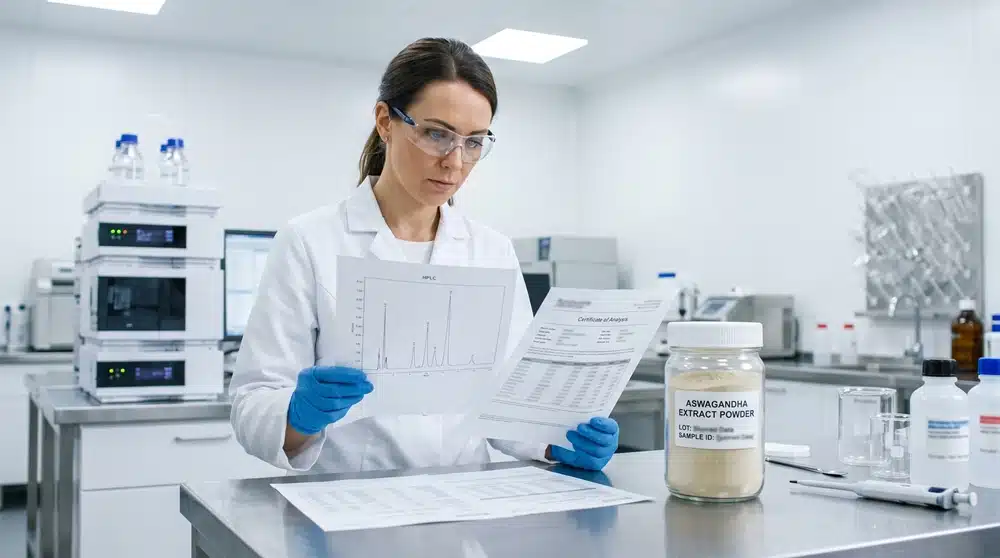
Cependant, le terme “ extrait ” à lui seul ne fournit pas suffisamment d’informations. Une équipe chargée des achats devrait demander la partie botanique utilisée, le taux d’extraction, le pourcentage de marqueurs actifs, la méthode d’analyse, le support, les résidus de solvants, les métaux lourds, les résidus de pesticides, les analyses microbiologiques et le certificat d’analyse (COA) du lot. A fournisseur de poudres d'extraits de plantes devrait être en mesure de fournir ces documents aux acheteurs éligibles.
Différence de dosage entre la poudre et l'extrait de racine d'ashwagandha
Le dosage de la poudre et de l'extrait de racine ne doit pas être converti à l'aide d'un simple rapport universel . La différence de dose apparente dépend de la concentration, de la composition en withanolides , de la méthode d'extraction, de la source (racine seule ou racine et feuilles) et du contexte clinique ou commercial spécifique.
Par exemple, les études cliniques synthétisées par les NIH ont utilisé un large éventail de préparations à base d’ashwagandha, notamment des extraits et des granulés de racine entière. Cela signifie qu’un extrait de 300 mg n’équivaut pas automatiquement à 300 mg de poudre de racine. Une meilleure approche consiste à comparer :
- la quantité totale d'ingrédients par portion ;
- la quantité standardisée indiquée par portion, le cas échéant ;
- la partie de la plante utilisée ;
- la méthode d'essai utilisée pour les withanolides ;
- le format du produit fini et la stratégie relative aux allégations figurant sur l'étiquette.
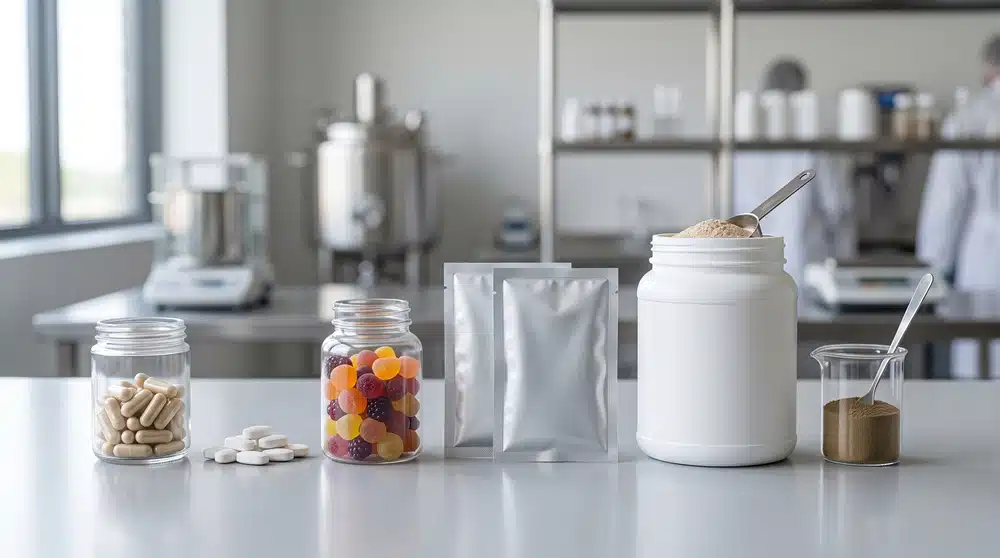
Pour les marques, il s'agit autant d'un choix de formulation que d'un choix de dosage. Les gélules et les comprimés peuvent privilégier les extraits en raison de l'espace limité dont elles disposent. Les mélanges en poudre peuvent permettre l'utilisation de poudre de racine entière si le goût et la taille de la portion sont acceptables.
Qu'est-ce qui est mieux : la racine d'ashwagandha ou son extrait ?
L'extrait d'ashwagandha est généralement préférable lorsqu'une marque a besoin d'un dosage plus faible, de caractéristiques techniques constantes et d'un contrôle précis des marqueurs actifs. C'est pourquoi cet extrait est couramment utilisé dans les gélules, les comprimés, les bonbons gélifiés et les formules ciblées destinées à soulager le stress ou à favoriser le sommeil.
La poudre de racine d'ashwagandha peut s'avérer plus adaptée lorsqu'une marque souhaite mettre en avant la racine entière, s'appuyer sur un récit botanique traditionnel ou proposer un mélange en poudre pour lequel une portion plus importante ne pose pas de problème. Elle peut également être utile aux marques qui souhaitent éviter de se positionner sur le marché des extraits hautement concentrés.
Pour les produits finis, envisagez les cas d'utilisation suivants :
| Objectif du produit | Formulaire recommandé | Raison |
|---|---|---|
| Petite portion en gélules | Extrait standardisé | Un produit concentré s'adapte mieux à l'espace restreint d'une capsule. |
| Comprimé avec un marqueur actif transparent | Extrait standardisé | Permet la gestion des spécifications et la documentation des marqueurs actifs. |
| Formule en bonbons gélifiés | Extrait, généralement à une dose soigneusement testée | Les bonbons gélifiés présentent des contraintes limitées en termes de charge active et de goût. |
| Boisson en poudre ou mélange pour smoothie | Poudre ou extrait de racine | La poudre de racine permet de conserver la racine entière ; l'extrait permet de réduire la portion. |
| Formule de soutien anti-stress en marque de distributeur | Extrait souvent standardisé | Permet un positionnement cohérent des ingrédients et une réduction de la taille des portions. |
| Poudre botanique traditionnelle | Poudre de racine | Meilleur ajustement pour le positionnement de racines entières et de racines ayant subi un traitement minimal. |
Pour le développement spécifique à un format, comparez la prise en charge offerte par un fabricant de compléments alimentaires en gélules, fabricant de compléments alimentaires sous forme de gomme ou fabrication de compléments alimentaires à base de plantes partenaire.
Comment comparer les compléments alimentaires à base d'ashwagandha en fonction de la standardisation de l'extrait
Si vous comparez des compléments alimentaires à base d'ashwagandha ou si vous recherchez des ingrédients pour une nouvelle formule, ne vous fiez pas uniquement à la dose indiquée sur l'étiquette. Une quantité en milligrammes qui semble plus élevée ne signifie pas nécessairement une concentration plus élevée en principe actif.
Utilisez cette liste de contrôle :
- Identité botanique : Confirmer Withania somnifera et la partie de la plante utilisée.
- Uniquement la racine ou racine et feuilles : Précisez si l'extrait concerne uniquement la racine, la racine et les feuilles, ou si cela n'est pas précisé.
- Spécifications de l'withanolide : Vérifiez le pourcentage et précisez s'il est déterminé par HPLC, UV ou une autre méthode.
- Taux d'extraction : Considérez les rapports tels que 10:1 comme des informations complémentaires, et non comme un substitut aux tests de marqueurs actifs.
- Excipients et substances de support : Vérifier la présence éventuelle de maltodextrine, d'amidon ou d'autres excipients.
- Contaminants : Examiner la présence de métaux lourds, de résidus de pesticides, les paramètres microbiologiques et les résidus de solvants.
- Documents par lots : Demandez le certificat d'analyse (COA), la fiche de données de sécurité (FDS), la fiche technique et le schéma de fonctionnement si nécessaire.
Gensei’s contrôle de la qualité des compléments alimentaires Ce processus peut servir de référence interne pour expliquer les essais d'identité, la teneur en principe actif, la pureté et la documentation relative aux lots.
Extrait d'ashwagandha « racine seule » ou « racine et feuilles »
Une autre différence importante concerne la partie de la plante utilisée. Certains extraits sont obtenus uniquement à partir de la racine, tandis que d’autres peuvent être préparés à partir de la racine et des feuilles. Cela peut avoir une incidence sur le profil en withanolides, le positionnement du produit et les attentes des clients.
Pour un positionnement prudent de leurs compléments alimentaires, de nombreuses marques privilégient les extraits provenant exclusivement de la racine, car celle-ci est la source traditionnelle la plus connue du grand public. Les extraits de racine et de feuilles peuvent certes encore être commercialisés, mais l'étiquetage, les spécifications et le discours marketing doivent clairement correspondre à l'ingrédient réel.
La règle la plus sûre en matière d'approvisionnement est simple : ne faites pas de suppositions. Demandez au fournisseur d'indiquer la partie botanique sur la fiche technique et le certificat d'analyse (COA).
Considérations relatives à la sécurité et aux allégations figurant sur les étiquettes
Le contenu relatif à l’ashwagandha doit être rédigé avec soin, car il relève de la catégorie “ santé et compléments alimentaires ”. Évitez toute formulation suggérant que le produit permet de diagnostiquer, traiter, guérir ou prévenir une maladie. Au lieu de dire “ traite l’anxiété ” ou “ guérit l’insomnie ”, utilisez un langage conforme au principe “ structure/fonction ”, tel que “ favorise une réponse saine au stress ”, « favorise la relaxation » ou « favorise la qualité du sommeil ».”
Les femmes enceintes ou allaitantes, les personnes souffrant de troubles hépatiques, de troubles thyroïdiens ou de maladies auto-immunes, celles qui prennent des sédatifs ou des médicaments pour la thyroïde, ou encore celles qui se préparent à une intervention chirurgicale, doivent consulter un professionnel de santé avant de consommer de l’ ashwagandha. La sécurité d’une utilisation à long terme n’est pas bien établie, et de rares effets indésirables liés au foie ont été signalés.
Pour les pages B2B, ajoutez une brève mention relative à la conformité : “ Ce contenu est destiné uniquement à des fins d’information sur les ingrédients et les formulations. Les allégations relatives aux produits finis, les étiquettes et la conformité aux réglementations du marché doivent être vérifiées pour le pays cible avant le lancement. ”
FAQ
L'extrait d'ashwagandha est-il identique à l'ashwagandha ?
Non. Le terme “ ashwagandha ” peut désigner la plante, la poudre de racine ou un complément alimentaire contenant
un extrait. L'extrait d'ashwagandha est un ingrédient concentré et peut être standardisé
aux withanolides. La poudre de racine est obtenue à partir de racines séchées et broyées.
Quelle est la différence entre l'ashwagandha et l'extrait d'ashwagandha ?
L'ashwagandha est la plante d'origine. L'extrait d'ashwagandha est un produit transformé et
forme concentrée de cette plante. L'extrait pourrait offrir une concentration plus constante en principes actifs
niveau de marqueur, mais les spécifications exactes dépendent du fournisseur et du certificat d'analyse (COA) du lot.
Extrait d'ashwagandha ou poudre : lequel est le plus puissant ?
L'extrait est généralement plus concentré que la poudre de racine, mais il ne faut pas pour autant dire qu'il est “ plus puissant ”
confirmé par la spécification et la méthode d'essai relatives aux withanolides, et pas seulement par le nombre de milligrammes
quantité indiquée sur l'étiquette.
Qu'est-ce que l'extrait de racine ?
L'extrait de racine est un ingrédient obtenu en extrayant des composés de la racine d'une plante. Dans le cas de l'ashwagandha, l'extrait de racine signifie que la source botanique est la racine de Withania somnifera, mais le marqueur actif et la concentration doivent encore être vérifiés par rapport au cahier des charges et au certificat d'analyse.
Pour les gélules, vaut-il mieux utiliser de la poudre ou de l'extrait de racine d'ashwagandha ?
L'extrait est souvent plus adapté aux gélules, car il permet d'apporter un marqueur standardisé
niveau avec un poids de remplissage moindre. On peut utiliser de la poudre de racine, mais cela peut nécessiter davantage de
des gélules ou une portion plus généreuse.
Pour les bonbons gélifiés, vaut-il mieux utiliser de la poudre ou de l'extrait de racine d'ashwagandha ?
L'extrait est généralement plus pratique pour les bonbons gélifiés, car ceux-ci offrent un espace limité.
en raison des principes actifs et des contraintes strictes en matière de goût. La dose finale, l'arôme et
La stabilité doit être testée au cours de la formulation.
Pour les mélanges en poudre, vaut-il mieux utiliser la racine d'ashwagandha ou son extrait ?
Les deux méthodes sont possibles. La poudre de racine favorise le maintien de la racine entière, mais peut altérer le goût.
et la taille de la portion. L'extrait permet de réduire la taille de la portion, mais nécessite un mélange minutieux et une dégustation
contrôle des essais et des spécifications.
L'ashwagandha est-il approuvé par la FDA ?
La sécurité et l'efficacité des compléments alimentaires ne sont pas validées par la FDA avant
marketing. Les marques ont la responsabilité d'utiliser des ingrédients conformes et de formuler des allégations véridiques,
un étiquetage correct et une justification adéquate.
Qui ne doit pas prendre d'ashwagandha ?
Les femmes enceintes, celles qui allaitent, celles qui souffrent de troubles hépatiques ou thyroïdiens, celles qui ont
souffrent de maladies auto-immunes, prennent des sédatifs ou des médicaments pour la thyroïde, ou se préparent à
Les personnes ayant subi une intervention chirurgicale doivent consulter un professionnel de santé avant utilisation.
Conclusion
La poudre de racine d'ashwagandha et l'extrait d'ashwagandha répondent à des objectifs de formulation différents. La poudre de racine convient mieux aux produits à base de racine entière et à ceux pour lesquels l'utilisation de poudre est adaptée, tandis que l'extrait standardisé est souvent plus adapté aux marques qui ont besoin d'une dose plus faible, d'une teneur en withanolides constante et d'une documentation détaillée sur chaque lot.
Si vous développez un complément alimentaire à base d’ashwagandha, comparez les caractéristiques des ingrédients avant de choisir la forme de présentation. Gensei peut vous accompagner dans l’approvisionnement en ingrédients botaniques, la création de formules sur mesure, la fabrication de gélules, de comprimés, de bonbons gélifiés, de mélanges en poudre et de compléments alimentaires en marque de distributeur. Contactez-nous pour obtenir un certificat d'analyse (COA), connaître les quantités minimales de commande (MOQ), recevoir des échantillons et bénéficier d'une assistance à la formulation pour votre prochain produit à base d'ashwagandha.
Références
- Bureau des compléments alimentaires des NIH. L'ashwagandha : est-il efficace contre le stress, l'anxiété ou les troubles du sommeil ? Fiche d'information destinée aux professionnels de santé. https://ods.od.nih.gov/factsheets/Ashwagandha HealthProfessional/
- NCCIH. Ashwagandha : efficacité et innocuité. https://www.nccih.nih.gov/health/ashwagandha
- FDA. Questions et réponses sur les compléments alimentaires. https://www.fda.gov/food/information-consumers-using-dietary supplements/questions-and-answers-dietary-supplements
- FDA. Allégations relatives à la structure et à la fonction. https://www.fda.gov/food/nutrition-food-labeling-and-critical foods/structurefunction-claims
- FTC. Lignes directrices relatives à la conformité des produits de santé. https://www.ftc.gov/system/files/ftc_gov/pdf/Health-Products Compliance-Guidance.pdf
- Cheah KL et al. Effets de l'extrait d'ashwagandha sur le sommeil : revue systématique et méta-analyse. https://pmc.ncbi.nlm.nih.gov/articles/PMC8462692/
- Akhgarjand C et al. La prise d'ashwagandha a-t-elle un effet bénéfique sur le stress et l'anxiété ? https://pubmed.ncbi.nlm.nih.gov/36017529/

Warren Wan est un expert chevronné qui possède une vaste expérience dans la chaîne d’approvisionnement des compléments alimentaires, ainsi qu’une solide expertise pratique dans la recherche, le développement, le contrôle des processus et l’approvisionnement mondial d’ingrédients clés tels que les peptides de collagène, les protéines de bouillon d’os et la kératine. En tant qu'auteur de cette chronique, il s'attache à aller au-delà des discours marketing pour transformer les notions scientifiques obscures relatives aux ingrédients et les normes de contrôle qualité de la production en une vulgarisation scientifique rigoureuse et accessible, aidant ainsi les lecteurs à comprendre la vérité qui se cache derrière les étiquettes et à faire des choix plus rationnels en matière de santé.