

Quick Answer: L-Carnitine vs Creatine for Supplement Brands
L-carnitine and creatine are often compared because both appear in sports nutrition products, but they do very different jobs.
Creatine is the stronger choice when the product goal is strength, power, high-intensity training performance, muscle fullness, or resistance-training support. For most sports nutrition formulas, creatine monohydrate is still the most practical and evidence-backed form.
L-carnitine is better suited for products positioned around fat metabolism, energy production, endurance support, recovery, or vegan and vegetarian consumers who may have lower dietary carnitine intake.
For supplement brands, the better question is not simply “Which ingredient is better?” The better question is:
Which ingredient fits your product format, label claim, target consumer, dosage, taste profile, cost target, and manufacturing process?

What Is L-Carnitine?
L-carnitine is a naturally occurring compound involved in energy metabolism. Its main physiological role is helping transport long-chain fatty acids into the mitochondria, where they can be oxidized for energy.
In sports nutrition products, L-carnitine is usually positioned for:
- Fat metabolism support
- Energy production
- Endurance-focused formulas
- Recovery support
- Vegan and vegetarian sports nutrition
- Weight management products
- Liquid shots, capsules, tablets, and drink mixes
From a formulation perspective, brands should pay close attention to the ingredient form. Common commercial options include L-carnitine base, L-carnitine L-tartrate, acetyl-L-carnitine, and other salt forms. These forms may differ in taste, hygroscopicity, dosage, cost, and suitability for capsules, tablets, powders, liquids, or gummies.
L-carnitine should not be marketed as a magic fat burner. It may support fat metabolism, but the consumer outcome still depends on diet, exercise, total calorie intake, and individual baseline status.
What Is Creatine?
Creatine is a naturally occurring compound stored mainly in skeletal muscle as free creatine and phosphocreatine. It helps regenerate ATP during short bursts of high-intensity activity, which is why creatine is most strongly associated with strength, power, sprinting, and resistance training.
For supplement brands, creatine is commonly used in:
- Pre-workout powders
- Post-workout formulas
- Muscle-building products
- Strength and performance formulas
- Creatine-only powders
- Capsules and tablets
- Sports nutrition bundles with protein, electrolytes, or amino acids
For most brands, creatine monohydrate should be the default starting point. It is cost-effective, widely available, well studied, and easier to justify than more expensive creatine forms that claim superior absorption without strong supporting evidence.
Creatine can cause a small increase in body weight due to water retention inside muscle tissue. For strength and performance positioning, this is usually acceptable. For weight-loss positioning, brands should explain this clearly to avoid consumer confusion.
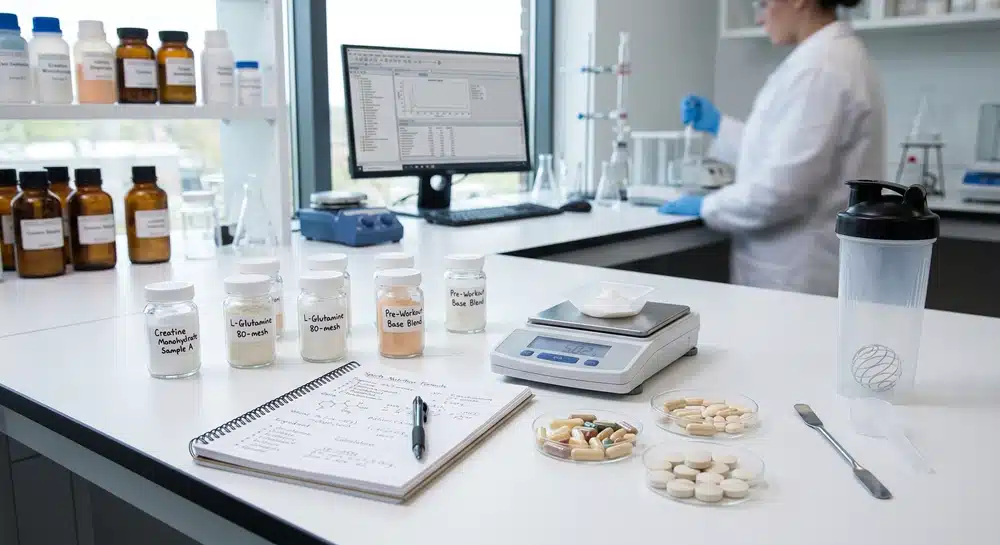
L-Carnitine vs Creatine: B2B Formulation Comparison
| Factor | L-Carnitine | Creatine | Formulation Note for Supplement Brands |
| Main Positioning | Fat metabolism, energy, endurance, recovery | Strength, power, muscle performance, high-intensity training | Creatine has stronger sports performance positioning; L-carnitine is better for energy and weight-management concepts. |
| Primary Mechanism | Supports transport of fatty acids into mitochondria | Helps regenerate ATP through the phosphocreatine system | They are complementary, not direct substitutes. |
| Best Product Types | Capsules, tablets, liquids, shots, weight-management powders | Powders, pre-workouts, post-workouts, capsules, tablets | Creatine is especially strong in powder products because the daily dose is relatively high. |
| Typical Adult Use Level | Often 1–3 g/day depending on form and positioning | Commonly 3–5 g/day creatine monohydrate | Check regional regulations and formulation goals before finalizing serving size. |
| Taste Profile | Can be sour, salty, or slightly fishy depending on form | Mild but can feel gritty in water | Flavor masking is more important for L-carnitine liquids and powders. |
| Solubility and Texture | Often suitable for liquids depending on form | Creatine monohydrate can leave sediment in RTD formulas | Powder and capsule formats are usually easier for creatine. |
| Cost Per Effective Serving | Usually higher | Usually lower | Creatine monohydrate is one of the most cost-efficient sports nutrition ingredients. |
| Consumer Expectation | Energy, fat metabolism, endurance | Strength, muscle, power, performance | Match the label claim to the consumer expectation. |
| Best Audience | Weight-management users, endurance users, vegans, older adults | Strength athletes, gym users, bodybuilders, sprint athletes | Vegan consumers may be interested in both because dietary intake is lower from plant-based diets. |
| Manufacturing Risk | Taste masking, hygroscopicity, form selection | Sedimentation, dose size, texture, capsule count | Choose the ingredient form based on dosage format, not only marketing claims. |
Formulation Notes From a Supplement Manufacturing Perspective
1. Creatine is usually better for powder formulas
Creatine monohydrate is commonly used at 3–5 g per serving. That makes it easy to use in powders, but less convenient in capsules or tablets because the serving may require multiple large units.
For capsule products, brands should calculate capsule count early. A full 3–5 g creatine serving can require several capsules, which may reduce consumer compliance.
2. L-carnitine form matters more than many brands expect
L-carnitine ingredients can differ in taste, hygroscopicity, bulk density, and application. A form that works well in a liquid shot may not be the best choice for a capsule, tablet, or gummy.
Before selecting a supplier, brands should request:
- COA
- Assay method
- Heavy metal testing
- Microbial testing
- Residual solvent testing, if applicable
- Country of origin
- Allergen statement
- GMO status
- Vegan/vegetarian statement
- Halal or kosher status, if needed
3. Combining creatine and L-carnitine can make sense
Creatine and L-carnitine work through different pathways, so they can appear in the same sports nutrition formula. However, the product must still make sense from a dose, taste, and serving-size perspective.
A practical stack may be positioned around:
- Strength plus energy metabolism
- Performance plus recovery
- Vegan sports nutrition
- Body recomposition support
- Pre-workout or training-day formulas
The challenge is not whether the two ingredients can appear together. The challenge is whether the final serving size, taste, texture, cost, and label claims are commercially realistic.
How to Choose: L-Carnitine, Creatine, or Both?
Choose L-Carnitine If Your Brand Is Building:
- A weight-management support product
- An endurance or energy metabolism formula
- A vegan or vegetarian sports nutrition product
- A capsule, tablet, liquid shot, or gummy concept
- A formula positioned around fat metabolism rather than strength
Choose Creatine If Your Brand Is Building:
- A strength or power formula
- A muscle-building supplement
- A pre-workout or post-workout powder
- A simple, cost-effective sports nutrition SKU
- A product for gym users, bodybuilders, sprint athletes, or resistance-training consumers
Consider Using Both If Your Brand Wants:
- A more complete sports nutrition stack
- A vegan performance formula
- A strength-plus-metabolism concept
- A training-day powder with multiple mechanisms
- A body recomposition product with clear positioning
Quality Checklist Before Sourcing L-Carnitine or Creatine

Before purchasing either ingredient, supplement brands should review:
- Assay and active content
- Ingredient form and salt form
- Heavy metals
- Microbial limits
- Residual solvents
- Particle size
- Bulk density
- Solubility
- Taste profile
- Allergen statement
- GMO status
- Vegan suitability
- Country of origin
- Manufacturing standard
- Third-party testing, if targeting athletes
- Banned-substance testing, if targeting competitive sportsFor athlete-facing products, consider third-party testing such as NSF Certified for Sport or similar programs to reduce contamination and banned-substance risk.
Conclusion: Which Ingredient Should Supplement Brands Choose?
Creatine and L-carnitine are not true competitors. They solve different formulation problems.
Choose creatine when your product is built around strength, power, high-intensity training, muscle performance, and cost-effective sports nutrition.
Choose L-carnitine when your product is built around fat metabolism, energy production, endurance, vegan consumers, or weight-management support.
Choose both when the formula has a clear reason to combine strength support with energy metabolism support, and when the serving size, taste, texture, and cost still make sense.

Need Help Developing a Sports Nutrition Formula?
If you are developing a creatine powder, L-carnitine capsule, pre-workout formula, post-workout product, gummy, tablet, or private-label sports nutrition supplement, send us your target claim, dosage form, serving size, and price point. Our formulation team can help you evaluate ingredient form, dosage, manufacturing feasibility, and packaging options.
FAQs About L-Carnitine vs Creatine
What is better, creatine or L-carnitine?
Creatine is usually better for strength, power, high-intensity training, and muscle performance. L-carnitine is usually better for formulas positioned around fat metabolism, endurance, energy production, or vegan sports nutrition. For supplement brands, the better choice depends on product positioning, dosage form, serving size, taste, cost, and label claims.
Can you take creatine and L-carnitine together?
Yes, creatine and L-carnitine can appear in the same formula because they work through different mechanisms. Creatine supports ATP regeneration during high-intensity exercise, while L-carnitine supports fatty acid transport and energy metabolism. The main formulation challenge is not compatibility; it is dose size, taste, cost, and consumer positioning.
Is L-carnitine a fat burner?
L-carnitine supports fat metabolism, but it should not be positioned as a magic fat burner. Consumer results depend on diet, training, calorie intake, and baseline nutritional status. Safer claim language includes “supports fat metabolism” or “supports energy production” rather than aggressive weight-loss claims.
Is creatine good for cutting or bulking?
Creatine can be used in both cutting and bulking phases. During bulking, it supports strength and training capacity. During cutting, it may help maintain high-intensity performance. However, creatine can increase water retention inside muscle tissue, so brands should explain that scale weight may rise even when body composition is improving.
Which ingredient is better for vegan sports nutrition?
Both can be relevant for vegan sports nutrition. Vegan and vegetarian consumers typically consume less creatine and carnitine from animal-based foods. Creatine is often stronger for performance positioning, while L-carnitine is useful for energy metabolism and fat-metabolism support.
Which is better for capsules, L-carnitine or creatine?
L-carnitine is usually easier to formulate into capsules because the serving size can be lower depending on the product concept. Creatine often requires 3–5 g per day, which can lead to a high capsule count. For creatine, powder is usually the most practical dosage form.
Which is better for powder supplements?
Creatine is usually better for powder supplements because its effective serving size is relatively high and consumers already expect creatine powders. L-carnitine can also be used in powders, but taste masking and ingredient form selection become more important.
What should brands check before buying creatine?
Brands should check assay, purity, heavy metals, microbial limits, particle size, bulk density, country of origin, vegan suitability, and third-party testing. For athlete-facing products, banned-substance testing is especially important.
What should brands check before buying L-carnitine?
Brands should check the exact ingredient form, assay, heavy metals, microbial limits, residual solvents, solubility, hygroscopicity, taste, country of origin, vegan suitability, allergen statement, and suitability for the intended dosage form.
Can creatine or L-carnitine make disease treatment claims?
No. Dietary supplement products should not claim to diagnose, treat, cure, or prevent disease. Safer structure/function-style language includes phrases such as “supports muscle performance,” “supports strength,” “supports energy metabolism,” or “supports fat metabolism,” as long as the claim is truthful, substantiated, and appropriate for the target market.
References
- NIH Office of Dietary Supplements. Carnitine — Health Professional Fact Sheet. https://ods.od.nih.gov/factsheets/Carnitine-HealthProfessional/
- NIH Office of Dietary Supplements. Dietary Supplements for Exercise and Athletic Performance — Health Professional Fact Sheet. https://ods.od.nih.gov/factsheets/ExerciseAndAthleticPerformance-HealthProfessional/
- International Society of Sports Nutrition. International Society of Sports Nutrition Position Stand: Safety and Efficacy of Creatine Supplementation in Exercise, Sport, and Medicine. https://link.springer.com/article/10.1186/s12970-017-0173-z
- Australian Institute of Sport. Creatine. https://www.ausport.gov.au/ais/nutrition/supplements/group_a/performance-supplements2/creatine
- FDA. Structure/Function Claims. https://www.fda.gov/food/nutrition-food-labeling-and-critical-foods/structurefunction-claims
- FDA. Notifications for Structure/Function and Related Claims in Dietary Supplement Labeling. https://www.fda.gov/food/information-industry-dietary-supplements/notifications-structurefunction-and-related-claims-dietary-supplement-labeling
- NSF. Certified for Sport® Program. https://www.nsf.org/consumer-resources/articles/certified-for-sport-program
- USP. Dietary Supplement Manufacturing — USP Verified Mark. https://www.usp.org/verification-services/verified-mark

Warren Wan is a seasoned expert with extensive experience in the dietary supplement supply chain, possessing rich practical experience in the research, development, process control, and global sourcing of core ingredients such as collagen peptides, bone broth protein, and keratin. As the author of this column, he is dedicated to stripping away the marketing packaging, transforming obscure ingredient science and production quality control standards into easy-to-understand, hardcore science popularization, helping readers understand the truth behind the labels and make more rational health choices.


