What is vegetarian gelatin?
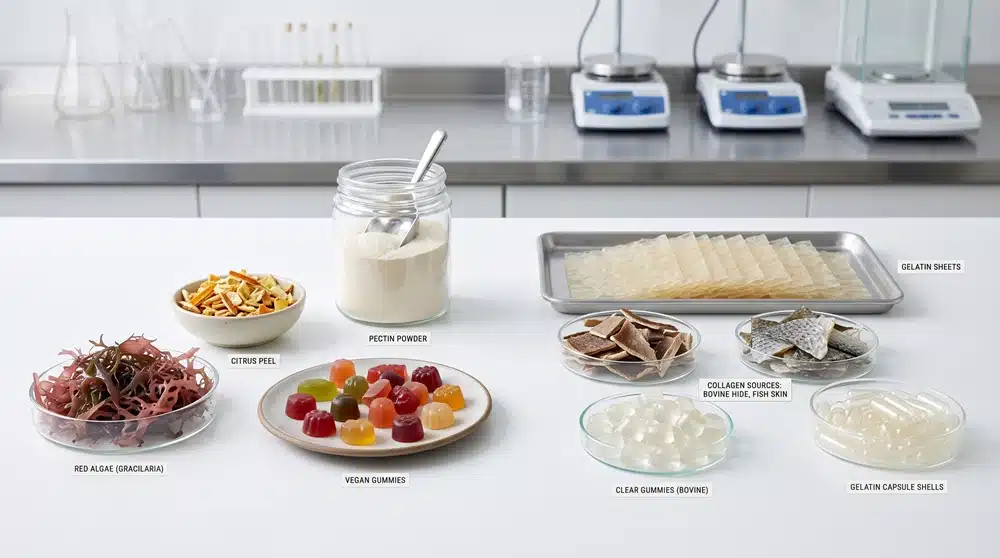
Vegetarian gelatin is a consumer term for animal-free gelling agents that mimic gelatin’s setting function. It is usually not true gelatin because it is not collagen protein. Most vegetarian or vegan gelatin systems are polysaccharides, such as agar from red algae, pectin from fruit cell walls, carrageenan from seaweed, or cellulose-based materials used in vegetarian capsules.
In food formulation, the right choice depends on the final product: agar creates a firm and heat-stable gel, pectin is often used for fruit-forward gummies and jams, carrageenan supports creamy or elastic textures in dairy and plant-based dairy systems, and cellulose materials are mainly used for capsules rather than dessert gels.
What is animal gelatin?
Animal gelatin is a protein-based gelling agent produced by partial hydrolysis of collagen from animal skin, bone and connective tissue. Food, confectionery and supplement brands use animal gelatin when they need clear gels, elastic chew, foam stabilization, gummy texture, marshmallow bounce, softgel or hard capsule shells, and thermoreversible gels that melt in the mouth.
Unlike agar, pectin and carrageenan, animal gelatin is measured by Bloom strength. Commercial edible gelatin commonly ranges from low to high Bloom grades, and the Bloom value helps formulators predict gel firmness, dosage level and texture in gummies, desserts and capsule shells.
Source and Composition
Animal gelatin: Animal gelatin is recovered from collagen by hydrolysis. Common raw materials include bovine hide, porcine skin, bovine bone and fish skin or scales, depending on the grade and market requirements. Chemically, gelatin is a mixture of amino-acid-based protein fragments rather than a single molecule. Its performance is affected by molecular weight distribution, pH, concentration, heating history and Bloom strength.
Vegetarian or vegan gelatin alternatives: Plant-based gelatin alternatives are usually hydrocolloids rather than collagen proteins. Agar is obtained from red algae and forms a firm gel after heating and cooling. Pectin is a polysaccharide found in fruit and vegetable cell walls, with commercial pectin commonly extracted from citrus peel or apple pomace. Carrageenan is extracted from red seaweed and is used as a gelling, thickening and stabilizing agent, especially in dairy, plant-based dairy, water-based gels and processed foods.
Important distinction: because agar, pectin and carrageenan are polysaccharides, they do not provide the collagen-derived amino acid profile of animal gelatin. They can replace gelatin’s texturizing role in many products, but they do not replace animal gelatin as a collagen protein source.
| Attribute | Vegetarian / vegan gelling systems | Animal gelatin | Formula implication |
|---|---|---|---|
| Primary material | Polysaccharides such as agar, pectin, carrageenan; cellulose materials for capsules | Collagen-derived peptides/proteins | Do not call plant hydrocolloids “collagen” or “true gelatin”. |
| Typical source | Red algae, citrus peel/apple pomace, seaweed, plant cellulose | Bovine, porcine, fish or other animal collagen sources | Source affects claims, allergen review, religion and consumer acceptance. |
| Gel strength measure | Usually not measured by Bloom; each hydrocolloid has its own gel test | Bloom strength; commercial edible gelatin often 50-300 Bloom | Bloom is useful for animal gelatin purchasing and recipe control. |
| Texture | Agar: firm/brittle; pectin: clean fruit chew; carrageenan: creamy/elastic depending type | Elastic, clear, bouncy, melt-in-the-mouth | Texture target determines the best system. |
| Heat behavior | Agar gels after cooling to around 30-40°C and melts around 90-95°C; pectin/carrageenan vary by formula | Thermoreversible; prolonged heating in solution can weaken gel strength and viscosity | Agar can hold better at warm room temperature; gelatin gives better mouth melt. |
| Diet fit | Usually vegetarian/vegan, but certification and processing aids still matter | Not vegan or vegetarian; halal/kosher depends on animal source and certification | Avoid absolute halal/kosher statements without certificate review. |
| Best-fit applications | Vegan gummies, fruit gels, jelly cups, jams, plant-based dairy, vegetarian capsules | Classic gummies, marshmallows, desserts, softgels, hard capsules, protein-containing products | Use application-based product recommendations. |
Texture and Use
Animal gelatin is usually chosen when a product needs elasticity, bounce, clarity and a soft melt-in-the-mouth finish. This is why it remains common in classic gummy candies, marshmallows, gelatin desserts, softgels and hard capsules. Higher Bloom gelatin can create firmer gels at lower use levels, while lower Bloom gelatin can support softer textures.
Vegetarian gelatin alternatives can work very well, but the texture is ingredient-specific. Agar is firm, clean-cut and more heat-stable, but it can feel brittle compared with animal gelatin. Pectin is useful for fruit gels and pectin gummies with a shorter, cleaner bite. Carrageenan is useful when formulators need thickening, stabilization or creamy gel structure in dairy and plant-based dairy systems. Because each system behaves differently, a plant-based formula should be developed around the chosen hydrocolloid rather than converted gram-for-gram from a gelatin formula.
| Application | Best Starting Point | Why | Manufacturing Note |
|---|---|---|---|
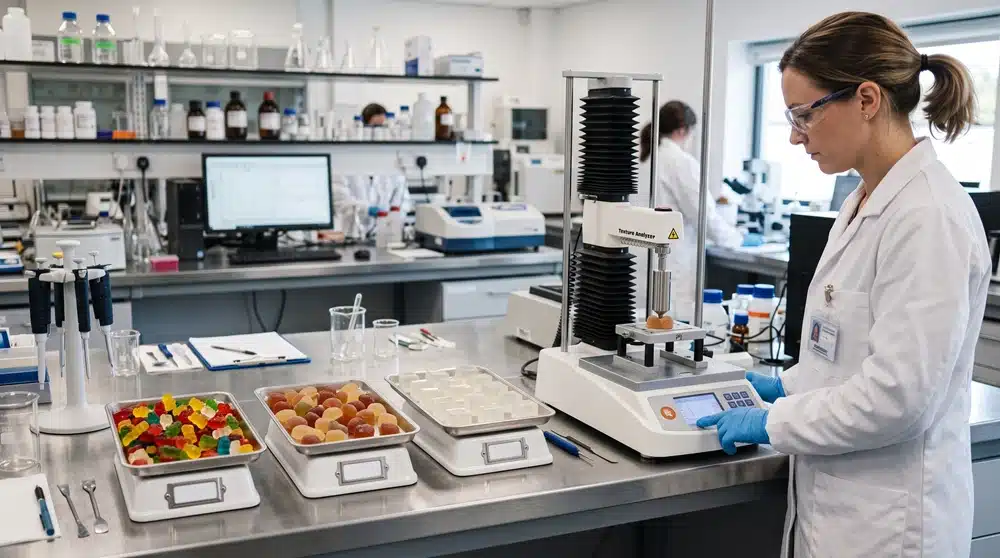
| Classic gummy chew | Animal gelatin | Elastic, bouncy, familiar chew and good clarity. | For vegan gummies, test pectin or pectin/agar blends instead of direct replacement. |
| Vegan gummies | Pectin or customized plant-based blend | Better label fit for vegan and vegetarian consumers. | Control pH, solids, moisture and drying to avoid sweating or weak bite. |
| Jelly cups / firm slices | Agar | Firm set and higher heat stability. | May be more brittle and less melt-in-mouth than gelatin. |
| Fruit jams and gels | Pectin | Works with fruit acidity and sweetness systems. | HM/LM pectin selection depends on sugar, acid and calcium system. |
| Creamy dairy gels | Carrageenan | Supports thickening, stabilizing and creamy texture. | Choose kappa/iota/lambda based on gel target and ions/proteins. |
| Hard capsules | Gelatin or vegetarian cellulose-based capsule | Gelatin is common; HPMC/pullulan support vegetarian/vegan positioning. | Learn more about capsule manufacturing considerations. |
| Softgels | Animal gelatin shell; vegetarian options require specialized systems | Animal gelatin is still common for softgel shells. | Review softgel manufacturing feasibility per formula. |
Dietary and Ethical Considerations
For vegan and vegetarian consumers, conventional animal gelatin is not suitable because it is derived from animal collagen. Plant-based systems such as agar, pectin, carrageenan and cellulose-based capsules are better starting points for vegetarian or vegan label positioning.
For halal and kosher markets, do not assume that all animal gelatin is unacceptable or that all plant-based systems automatically meet the requirement. Animal gelatin may be halal or kosher only when the animal source, slaughter/process controls, facility handling and certification meet the target market’s standard. Plant-based hydrocolloids may still require certification review because processing aids, carriers and cross-contact can affect the claim.
For B2B supplement projects, the safest approach is to select the gelling system first, then verify the specification, origin statement, allergen status, GMO status when relevant, halal/kosher certificate and vegan/vegetarian suitability before printing claims on the label.
Health Considerations
Animal gelatin is a protein ingredient derived from collagen. It contains amino acids such as glycine, proline and hydroxyproline, which are associated with collagen structure. However, the benefits of gelatin should not be overstated in a food or supplement article unless the claim is supported by the final product formula, dosage, market regulation and scientific evidence.
Vegetarian gelatin alternatives such as agar, pectin and carrageenan are mainly polysaccharides rather than protein. They can provide texture, thickening and gel formation, but they do not provide collagen-derived protein or the same amino acid profile as animal gelatin.
For supplement brands, this means the choice is both a texture decision and a positioning decision: animal gelatin supports collagen-derived protein identity, while plant-based systems support vegan or vegetarian claims and may be better for products where the gelling function is more important than protein content.
Substitution: can vegetarian gelatin replace animal gelatin?
Vegetarian gelatin alternatives can replace animal gelatin in many formulas, but they should not be treated as a universal 1:1 replacement. Gelatin strength depends on Bloom, concentration, pH, sugar level, processing temperature and setting time. Plant-based hydrocolloids depend on different variables: agar needs sufficient heat to dissolve, pectin depends on pH, sugar and/or calcium system, and carrageenan depends on type, ions and interaction with proteins or other gums.
- Define the target texture first: bouncy chew, firm slice, spoonable gel, creamy set, capsule shell or heat-stable jelly.
- Choose the hydrocolloid family based on that target, not just on the word “vegan.”
- Run a small pilot batch before scaling up. Track hydration temperature, cooking temperature, pH, soluble solids, cooling profile, demolding time, water activity, syneresis and texture after storage.
- Validate before approval: Do not approve a plant-based replacement until the product passes taste, texture, stability and label-claim review.
Common substitution mistakes include using agar when the target is a soft gelatin-like chew, adding pectin without controlling acidity or calcium, overheating animal gelatin for too long, or assuming a vegetarian capsule material will behave like a food gel.
Heat Stability, Cold Set and Processing Differences
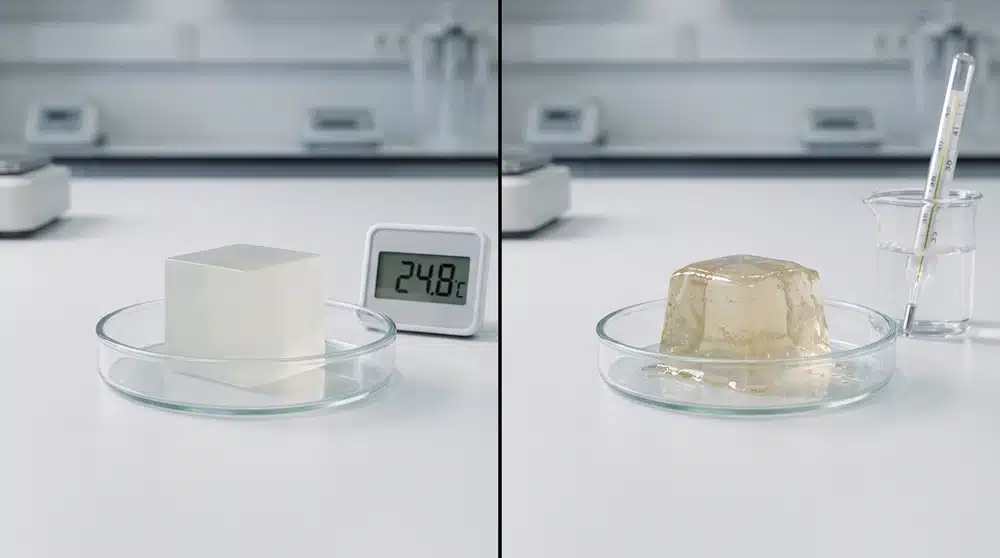
Heat stability is one of the biggest differences between animal gelatin and plant-based gelling systems. Agar is known for strong thermal hysteresis: it forms a gel when a hot solution cools and does not melt again until a much higher temperature. This makes agar useful for firm gels that need better warm-room stability, but it also creates a firmer, less melt-in-the-mouth bite.
Animal gelatin behaves differently. It forms a thermoreversible gel and is valued for its soft mouth melt, but prolonged heating in solution can gradually reduce gel strength and viscosity. For gelatin formulas, avoid unnecessary long hold times at elevated temperature and validate the process when the formula is acidic or contains enzymes.
Cold-set desserts also differ. Animal gelatin can be bloomed, dissolved in warm liquid and set by chilling. Agar usually must be fully hydrated by boiling before it sets. Pectin and carrageenan require formula-specific controls, so the best cold-set system depends on acidity, minerals, proteins, sugar level and target texture.
fAQs
Conclusion
if you are interested in purchasing or want to learn more about high quality vegetarian gelatin and animal gelatin raw materials, reach out to us at sales@collagensei.com. At Gensei Global Industries, we are an FDA-certified manufacturer offering ISO, HALAL, KOSHER, and MSC certifications. With warehouses in California and New York, we provide a reliable supply of raw materials, backed by third-party testing and complete certification for peace of mind. Explore our extensive product range, including OEM and ODM services, to find the right solutions for your business needs.
references
- GMIA Gelatin Handbook: https://nitta-gelatin.com/wp-content/uploads/2018/02/GMIA_Gelatin-Handbook.pdf
- FAO agar source and thermal properties: https://www.fao.org/4/ab730e/ab730e03.htm
- USDA ARS pectin: https://www.ars.usda.gov/news-events/news/research-news/2007/great-expectations-for-pectin/
- USDA AMS carrageenan technical report: https://www.ams.usda.gov/sites/default/files/media/Carrageenan%20TR%202011.pdf
- PubMed: Collagen and gelatin: https://pubmed.ncbi.nlm.nih.gov/25884286/
- PETA: What is gelatin made of?: https://www.peta.org/faq/what-is-gelatin-made-of/
- The Humane League: What is gelatin?: https://thehumaneleague.org/article/what-is-gelatin
- Simply Desserts: gelatin vs plant-based gelatin: https://simplydesserts.us/sd-blog/gelatin-everything-you-need-to-know/
- Healthline: Collagen vs gelatin: https://www.healthline.com/nutrition/collagen-vs-gelatin
- VegNews: Is gelatin vegan?: https://vegnews.com/guides/gelatin-vegan
- Collagensei: Gummy Supplement Manufacturer: https://collagensei.com/gummy-supplement-manufacturer/
- Collagensei: Capsule Supplement Manufacturer: https://collagensei.com/capsule-supplement-manufacturer/
- Collagensei: Softgel Capsule Manufacturer: https://collagensei.com/softgel-capsule-manufacturer/
- Collagensei: Custom Formula Supplement Manufacturer: https://collagensei.com/custom-formula-supplement-manufacturer/
- Collagensei: Supplement Quality Control: https://collagensei.com/supplement-quality-control/
- Collagensei: Collagen VS Gelatin: https://collagensei.com/collagen-vs-gelatin/
- Collagensei: Joint Health Ingredients: https://collagensei.com/joint-health-ingredients/
- Collagensei: Wholesale Collagen Peptides: https://collagensei.com/wholesale-collagen-peptides/
- Collagensei: Custom Private Label Supplement: https://collagensei.com/custom-private-label-supplement/

Warren Wan is a seasoned expert with extensive experience in the dietary supplement supply chain, possessing rich practical experience in the research, development, process control, and global sourcing of core ingredients such as collagen peptides, bone broth protein, and keratin. As the author of this column, he is dedicated to stripping away the marketing packaging, transforming obscure ingredient science and production quality control standards into easy-to-understand, hardcore science popularization, helping readers understand the truth behind the labels and make more rational health choices.