
For dietary supplement brand owners, sports-nutrition formulators, and private-label teams, Coenzyme Q10 and L-Carnitine are often evaluated together because they support two different steps of cellular energy metabolism. L-Carnitine helps transport long-chain fatty acids into mitochondria for beta-oxidation, while CoQ10 supports electron transfer in the mitochondrial respiratory chain and helps maintain cellular antioxidant balance. The formulation challenge is that CoQ10 is fat-soluble and poorly suited to simple dry capsules, while many L-carnitine forms are water-soluble, high-dose, and moisture-sensitive. [Cite: NIH ODS Carnitine; NCCIH Coenzyme Q10]
This guide compares CoQ10 and L-Carnitine from both a nutrition-science and manufacturing perspective: mechanism, best use cases, dosage-form selection, softgel versus capsule feasibility, quality-control tests, and FDA-compliant structure/function claim language.
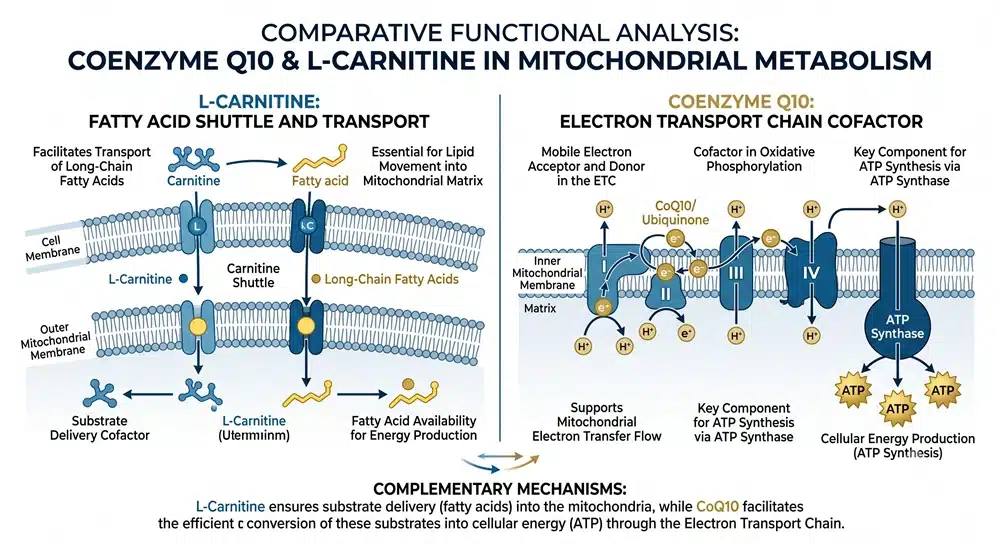
CoQ10 and L-Carnitine are complementary but not interchangeable. L-Carnitine moves fatty acids into mitochondria, while CoQ10 helps the mitochondrial electron transport chain convert fuel into ATP. For supplement brands, the key decision is dosage form: CoQ10 favors lipid-based softgels or enhanced powders; L-carnitine often requires moisture-controlled capsules, tablets, or powder blends.
Coenzyme Q10 – What is it?
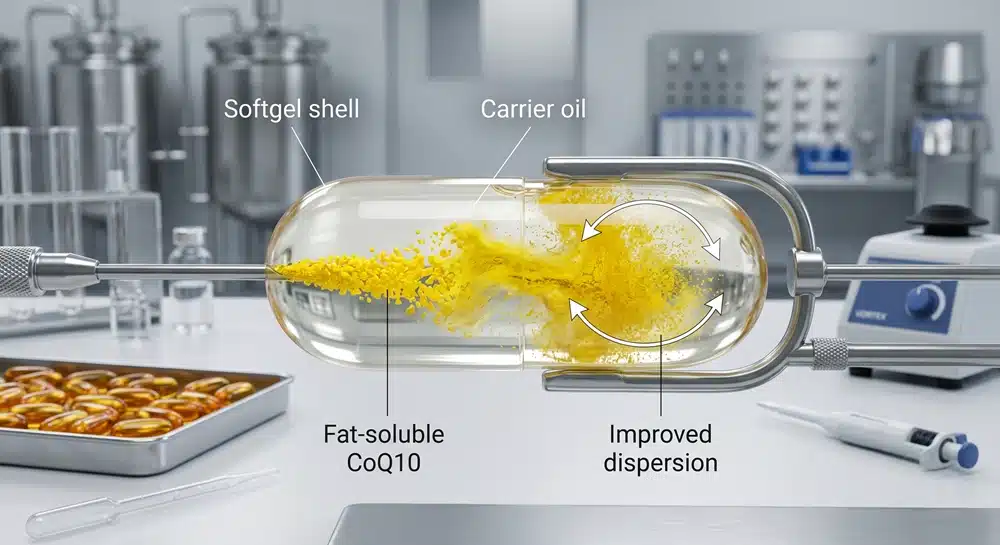
Coenzyme Q10 (CoQ10, ubiquinone/ubiquinol) is a fat-soluble quinone located in cellular membranes and mitochondria. In energy formulas, CoQ10 is best positioned as a mitochondrial electron-transfer cofactor and lipid-phase antioxidant, not as a stimulant. Because crystalline CoQ10 has low water solubility and poor powder dispersibility, its commercial performance depends strongly on carrier oil selection, particle-size control, and dosage-form engineering.
CoQ10 is naturally present in the body and participates in the mitochondrial electron transport chain, where cells produce adenosine triphosphate (ATP). Levels can vary with age, diet, health status, and medication use. In dietary supplement copy, compliant language should focus on structure/function support such as “supports cellular energy production” or “helps maintain antioxidant status,” rather than disease-treatment outcomes.
Why should you take Coenzyme Q10?
For Cellular Energy and Active Lifestyles
CoQ10 supports the energy-production machinery inside mitochondria. This makes it relevant for sports nutrition, daily vitality, and active-aging products. However, formula claims should avoid promising treatment of fatigue or medical conditions. A compliant product page should describe support for cellular energy metabolism and antioxidant balance.
For Heart-Health Positioning
The heart is a high-energy organ, so CoQ10 is commonly positioned in cardiovascular wellness formulas. Evidence quality varies by outcome and population, so B2B copy should use conservative wording such as “supports heart health” and should avoid implying treatment of heart failure, heart attack, or statin side effects unless claims have been reviewed by qualified regulatory counsel.
As a Lipid-Phase Antioxidant
CoQ10 is often discussed as an antioxidant because the reduced form, ubiquinol, participates in lipid-phase redox activity. In finished products, this also creates a formulation concern: oxygen, heat, and carrier-oil quality can affect product stability. Brands should request appropriate raw-material and finished-product specifications before launch.
How to choose the best coenzyme Q10 supplement?
1. Ubiquinone vs Ubiquinol
Ubiquinone is the oxidized form of CoQ10 and is widely used in supplements. Ubiquinol is the reduced form and is often positioned as more directly bioavailable, especially for older adults. The best choice depends on target market, cost, stability, dosage form, and label positioning.
2. Sourcing and Manufacturing Quality
For B2B buyers, CoQ10 sourcing should include identity, assay, residual solvent where applicable, heavy metals, microbiology, and stability data. Naturally fermented CoQ10 is common in premium products, but the dosage form matters just as much as the raw material.
Formulator’s note: CoQ10 is rarely a “simple powder” ingredient in high-performing commercial formulas. For oil-based CoQ10 softgels, the main variables are CoQ10 assay, carrier oil type, suspended-particle uniformity, fill viscosity, oxygen exposure, shell compatibility, and peroxide control in the oil phase. For dry capsules or tablets, brands should ask whether the CoQ10 is standard crystalline powder, micronized CoQ10, beadlet, emulsified powder, or another enhanced-dispersion form. Brands can review these options through Custom Formula Supplement Manufacturing or Softgel Capsule Manufacturing.
3. Dosage and Bioavailability
Commercial CoQ10 doses commonly range from 100 mg to 200 mg per serving, but the right dose depends on positioning and product format. Since CoQ10 is fat-soluble, lipid carriers, softgels, emulsified powders, or beadlet technologies may improve consumer experience compared with plain crystalline powder.
when is best time to take coenzyme q10
CoQ10 is generally best taken with a meal containing fat because it is fat-soluble. Morning use is popular for daily energy-positioned products, while evening use may work for consumers who tolerate it well. From a label standpoint, “take with food” is often a safer, more practical instruction than promising immediate energy effects.
The Golden Rule: Take It with a Meal
This is the most critical piece of advice. CoQ10 is a fat-soluble compound, meaning it needs fat to be properly absorbed by your body. Taking your supplement on an empty stomach will significantly reduce its effectiveness. To ensure optimal absorption, always take your CoQ10 with a meal that contains healthy fats, such as:
- Avocado
- Nuts and seeds
- Olive oil or other healthy cooking oils
- Fatty fish like salmon or tuna
- Eggs
Many CoQ10 supplements, especially the popular softgel varieties, are already suspended in an oil base to improve bioavailability, but pairing it with a meal is still the best practice.
Morning or Evening?
This is where personal preference and a little self-observation come in.
- Morning: Many people choose to take CoQ10 with breakfast. This can be a great option because CoQ10 is involved in energy production, so taking it in the morning can help support your energy levels throughout the day. It also helps establish a consistent routine, which is vital for seeing long-term benefits from any supplement.
- Evening: For some, taking CoQ10 with dinner can be a good choice, especially if it’s their largest meal of the day with the most fat content. However, a small number of people report that CoQ10 has an “energizing” effect that can interfere with sleep. If you find yourself feeling restless after a late-night dose, it’s best to switch to the morning.
The Bottom Line: Consistency is Key
While timing can influence how you feel, consistency is what truly matters. It can take several weeks to build up CoQ10 levels in your body to a therapeutic level. The most effective strategy is to pick a time of day that you’ll remember to take your supplement every single day, whether that’s with your morning coffee and eggs or with your evening meal. Just remember to pair it with some healthy fats for the best results.
L-Carnitine – What is it?
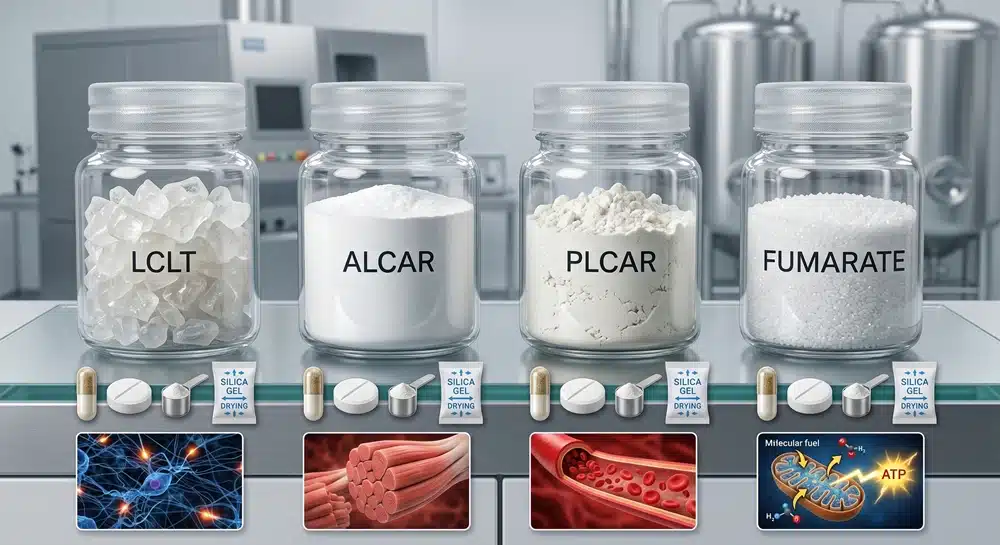
L-Carnitine is a conditionally essential nutrient involved in the transport of long-chain fatty acids into mitochondria, where fatty acids can be oxidized for energy. In supplement formulation, L-Carnitine is not a single material choice: L-carnitine base, L-carnitine L-tartrate, acetyl-L-carnitine, propionyl-L-carnitine, and fumarate forms differ in target use case, taste, powder behavior, hygroscopicity, dose size, and capsule-filling feasibility.
L-Carnitine is naturally produced in the body and is also found in foods, especially animal-derived foods. In supplements, it is often used in active-lifestyle, sports-recovery, weight-management-support, and men’s performance formulas. Compliant language should focus on “supports fat metabolism” or “supports exercise recovery,” not guaranteed fat loss.
Why should you take L-Carnitine?
Supporting Fatty Acid Transport
L-Carnitine helps transport long-chain fatty acids into mitochondria. This is the strongest mechanistic explanation for why it is paired with CoQ10: one ingredient helps move fuel into the mitochondria, while the other supports the mitochondrial electron-transfer process.
Exercise Performance and Recovery Positioning
L-Carnitine L-tartrate is widely used in sports nutrition formulas. It is commonly positioned around exercise recovery and active lifestyles. Brands should avoid claiming that L-Carnitine alone causes fat loss or directly treats fatigue. For sports products, Sports Nutrition Contract Manufacturing can help determine whether capsules, tablets, powders, or daily packs are most feasible.
Cognitive and Specialty Positioning
Acetyl-L-Carnitine is commonly used in cognitive and mental-energy formulas because of its acetylated structure and positioning. It should not be automatically substituted for L-carnitine L-tartrate in sports formulas without reviewing target market, dose, taste, and product format.
How to choose the best L-Carnitine supplement?
Start with the intended product claim and format. If the product is a sports nutrition powder, L-carnitine L-tartrate may be practical. If the product is a capsule for cognitive support, acetyl-L-carnitine may be more relevant. If the product targets general energy with CoQ10, consider whether a single capsule, tablet, powder stick, or dual-format pack can deliver the required dose without compromising stability.
L-Carnitine formulas should be checked for assay, loss on drying, particle size, flowability, taste, odor, heavy metals, and microbiology. Hygroscopicity is especially important in capsules and powder blends. Poor moisture control can cause clumping, weight variation, and shorter shelf-life perception.
Safety Note for Men’s Performance Formulas: L-Carnitine, Synephrine, SR9011 and GW0742
L-Carnitine is a legal dietary supplement ingredient when used in compliant dietary supplement products. Synephrine is a stimulant-like bitter-orange compound that requires careful dose, caffeine, blood-pressure, and warning-label review. SR9011 and GW0742/GW1516-type compounds are not appropriate dietary supplement ingredients and should not be positioned as part of a legal supplement formula. Athletes should also be aware that GW1516/Cardarine-type metabolic modulators are prohibited in sport and have been associated with anti-doping risks.
For men’s performance or active-lifestyle formulas, the safer B2B pathway is to build around permitted ingredients, transparent labels, third-party contaminant screening, and compliant structure/function language such as “supports energy metabolism” or “supports exercise recovery.” Avoid disease-treatment claims, steroid-like positioning, and any implication that a formula contains or replaces prohibited research chemicals.
Coenzyme Q10 and L-Carnitine:the key differences
CoQ10 and L-Carnitine are often sold together, but they are not the same ingredient. CoQ10 supports the mitochondrial electron-transfer chain and lipid-phase antioxidant systems. L-Carnitine supports fatty acid transport into mitochondria. This distinction matters because it affects both the consumer story and the finished dosage form.
Here is a form to help you understand the key differences between Coenzyme Q10 and L-Carnitine:
| Comparison Point | Coenzyme Q10 (CoQ10) | L-Carnitine | B2B Formulation Implication |
|---|---|---|---|
| Core mechanism | Supports electron transfer in the mitochondrial respiratory chain and cellular antioxidant balance. | Supports long-chain fatty acid transport into mitochondria for beta-oxidation. | They are complementary, not interchangeable. |
| Solubility profile | Fat-soluble, poorly suited to simple water-based delivery. | Generally water-soluble; many forms are moisture-sensitive. | CoQ10 often favors softgels or lipid carriers; L-carnitine favors capsules, tablets, powders or split-dose systems. |
| Common commercial dose | Often 100–200 mg/day depending on formula positioning. | Often 500–2,000 mg/day depending on form and use case. | L-carnitine dose size can drive capsule count and packaging strategy. |
| Quality-control focus | Assay by HPLC/UPLC, oxidation state, carrier oil quality, peroxide value where oil-based. | Assay, identity, loss on drying, heavy metals, microbiology and flowability. | Combined formulas require separate release specifications for each active. |
| Best-fit product formats | Softgels, lipid-based liquids, enhanced-dispersion powders, beadlets. | Capsules, tablets, powder sticks, RTD shots, sports nutrition blends. | Dual-capsule packs may outperform one-capsule “everything together” designs. |
Why They Work Better Together
Their synergy is best explained as fuel delivery plus energy conversion support. L-Carnitine helps move long-chain fatty acids into mitochondria, while CoQ10 supports mitochondrial electron transfer. Together, they are suitable for daily energy, heart-health-support, sports nutrition, active aging, and stimulant-free performance formulas.
From a formulator’s viewpoint, “better together” does not always mean “best in the same capsule.” A 100 mg CoQ10 oil softgel and a 1,000 mg L-carnitine powder serving may require different manufacturing platforms. For premium products, consider a dual-format daily pack: one CoQ10 softgel for lipid-phase absorption plus one L-carnitine capsule, tablet or powder stick for dose efficiency.
Manufacturing Insights: CoQ10 + L-Carnitine Formulation Challenges
CoQ10 and L-Carnitine look simple on a label, but they behave very differently in production. CoQ10 is lipophilic and performs better when dispersed in an oil phase or engineered into enhanced-dispersion powder. L-Carnitine forms are usually higher-dose materials, and many are hygroscopic, which can reduce flowability, increase clumping risk, and create capsule-weight variation under poor humidity control.
A practical factory review should start with four questions: (1) Is the formula one-dose or split-dose? (2) Is CoQ10 delivered as oil suspension, beadlet, micronized powder, or emulsified powder? (3) Which L-carnitine form best matches the target claim and dosage form? (4) What release specifications will confirm identity, assay, microbial quality, heavy metals, moisture, and capsule/tablet uniformity?
For combined products, GENSEI can position feasibility around softgel + capsule dual packs, powder sticks with enhanced CoQ10 dispersion, or capsule formulas using carefully selected excipients.
conclusion
Coenzyme Q10 and L-Carnitine are a strong pairing for stimulant-free energy formulas because they support different steps of mitochondrial energy metabolism. CoQ10 supports electron transfer and lipid-phase antioxidant balance, while L-Carnitine supports fatty acid transport into mitochondria. For consumers, the key point is that they are complementary. For supplement brands, the key point is that their material properties demand different dosage-form decisions, release tests, and stability controls.
A strong CoQ10 + L-Carnitine product should not be built only from marketing claims. It should be built from validated raw materials, suitable dosage forms, moisture and oxidation control, batch-level COA documentation, and compliant structure/function language.
FAQs
references
- NIH Office of Dietary Supplements. “Carnitine Health Professional Fact Sheet.” Available at: https://ods.od.nih.gov/factsheets/Carnitine-HealthProfessional/
- NCCIH. “Coenzyme Q10.” Available at: https://www.nccih.nih.gov/health/coenzyme-q10
- PubChem. “Coenzyme Q10.” Available at: https://pubchem.ncbi.nlm.nih.gov/compound/Coenzyme-Q10
- PubMed. “CoQ10-loaded oleogels / bioavailability formulation reference.” Available at: https://pubmed.ncbi.nlm.nih.gov/30529659/
- FDA. “Structure/Function Claims.” Available at: https://www.fda.gov/food/nutrition-food-labeling-and-critical-foods/structurefunction-claims
- eCFR. “21 CFR 101.93 dietary supplement statements.” Available at: https://www.ecfr.gov/current/title-21/chapter-I/subchapter-B/part-101/subpart-F/section-101.93
- eCFR. “21 CFR Part 111 Dietary Supplement cGMP.” Available at: https://www.ecfr.gov/current/title-21/chapter-I/subchapter-B/part-111
- FDA. “Dietary supplement cGMP Small Entity Compliance Guide.” Available at: https://www.fda.gov/regulatory-information/search-fda-guidance-documents/small-entity-compliance-guide-current-good-manufacturing-practice-manufacturing-packaging-labeling
- USADA. “What should athletes know about GW1516?” Available at: https://www.usada.org/spirit-of-sport/what-should-athletes-know-gw1516/
- WADA. “Alert on GW501516.” Available at: https://www.wada-ama.org/en/news/wada-issues-alert-gw501516

Warren Wan is a seasoned expert with extensive experience in the dietary supplement supply chain, possessing rich practical experience in the research, development, process control, and global sourcing of core ingredients such as collagen peptides, bone broth protein, and keratin. As the author of this column, he is dedicated to stripping away the marketing packaging, transforming obscure ingredient science and production quality control standards into easy-to-understand, hardcore science popularization, helping readers understand the truth behind the labels and make more rational health choices.


