
L-Glutamine vs L-Carnitine: Benefits, Differences, Dosage, Safety and Supplement Formulation Guide
Quick answer: L-glutamine is best positioned for muscle recovery, immune support and gut-barrier support, while L-carnitine is best positioned for fatty-acid transport, energy metabolism and endurance or weight-management formulas. Neither replaces protein intake, creatine, training, sleep or a calorie-controlled diet. The better choice depends on whether your main goal is recovery/gut support or fat metabolism/endurance. Let’s break it down.
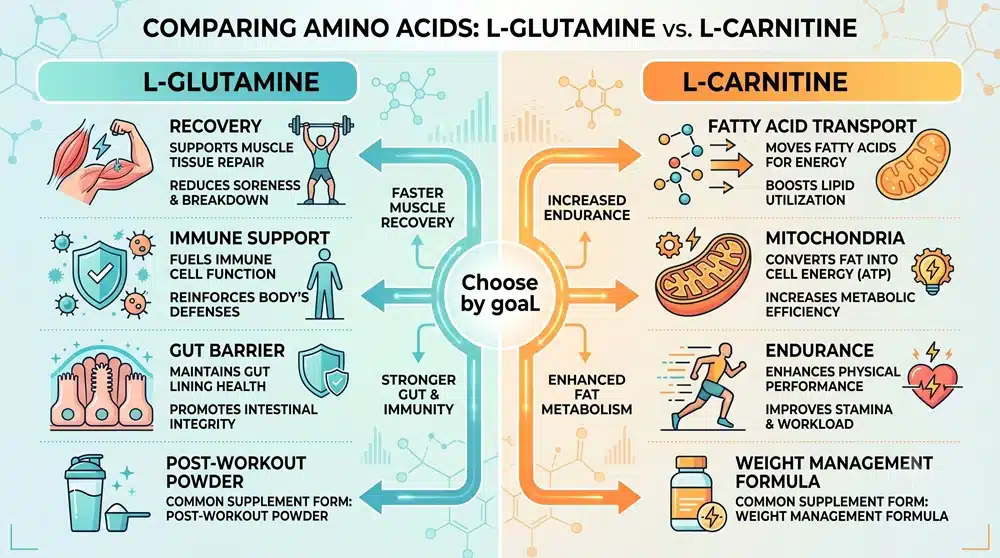
Understanding L-Glutamine and L-Carnitine: A Quick Overview
Before diving into the details, let’s clarify what these supplements are and their primary roles in the body.
- L-Glutamine is a conditionally essential amino acid. The body can make it, but demand may rise during illness, injury, intense training or other metabolic stress. It helps transport nitrogen, supports protein metabolism, and serves as a major fuel source for intestinal and immune cells. In supplement content, it is strongest when discussed around recovery, immune resilience and gut-barrier support rather than direct fat loss.
- L-Carnitine is an amino-acid derivative made from lysine and methionine. Its best-known role is helping long-chain fatty acids enter mitochondria, where they can be oxidized to produce ATP. This makes it more relevant to energy metabolism, endurance and weight-management positioning. It is not a stimulant and should not be presented as a stand-alone fat-loss solution.
While both are amino acid-related, their mechanisms and benefits differ significantly. Let’s explore each in depth.
L-Glutamine: The Recovery and Resilience Champion
How L-Glutamine Works
L-Glutamine is a versatile amino acid with multiple roles in the body. It serves as a fuel source for rapidly dividing cells, like those in your immune system and gut lining. During intense physical activity or stress, glutamine levels can drop significantly—sometimes by up to 50% after prolonged exercise—making supplementation valuable for certain individuals. Here’s what it does:
- Muscle Repair: Glutamine is a key component in protein synthesis, helping repair muscle tissue damaged during workouts and reducing muscle breakdown (catabolism).
- Immune Support: It fuels immune cells like lymphocytes and macrophages, maintaining your body’s defenses, especially during periods of overtraining or illness.
- Gut Health: Glutamine is the primary energy source for enterocytes (intestinal cells), supporting the integrity of the gut lining and potentially aiding conditions like leaky gut or irritable bowel syndrome.
What the evidence says about L-glutamine: The strongest rationale for L-glutamine is not that it directly builds muscle like protein or creatine, but that it supports cells with high glutamine demand. Reviews describe glutamine as an important fuel for immune cells and intestinal epithelial cells, and clinical research has investigated its role in gut permeability and IBS-D populations. For healthy athletes, however, evidence for broad improvements in body composition or aerobic performance is mixed. The most accurate claim is: L-glutamine may support recovery, immune function and gut-barrier health in specific contexts, especially when training stress, illness or digestive issues increase demand.
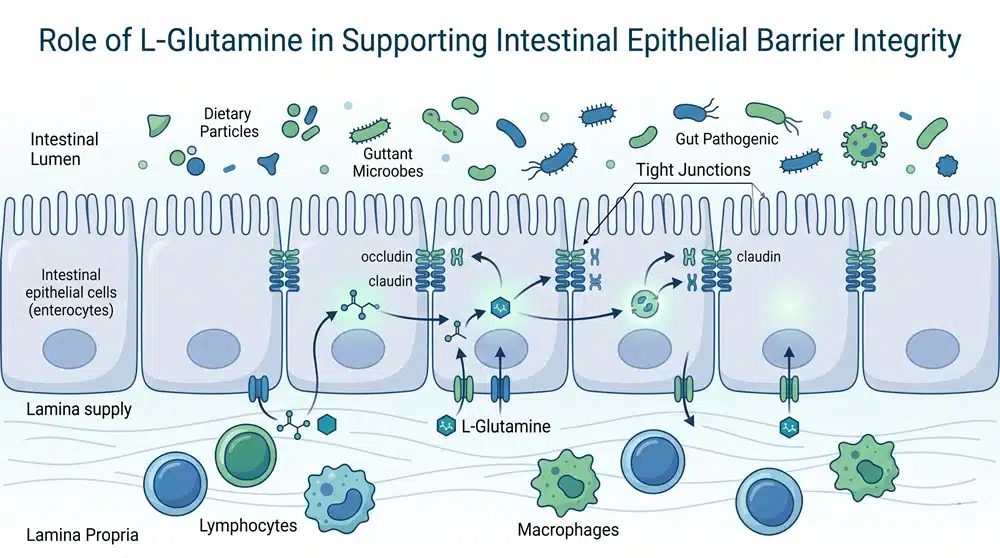
Benefits of L-Glutamine
- Accelerates Muscle Recovery: By reducing muscle breakdown and supporting protein synthesis, L-Glutamine can decrease post-workout soreness and speed recovery. Studies suggest it may lower markers of muscle damage, like creatine kinase, after intense exercise.
- Boosts Immune Function: Heavy exercise or stress can suppress immunity, increasing susceptibility to infections. L-Glutamine supplementation (typically 5-10 grams daily) has been shown to support immune cell activity, potentially reducing illness frequency in athletes.
- Improves Gut Health: Glutamine strengthens the intestinal barrier, reducing inflammation and permeability. This can benefit those with digestive disorders or those seeking to optimize nutrient absorption.
- May Enhance Hydration: Glutamine may help cells retain water, aiding hydration during endurance activities, which is especially useful for long-distance runners or cyclists.
Potential Side Effects
L-Glutamine is generally safe when taken at recommended doses (5-15 grams daily). However, there are a few considerations:
- Digestive Discomfort: High doses (above 20 grams daily) may cause bloating, nausea, or stomach cramps in some people.
- Kidney and Liver Concerns: Individuals with kidney or liver disease should avoid high doses, as these organs process amino acids. Consult a doctor if you have pre-existing conditions.
- Drug Interactions: Glutamine may interact with medications like lactulose or anticonvulsants, so medical advice is essential if you’re on prescription drugs.
Who Should Consider L-Glutamine?
L-Glutamine is ideal for:
- Athletes, especially bodybuilders or endurance runners, aiming to reduce muscle soreness and enhance recovery.
- Individuals under physical or mental stress, such as those recovering from surgery or dealing with chronic illness.
- People with digestive issues, like leaky gut, Crohn’s disease, or irritable bowel syndrome, seeking to support gut integrity.
L-Carnitine: The Fat-Burning and Energy Booster
How L-Carnitine Works
L-Carnitine plays a pivotal role in energy metabolism by shuttling long-chain fatty acids into mitochondria for oxidation, producing ATP (the body’s energy currency). This process is critical during exercise, when fat becomes a key fuel source. Your body makes L-Carnitine in the liver and kidneys, but levels can be low in vegetarians, older adults, or those with certain health conditions. Supplementation (typically 500-2000 mg daily) can boost its effects. Here’s what it does:
- Fat Metabolism: By transporting fats into mitochondria, L-Carnitine enhances fat burning, which may aid weight loss when paired with diet and exercise.
- Exercise Performance: It reduces fatigue and improves oxygen efficiency, allowing for longer, more intense workouts.
- Cardiovascular Support: L-Carnitine supports heart muscle energy production, potentially improving circulation and reducing symptoms in heart conditions.
How the carnitine shuttle works: Long-chain fatty acids cannot efficiently enter the mitochondrial matrix on their own. L-carnitine helps form acyl-carnitine, which is transported across the mitochondrial membrane system and converted back to acyl-CoA for beta-oxidation. In practical terms, this means L-carnitine supports the logistics of fat use for energy. It does not force fat loss by itself; diet, training, total energy balance and metabolic status still determine results.
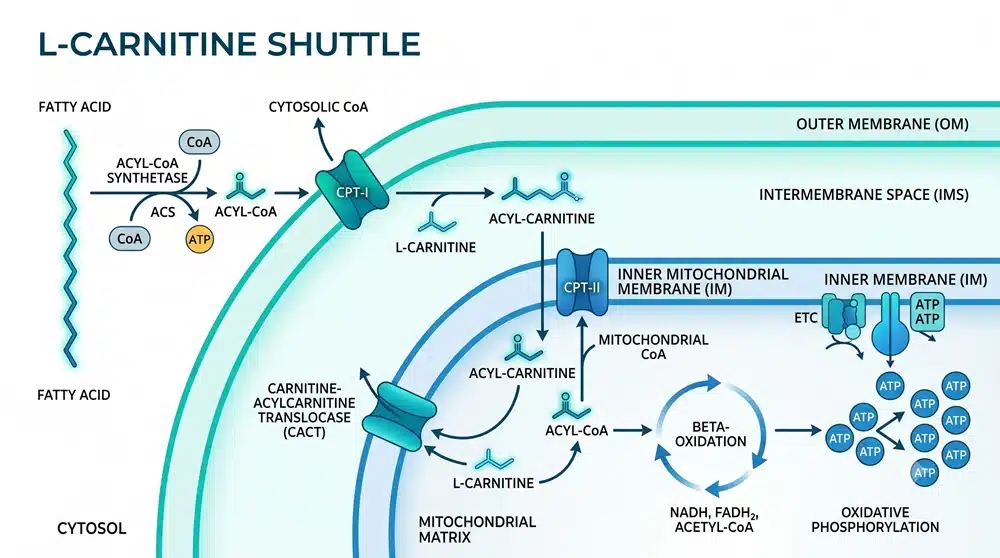
Benefits of L-Carnitine
- Aids Fat Loss: Supports weight-management programs, but is not a magic fat burner: A 2016 systematic review and meta-analysis of randomized controlled trials found that adults taking carnitine lost about 1.33 kg more body weight than placebo on average. Later meta-analyses also report small but significant reductions in body weight, BMI or fat mass, with effects more relevant in overweight or obese populations. The practical takeaway is that L-carnitine may support a weight-management program, but it should be paired with exercise, adequate protein intake and an energy-controlled diet.
- Enhances Endurance: By sparing glycogen and increasing fat utilization, L-Carnitine can delay fatigue, benefiting endurance athletes like marathon runners or cyclists.
- Supports Heart Health: Studies suggest L-Carnitine may reduce symptoms of angina and improve exercise capacity in people with heart failure. It’s also linked to better lipid profiles.
- Reduces Muscle Damage: L-Carnitine may lower markers of muscle stress, complementing its role in recovery for active individuals.
Potential Side Effects
L-Carnitine is well-tolerated at standard doses, but there are potential drawbacks:
- Gastrointestinal Issues: Some users report nausea, diarrhea, or a fishy body odor (due to trimethylamine production) at doses above 2 grams.
- Cardiovascular Debate: A 2013 study linked high L-Carnitine intake to increased TMAO (trimethylamine N-oxide) levels, which may raise heart disease risk in some people. However, this is controversial and not fully conclusive.
- Thyroid Interference: L-Carnitine may reduce thyroid hormone activity, so those with hypothyroidism should consult a doctor.
Who Should Consider L-Carnitine?
L-Carnitine is best for:
- Individuals focused on weight loss or fat reduction, especially when combined with exercise.
- Endurance athletes, like runners or swimmers, seeking to improve stamina and reduce fatigue.
- Older adults or those with heart conditions looking to support cardiovascular health.
L-Glutamine vs L-Carnitine: A Detailed Comparison
To choose the right supplement, let’s compare L-Glutamine and L-Carnitine across key factors.
| Question / goal | Better fit | Why | Common use context | Watch-outs |
| Post-workout recovery | L-Glutamine or both | Glutamine is linked to nitrogen transport, immune cells and gut cells; carnitine may also help exercise-induced muscle damage in some studies. | Glutamine 5 g post-workout; LCLT often used in recovery formulas. | Glutamine is not a substitute for total protein or creatine. |
| Fat metabolism / weight management | L-Carnitine | Carnitine supports fatty-acid transport into mitochondria; human weight-loss effects are modest and context-dependent. | Often 500-2,000 mg/day in capsules, liquids or pre-workout powders. | Do not position as a stand-alone fat burner. |
| Endurance and energy metabolism | L-Carnitine | More relevant to long-chain fatty-acid oxidation and exercise energy logistics. | Pre-workout or daily use; L-carnitine L-tartrate is common in sports formulas. | Effects can take weeks and vary by diet/training. |
| Gut-barrier support | L-Glutamine | Enterocytes use glutamine as a fuel source; studies examine permeability and IBS-D contexts. | Powders, sachets and capsules for gut health formulas. | Avoid implying it treats disease unless compliant with local regulations. |
| Vegetarian/vegan relevance | Usually L-Carnitine | Dietary carnitine is higher in animal foods; vegans/vegetarians may have lower dietary intake, although the body can synthesize some. | Vegan capsules or powders. | Assess whole diet and health status. |
| Best B2B dosage form | Depends on formula | L-glutamine needs higher serving size; L-carnitine form choice affects taste, hygroscopicity and pH. | Glutamine: powder/stick pack; carnitine: capsules/liquids/powders depending on form. | Confirm COA, assay, heavy metals, micro and stability. |
Evidence-Based Decision Guide: Which One Should You Choose?
Choose L-glutamine if your main question is: “How can I support recovery, immune resilience or gut-barrier function during high stress?” It is most relevant for recovery formulas, gut-health positioning and situations where training stress or digestive concerns increase demand.
Choose L-carnitine if your main question is: “How can I support fat transport, endurance or energy metabolism?” It fits better in weight-management, endurance, metabolic support and stimulant-free pre-workout formulas.
Choose both only when the formula has a clear reason: for example, a post-workout recovery powder that combines L-glutamine for recovery/gut support with L-carnitine L-tartrate for exercise recovery and fatty-acid transport. Avoid adding both just to make the label look more complete; every ingredient should have a dose, function and claim strategy.
Making the Right Choice: L-Glutamine, L-Carnitine, or Both?
Your choice depends on your health and fitness goals:
- Choose L-Glutamine if you’re focused on recovering from intense workouts, boosting immunity during stress, or improving gut health. It’s a great all-around supplement for athletes or those with digestive challenges.
- Choose L-Carnitine if your goal is to burn fat, enhance endurance, or support heart health. It’s particularly effective for weight loss plans or long-duration activities.
- Consider Both: L-Glutamine and L-Carnitine don’t interact negatively, so you can combine them. For example, take L-Glutamine post-workout for recovery and L-Carnitine pre-workout for energy. A typical stack might be 5 grams of L-Glutamine and 1 gram of L-Carnitine daily.
Practical Tips for Use
- Quality Matters: Choose reputable brands with third-party testing to ensure purity and potency.
- Follow Dosage Guidelines: Stick to 5-15 grams for L-Glutamine and 500-2000 mg for L-Carnitine daily, split into 1-2 doses.
- Consult a Professional: If you have health conditions (e.g., kidney, liver, thyroid, or heart issues), talk to a doctor or nutritionist before starting.
- Combine with Lifestyle: Supplements work best with a balanced diet, regular exercise, and adequate sleep.
Formulation and Manufacturing Notes for Supplement Brands
From a supplement manufacturing perspective, L-glutamine and L-carnitine are not interchangeable ingredients. They differ in serving size, taste impact, moisture sensitivity, formula positioning and best dosage form.
L-glutamine is typically used at gram-level servings, so it fits well in post-workout powders, recovery drink mixes, stick packs and gut-health powders. For capsules or tablets, the serving size may require multiple units. Brands should confirm assay, mesh size, bulk density, loss on drying, microbiology and heavy metals on the batch COA. Particle size and flowability matter when L-glutamine is blended with protein powders, electrolytes, creatine, collagen peptides or flavor systems.
L-carnitine requires more form selection. L-carnitine base, L-carnitine L-tartrate and acetyl-L-carnitine can behave differently in capsules, tablets, powders, gummies and liquids. L-carnitine L-tartrate is common in sports nutrition and recovery formulas; acetyl-L-carnitine is often chosen for cognitive-energy positioning; liquid L-carnitine formulas require attention to pH, flavor masking, preservation and stability. Some forms can be acidic or hygroscopic, so packaging, moisture control and compatibility testing are important.
For private-label brands, the best choice is not simply “which ingredient is stronger.” It is which ingredient form matches the target claim, serving size, dosage form, flavor system, market regulations and final product cost.
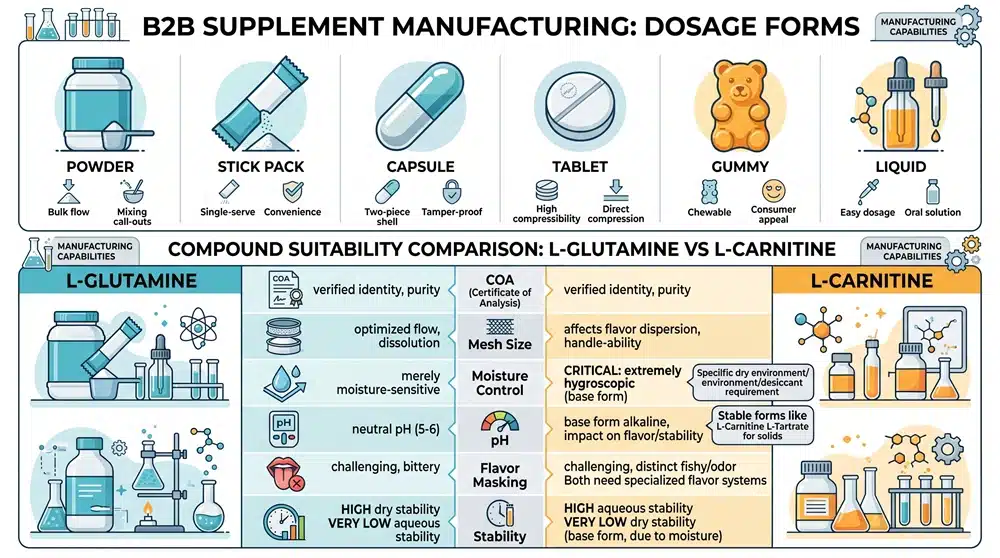
Safety, Contraindications and Claims Wording
For most healthy adults, both ingredients are generally well tolerated when used at typical supplement doses. However, people with kidney disease, liver disease, seizure disorders, thyroid conditions, cardiovascular disease, pregnancy, breastfeeding, cancer history or prescription medication use should speak with a healthcare professional before supplementing.
L-carnitine doses around 3 g/day or higher may increase the chance of nausea, abdominal cramps, diarrhea or a fishy body odor. Research has also explored the conversion of dietary L-carnitine into TMAO by gut microbiota, so brands should avoid making heart-health claims without appropriate regulatory review.
L-glutamine should also be positioned carefully. It may support gut-barrier function in specific contexts, but supplement content should not imply that it treats IBS, Crohn’s disease, leaky gut or other medical conditions unless the claim is legally permitted in the target market.
Conclusion: Your Path to Better Health
L-Glutamine and L-Carnitine are valuable tools for optimizing health and performance, but they serve distinct purposes. L-Glutamine excels at supporting muscle recovery, immune function, and gut health, making it a go-to for athletes and those with digestive concerns. L-Carnitine shines in fat metabolism, endurance, and cardiovascular support, ideal for weight loss and stamina goals. By aligning your choice with your needs—whether it’s faster recovery, fat burning, or both—you can maximize their benefits.
To get the most out of these supplements, choose high-quality products, follow dosing guidelines, and pair them with a healthy lifestyle. If you’re unsure which is best or whether to combine them, a healthcare provider or nutritionist can offer personalized advice. Ready to take your health to the next level? Pick the supplement that matches your goals and start your journey today!
FAQs
Can I take L-Glutamine and L-Carnitine together?
Yes, you can safely combine them as they target different functions. L-Glutamine aids muscle repair, immune support, and gut health, while L-Carnitine boosts fat metabolism and endurance. A common stack is 5 grams of L-Glutamine post-workout and 500-2000 mg of L-Carnitine pre-workout. Consult a healthcare provider if you have health conditions or take medications, as individual responses may vary.
Which is better for weight loss: L-Glutamine or L-Carnitine?
L-Carnitine is more effective for weight loss because it as it enhances fat oxidation during exercise. Studies show it may lead to help with 1-2 kg of fat loss over weeks when paired with diet and exercise. L-Glutamine supports weight loss indirectly by preserving muscle mass, which maintains your metabolism, but it’s not a direct fat burner. For fat loss, choose L-Carnitine, but combine with a calorie deficit for results.
Does L-Glutamine help with muscle gain?
L-Glutamine supports muscle gain by promoting protein synthesis and reducing muscle breakdown after intense training. It’s especially useful during heavy lifting or endurance workouts, potentially lowering muscle soreness. However, it’s not as anabolic as protein or creatine; it’s best for recovery to support consistent training, which drives muscle growth over time.
Can L-Carnitine improve my gym performance?
Yes, L-Carnitine can boost endurance by increasing fat utilization and sparing glycogen, allowing you to train harder and longer. Research shows improvements in exercise capacity, especially for cardio or high-intensity workouts. It’s most effective at 500-2000 mg taken 30-60 minutes before exercise, ideally as L-Carnitine L-Tartrate. Results may take 4-8 weeks to become noticeable.
Are L-Glutamine and L-Carnitine safe for long-term use?
Both are generally safe at recommended doses (L-Glutamine: 5-15 g/day; L-Carnitine: 500-2000 mg/day). L-Glutamine has minimal risks, though high doses may strain kidneys in those with pre-existing conditions. L-Carnitine is safe for most, but some studies suggest high doses (>3 g/day) may increase TMAO levels, potentially linked to heart risk, though evidence is mixed. Always consult a doctor for long-term use, especially with health concerns.
Do I need L-Glutamine or L-Carnitine if I eat a balanced diet?
If you eat a varied diet, you may get enough L-Glutamine from foods like eggs, dairy, and spinach, but intense exercise or stress can deplete levels, making supplementation helpful. L-Carnitine is found in meat and dairy, so vegetarians or those with low intake may benefit from supplements. If your goals include recovery or fat loss, supplements can provide a targeted boost beyond diet alone.
Can L-Glutamine help with bloating or gut issues?
Yes, L-Glutamine is a key fuel for intestinal cells, strengthening the gut lining and reducing inflammation. It may help with conditions like leaky gut, IBS, or bloating, especially at 5-10 grams daily. Benefits may take 2-4 weeks. If bloating persists, consult a healthcare provider to rule out other causes.
Does L-Carnitine cause side effects like bad breath or odor?
At higher doses (L-Carnitine >2 g/day), some people report a fishy body odor due to trimethylamine production. This is rare and can be minimized by lowering the dose or choosing forms like acetyl-L-carnitine. Other side effects, like nausea or diarrhea, are uncommon at standard doses (500-2000 mg).
Is L-Glutamine or L-Carnitine better for vegetarians or vegans?
Both are vegan-friendly as supplements, but L-Carnitine is more critical for vegetarians/vegans, who may get less from plant-based diets (since it’s abundant in meat). Low L-Carnitine levels can limit fat metabolism. L-Glutamine is less of a concern, as it’s found in plant-based proteins, but supplementation can still aid recovery or gut health.
How long does it take to see results from L-Glutamine or L-Carnitine?
L-Glutamine: Muscle recovery benefits (less soreness) may appear in 3-7 days at 5-10 grams daily. Immune or gut health improvements often take 2-6 weeks.
L-Carnitine: Endurance and energy boosts may be felt in 1-2 weeks, but fat loss or significant performance gains typically require 4-12 weeks, especially with exercise.
Which L-carnitine form is best: L-carnitine L-tartrate or acetyl-L-carnitine?
L-carnitine L-tartrate is commonly used in sports nutrition and recovery formulas because it is practical for powders, capsules and tablets. Acetyl-L-carnitine is often selected for brain-energy or cognitive positioning because the acetyl group gives it a different use case. The best form depends on your claim, dosage form, flavor system and target consumer.
Can vegans benefit more from L-carnitine?
Possibly. Carnitine is found mainly in animal-based foods such as meat and dairy, while plant-based diets usually provide less. The body can synthesize carnitine from lysine and methionine, but some vegan or vegetarian consumers may still prefer supplemental L-carnitine for energy-metabolism or endurance formulas.
Does L-carnitine raise TMAO?
L-carnitine can be converted by gut microbiota into trimethylamine, which the liver converts into TMAO. Research has explored TMAO as a cardiovascular risk marker, but the practical significance can vary by diet, microbiome and health status. People with cardiovascular concerns should consult a healthcare professional before high-dose or long-term use.
Should supplement brands combine L-glutamine and L-carnitine in one formula?
They can be combined when the product has a clear positioning, such as a recovery powder that targets both muscle recovery and energy metabolism. However, both ingredients need meaningful doses. Adding small label-decoration amounts may hurt credibility and provide little consumer value.
What quality documents should brands request for L-glutamine or L-carnitine raw materials?
For B2B sourcing, request batch COA, specification sheet/TDS, SDS, allergen statement, non-GMO statement if needed, heavy metals, microbiology, residual solvent data where relevant, country of origin and storage guidance. For powders, also confirm mesh size, bulk density, moisture and flowability when blending into finished products.
references
- NIH Office of Dietary Supplements – Carnitine Fact Sheet for Health Professionals
- NIH Office of Dietary Supplements – Carnitine Consumer Fact Sheet
- Pooyandjoo et al. 2016 – The effect of (L-)carnitine on weight loss in adults
- Talenezhad et al. 2020 – Effects of L-carnitine supplementation on weight loss and body composition
- Yarizadh et al. 2020 – L-Carnitine supplementation and exercise-induced muscle damage
- Fielding et al. 2018 – L-Carnitine supplementation in recovery after exercise
- Volek et al. 2002 – L-Carnitine L-tartrate and recovery
- Cruzat et al. 2018 – Glutamine metabolism and immune function
- Kim & Kim 2017 – Roles of glutamine in the intestine
- Rao & Samak 2011 – Glutamine and intestinal epithelial tight junctions
- Abbasi et al. 2024 – Glutamine supplementation and gut permeability meta-analysis

Warren Wan is a seasoned expert with extensive experience in the dietary supplement supply chain, possessing rich practical experience in the research, development, process control, and global sourcing of core ingredients such as collagen peptides, bone broth protein, and keratin. As the author of this column, he is dedicated to stripping away the marketing packaging, transforming obscure ingredient science and production quality control standards into easy-to-understand, hardcore science popularization, helping readers understand the truth behind the labels and make more rational health choices.


