
Magnesium and Vitamin B Complex: Benefits, Safety, Dosage and Best Forms
Quick answer: Yes, magnesium and vitamin B complex can usually be taken together. They support overlapping pathways in energy metabolism, nerve signaling, muscle function and stress response. The best routine is often B-complex with breakfast or lunch, and magnesium glycinate or citrate with dinner or before bed, depending on personal tolerance.
This guide compares magnesium forms, B1/B6/B9/B12 roles, dosage ranges, safety limits, medication spacing and supplement formulation notes for brands developing magnesium + B-complex capsules, tablets, powders or gummies.
Introduction
Magnesium and vitamin B complex and magnesium together are essential for numerous bodily functions, including energy production, nerve health, and muscle function. With modern diets often lacking these nutrients, deficiencies can lead to fatigue, stress, and other health issues. This article explores the benefits of magnesium and B complex vitamins, their synergy with folic acid and L-theanine, and practical applications, such as their role in hangover cure vitamin B complex magnesium and folic acid and magnesium and vitamin B complex for anxiety. Whether you’re looking to optimize health or address specific concerns, understanding these nutrients is key.

Understanding Magnesium
Magnesium is a vital mineral involved in over 300 enzymatic reactions. It supports:
- Muscle and Nerve Function: Relaxes muscles and regulates nerve signals.
- Energy Production: Helps convert food into energy via ATP synthesis.
- Bone Health: Contributes to bone structure alongside calcium.
Dietary Sources: Leafy greens (spinach), nuts (almonds), seeds (pumpkin), whole grains, and dark chocolate.
Deficiency Symptoms: Muscle cramps, fatigue, irritability, and irregular heartbeat. Studies suggest up to 50% of adults may not meet daily magnesium needs, with recommended intakes of 310–420 mg for adults depending on age and sex.
Magnesium: Dietary Sources and Functions in the Human Body
The table below provides a detailed overview of magnesium, including its primary dietary sources and key functions in the human body. This information is based on scientific data from reputable sources, such as the National Institutes of Health (NIH), and is presented for clarity and ease of reference.
| Nutrient | Primary Dietary Sources | Key Functions in the Body |
|---|---|---|
| Magnesium | Leafy green vegetables (spinach, kale), nuts (almonds, cashews), seeds (pumpkin, sunflower), whole grains (brown rice, quinoa), legumes (black beans, chickpeas), dark chocolate (70%+ cocoa), avocados, fish (mackerel, salmon) | Supports over 300 enzymatic reactions; essential for energy production (ATP synthesis); regulates muscle and nerve function; promotes bone health by aiding calcium absorption; maintains heart rhythm and blood pressure; supports protein synthesis and DNA formation. Deficiency may lead to muscle cramps, fatigue, irregular heartbeat, or osteoporosis risk. |
Key Notes:
- Dietary Sources: Magnesium is widely available in plant-based foods, but processing (e.g., refining grains) reduces content. Fortified foods or supplements may help meet needs.
- Bioavailability: Magnesium from foods like nuts and greens is well-absorbed, though oxalate-rich foods (e.g., spinach) may slightly reduce absorption.
- Functions: Magnesium is critical for energy metabolism, nervous system regulation, and structural health (bones, muscles).
- Deficiency Risks: Low intake is common, with up to 50% of adults not meeting recommended levels (310–420 mg/day for adults). Risk factors include poor diet, alcohol use, or conditions like diabetes or gastrointestinal disorders.
- Recommended Intake: Men (19–50 years): 400–420 mg/day; Women (19–50 years): 310–320 mg/day, per NIH guidelines.
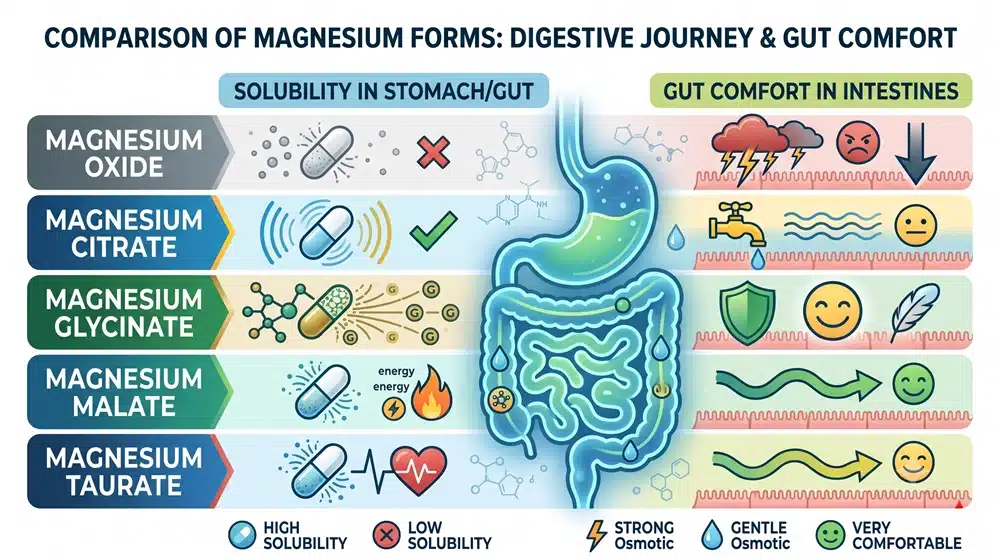
Which Magnesium Form Works Best With B Vitamins?
Not all magnesium supplements behave the same way in a formula or in the digestive tract. For a magnesium + B-complex supplement, the key is to balance elemental magnesium content, solubility, gastrointestinal comfort, serving size and finished dosage form.
| Magnesium form | Best-fit use case | Formulation notes | Reader takeaway |
| Magnesium glycinate / bisglycinate | Sleep, relaxation, sensitive stomach, premium capsules | Chelated form; usually positioned as gentle. Lower elemental magnesium percentage can increase capsule count. | Often the best consumer-friendly choice for sleep/anxiety positioning. |
| Magnesium citrate | General magnesium support, powder blends, constipation-prone users | Good solubility but may loosen stools at higher doses. | Useful, but not always ideal before travel or for sensitive digestion. |
| Magnesium oxide | Low-cost, high elemental magnesium tablets | Less soluble; more likely to cause GI discomfort in some users. | Cost-effective, but not always the best for “gentle absorption” claims. |
| Magnesium malate | Daytime energy and muscle-focused formulas | Pairs naturally with B vitamins in energy-positioned products. | Consider for morning formulas rather than bedtime formulas. |
| Magnesium taurate | Heart and calm-positioned formulas | Niche positioning; confirm regulatory claim wording by market. | Useful for premium formulas, but avoid disease-treatment claims. |
Vitamin B Complex: Dietary Sources and Functions in the Human Body
The table below provides a detailed overview of the eight B vitamins that make up the vitamin B complex, including their primary dietary sources and key functions in the human body. This information is based on scientific data from reputable sources, such as the National Institutes of Health (NIH), and is presented for clarity and ease of reference.
| Vitamin | Primary Dietary Sources | Key Functions in the Body |
|---|---|---|
| B1 (Thiamine) | Whole grains (brown rice, oats), pork, legumes (lentils, beans), seeds (sunflower), fortified cereals | Converts carbohydrates into energy; supports nerve function and muscle contraction; essential for brain health. Deficiency may lead to beriberi. |
| B2 (Riboflavin) | Dairy products (milk, yogurt), eggs, green leafy vegetables (spinach), lean meats, fortified cereals, almonds | Facilitates energy production; supports healthy skin, eyes, and mucous membranes; acts as an antioxidant. Deficiency can cause cracked lips and sore throat. |
| B3 (Niacin) | Poultry (chicken, turkey), fish (tuna, salmon), peanuts, whole grains, mushrooms, fortified foods | Supports energy metabolism; aids DNA repair and cell communication; promotes healthy skin and digestion. Severe deficiency causes pellagra (dermatitis, diarrhea, dementia). |
| B5 (Pantothenic Acid) | Meat (liver, chicken), avocados, broccoli, mushrooms, whole grains, eggs, sunflower seeds | Essential for synthesizing coenzyme A, which supports energy production; aids in hormone and cholesterol synthesis. Deficiency is rare but may cause fatigue. |
| B6 (Pyridoxine) | Bananas, potatoes, chickpeas, poultry, fish, fortified cereals, nuts (walnuts) | Supports neurotransmitter synthesis (e.g., serotonin, dopamine); aids red blood cell formation and immune function; helps metabolize proteins. Deficiency may cause depression or anemia. |
| B7 (Biotin) | Egg yolks, nuts (almonds, peanuts), salmon, avocados, sweet potatoes, cauliflower | Supports healthy hair, skin, and nails; aids in fat and carbohydrate metabolism; contributes to gene regulation. Deficiency may cause hair loss or rashes. |
| B9 (Folic Acid) | Leafy greens (spinach, kale), legumes (black beans), citrus fruits, fortified grains (bread, pasta), liver | Critical for DNA synthesis and cell division; prevents neural tube defects in pregnancy; supports red blood cell production. Deficiency can lead to megaloblastic anemia. |
| B12 (Cobalamin) | Meat (beef, liver), fish (clams, salmon), dairy products, eggs, fortified cereals, nutritional yeast | Essential for nerve health and myelin sheath formation; supports red blood cell production and DNA synthesis. Deficiency can cause neurological issues or pernicious anemia. |
Key Notes:
- Dietary Sources: Many B vitamins are found in animal products, making supplementation or fortified foods important for vegetarians and vegans, especially for B12.
- Bioavailability: Some sources (e.g., fortified cereals) may provide synthetic forms (like folic acid for B9), which are more bioavailable than natural forms.
- Functions: B vitamins often work together in metabolic pathways, particularly in energy production and nervous system health.
- Deficiency Risks: Poor diet, alcohol consumption, or medical conditions (e.g., celiac disease, pernicious anemia) can increase deficiency risks. Symptoms vary by vitamin but often include fatigue, neurological issues, or skin problems.
Deficiency Risks: Poor diet, alcohol consumption, stress, or medical conditions (e.g., celiac disease) increase risks. Vegetarians and vegans are particularly prone to B12 deficiency.
Synergistic Benefits of Magnesium and Vitamin B Complex
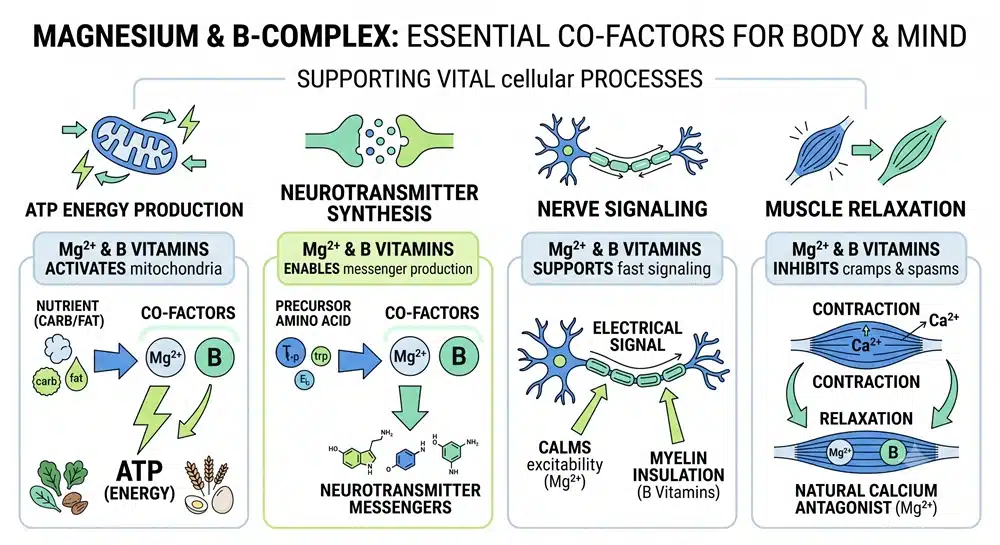
Magnesium and vitamin B complex benefits stem from their complementary roles. Here’s how they work together:
- Energy Production: B vitamins (especially B1, B2, B3) facilitate energy metabolism, while magnesium activates ATP, the body’s energy currency. This synergy combats fatigue.
- Nervous System Health: B6 and B12 support neurotransmitter synthesis, and magnesium calms nerve activity, reducing stress and magnesium and vitamin B complex for anxiety.
- Muscle Function: Magnesium relaxes muscles, while B vitamins aid recovery, benefiting athletes or those with cramps.
Research shows combining vitamin B complex and magnesium together enhances these effects. A 2019 study found that magnesium and B6 supplementation improved stress scores in adults with low magnesium levels.
Evidence Strength: What Is Strong vs Still Limited?
Magnesium and B vitamins clearly overlap in energy metabolism and nervous system function, but not every health claim has the same evidence strength. Use the table below to set realistic expectations.
| Claim area | Evidence strength | Recommended wording |
| Energy metabolism and fatigue related to deficiency | Strong for biological role; benefit is most likely when intake is low. | “Supports normal energy metabolism” rather than “boosts energy in everyone.” |
| Stress support: magnesium + B6 | Moderate. A clinical trial found magnesium helped stressed adults with low magnesium status; Mg+B6 showed greater benefit in a severe/extremely severe stress subgroup. | “May support stress response, especially in people with low magnesium status.” |
| Anxiety symptoms | Limited to moderate; avoid treatment language. | “May support a calmer nervous system; not a substitute for mental-health care.” |
| Sleep | Limited to moderate. Combination research exists for magnesium + melatonin + B complex, but it does not isolate magnesium+B complex alone. | “May support sleep routines, especially when magnesium is taken in the evening.” |
| Hangover cure | Weak. Alcohol can worsen hydration and nutrient status, but supplements are not a proven cure. | Use “after-alcohol recovery support” and emphasize hydration, food and rest. |
Folic Acid, Vitamin B Complex, and Magnesium
Folic acid, vitamin B complex, and magnesium form a potent trio. Folic acid (B9) is critical for DNA synthesis and red blood cell formation, particularly during pregnancy to prevent neural tube defects. When paired with magnesium and other B vitamins, it supports:
- Cardiovascular Health: Folic acid lowers homocysteine levels, a risk factor for heart disease, while magnesium supports blood pressure regulation.
- Cognitive Function: B vitamins and magnesium enhance brain health, reducing risks of cognitive decline.
Studies suggest 400–800 mcg of folic acid daily, alongside magnesium and B complex, optimizes these benefits.
Folate wording matters. “Folate” refers to the naturally occurring vitamin in foods, while “folic acid” is the synthetic form used in fortified foods and many supplements. Labels often use DFE (Dietary Folate Equivalents) to account for absorption differences.
L-Theanine, Magnesium, and Vitamin B Complex
L-theanine, magnesium, and vitamin B complex are increasingly popular for stress relief. L-theanine, an amino acid found in green tea, promotes relaxation without sedation. Combined with magnesium (a natural muscle relaxant) and B vitamins (neurotransmitter supporters), this trio:
- Reduces anxiety and improves focus.
- Enhances sleep quality by calming the nervous system.
A 2020 study showed L-theanine and magnesium together improved sleep in older adults, while B6 has been linked to better mood regulation.
Magnesium and Vitamin B Complex for Anxiety
Featured snippet block: Magnesium and B-complex vitamins may support anxiety-related nutrition by contributing to nerve signaling, neurotransmitter synthesis and normal stress response. The evidence is strongest for people with low magnesium status or inadequate B-vitamin intake; supplements should not replace professional anxiety treatment.
For formulas targeting calm and sleep, magnesium glycinate plus vitamin B6/P5P is a common structure, while L-theanine can be positioned as a non-sedating relaxation ingredient. However, keep claims conservative: “supports relaxation” is safer than “treats anxiety.”
Magnesium and vitamin B complex for anxiety is a well-researched application. Magnesium modulates the HPA axis, reducing cortisol levels, while B6 and B12 support serotonin and GABA production, key for mood stability. Clinical trials indicate:
- Magnesium supplementation (300 mg/day) reduces anxiety symptoms in 6–8 weeks.
- B6 (50–100 mg/day) enhances mood in individuals with low levels.
Combining these nutrients offers a natural approach to managing anxiety, especially for those with deficiencies.
After-Alcohol Recovery Support: Magnesium, B Vitamins and Folate
Alcohol intake can worsen dehydration, disrupt sleep and increase urinary losses of several nutrients. Magnesium, thiamine (B1), niacin (B3), vitamin B6, folate and B12 all play roles in energy metabolism and nervous system function, so replenishing a normal dietary intake may support recovery after drinking.
Important limitation: a magnesium + B-complex supplement should not be presented as a proven hangover cure. Hydration, electrolytes, food, sleep and avoiding excessive alcohol remain more important. People with alcohol dependence, liver disease, pregnancy, kidney disease or medication use should seek medical advice before supplementing.
Health Conditions Addressed
Beyond anxiety and hangovers, magnesium and B complex vitamins benefit:
- Sleep Disorders: Magnesium and B6 improve melatonin production, aiding insomnia.
- Cardiovascular Health: Magnesium lowers blood pressure; folic acid and B12 reduce homocysteine.
- Migraines: Magnesium (400–600 mg/day) reduces frequency; B2 (400 mg/day) shows promise.
- Muscle Cramps: Magnesium relaxes muscles; B vitamins support nerve health.
A 2021 meta-analysis confirmed magnesium’s efficacy for migraines, while B2 is endorsed by the American Academy of Neurology for prevention.
Practical Applications and Supplementation
Recommended Intakes:
- Magnesium: 310–420 mg/day (adults). Forms: citrate (bioavailable), glycinate (gentle on stomach).
- B Vitamins: Vary by vitamin (e.g., B6: 1.3–2 mg; B12: 2.4 mcg). Choose a balanced B-complex.
- Folic Acid: 400–800 mcg/day.
- L-Theanine: 100–200 mg/day for stress or sleep.
Best Practices:
- Take with meals to enhance absorption.
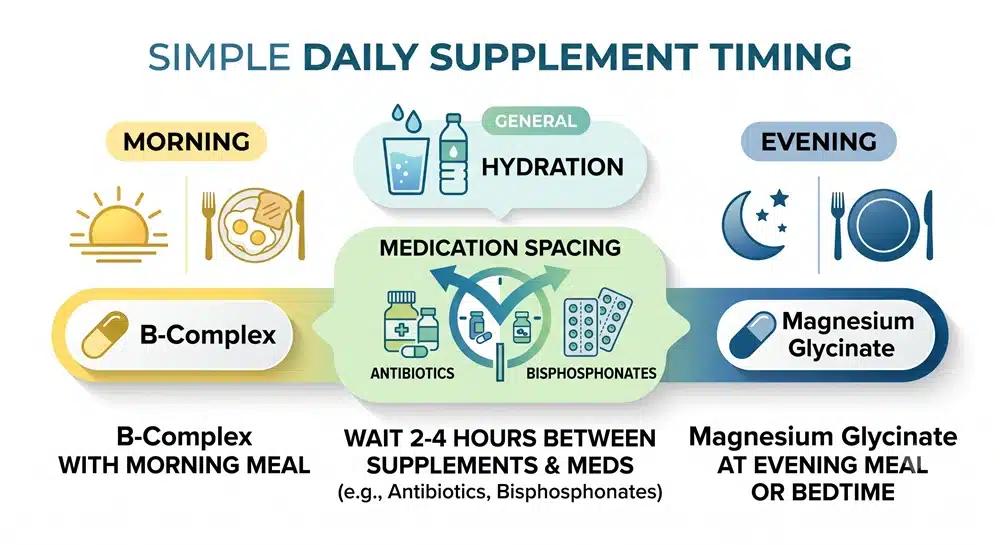
- Magnesium at night may aid sleep; B vitamins in the morning for energy.
- Check for interactions (e.g., magnesium with antibiotics; B6 with certain antidepressants).
- Consult a doctor, especially if pregnant, on medications, or with kidney issues.
How to Take Magnesium and B Complex Together
| Situation | Suggested approach | Why it helps |
| General wellness | Take B-complex with breakfast or lunch; take magnesium with a meal or in the evening. | B vitamins may feel energizing; magnesium may be better tolerated with food. |
| Sleep or relaxation goal | Use magnesium glycinate in the evening; keep high-dose B-complex earlier if it feels stimulating. | Matches common user experience while avoiding overclaiming sleep treatment. |
| Sensitive stomach | Start with a lower magnesium dose and choose glycinate/bisglycinate; avoid high-dose oxide/citrate if diarrhea occurs. | GI discomfort is a common reason users stop magnesium. |
| Antibiotics | Take magnesium at least 2 hours before or 4-6 hours after tetracycline or quinolone antibiotics. | Magnesium can bind these drugs and reduce absorption. |
| Bisphosphonates | Separate magnesium-rich supplements or medications by at least 2 hours. | Helps reduce absorption interference. |
| Kidney disease | Ask a healthcare provider before using magnesium supplements. | Reduced kidney function increases toxicity risk. |
Supplements: Look for third-party tested products (e.g., USP or NSF certified) to ensure quality.
Potential Side Effects and Precautions
- Magnesium: The adult RDA for total magnesium intake is 310-420 mg/day depending on age and sex, but the tolerable upper intake level for supplemental magnesium is 350 mg/day for adults. Food magnesium does not count toward this supplemental UL. Too much supplemental magnesium may cause diarrhea, nausea and abdominal cramping, and very high intakes can be dangerous in people with impaired kidney function.
- Vitamin B6: High-dose B6 is not automatically safer because it is water-soluble. The U.S. adult UL is 100 mg/day, while EFSA set a much lower adult UL of 12 mg/day in 2023 because of peripheral neuropathy concerns. For long-term daily formulas, avoid unnecessary high-dose B6 unless supervised by a clinician.
- Folic acid: Adult folic acid UL from fortified foods or supplements is 1,000 mcg/day. High folic acid intake can mask vitamin B12 deficiency, so formulas for older adults, vegans or metformin users should consider B12 status.
- Vitamin B12: The adult RDA is 2.4 mcg/day. B12 is generally well tolerated, but people with diagnosed deficiency, vegan diets, older age, metformin use or GI absorption issues should seek individualized guidance.
Daily Recommended Dietary Allowances (RDA) for Vitamin B Complex for Men and Women
The table below details the Recommended Dietary Allowances (RDA) for each vitamin in the B complex for adult men and women, as established by the National Institutes of Health (NIH). These values apply to healthy adults aged 19–50 years unless otherwise noted. For pregnant or lactating women, requirements may differ (not included here for brevity). The values are expressed in milligrams (mg), micrograms (mcg), or other units as appropriate.
| Vitamin | Men (19–50 years) | Women (19–50 years) | Notes |
|---|---|---|---|
| B1 (Thiamine) | 1.2 mg | 1.1 mg | Supports energy metabolism; higher needs with high-carb diets. |
| B2 (Riboflavin) | 1.3 mg | 1.1 mg | Essential for energy production; needs increase with physical activity. |
| B3 (Niacin) | 16 mg NE | 14 mg NE | NE = Niacin Equivalents; supports skin and nerve health. |
| B5 (Pantothenic Acid) | 5 mg (AI) | 5 mg (AI) | AI = Adequate Intake (no RDA set); widely available in foods. |
| B6 (Pyridoxine) | 1.3 mg | 1.3 mg | Increases to 1.7 mg for men and 1.5 mg for women over 50. |
| B7 (Biotin) | 30 mcg (AI) | 30 mcg (AI) | AI used; deficiency rare due to gut bacteria production. |
| B9 (Folic Acid) | 400 mcg DFE | 400 mcg DFE | DFE = Dietary Folate Equivalents; critical for DNA synthesis. |
| B12 (Cobalamin) | 2.4 mcg | 2.4 mcg | Absorption may decrease with age; vegans need supplements. |
Key Notes:
- RDA vs. AI: RDA is the average daily intake sufficient to meet the nutrient requirements of nearly all (97–98%) healthy individuals. AI (Adequate Intake) is used when insufficient evidence exists to establish an RDA (e.g., B5, B7).
- DFE for Folic Acid: Accounts for differences in absorption between natural folate and synthetic folic acid (1 mcg DFE = 1 mcg food folate = 0.6 mcg synthetic folic acid from supplements).
- Sources: Values are sourced from the NIH Office of Dietary Supplements (2023).
- Special Considerations: Men and women with specific conditions (e.g., alcoholism, malabsorption disorders) or lifestyles (e.g., veganism) may require higher intakes or supplementation. Consult a healthcare provider for personalized advice.
Formulation Notes for Supplement Brands

For supplement brands developing a magnesium + B-complex product, the consumer question “Can I take them together?” becomes a formulation question: which magnesium form, which B-vitamin forms, what serving size, what dosage form and what quality documents are needed?
- Capsules: Magnesium bisglycinate/glycinate is popular for relaxation positioning, but lower elemental magnesium means more fill weight. B-complex ingredients can include low-dose but color-strong materials such as riboflavin (B2), so capsule color, powder uniformity and label transparency matter.
- Tablets: Mineral powders can challenge compression, hardness and disintegration. Confirm particle size, bulk density, flowability, excipient compatibility and final elemental magnesium content per serving before scaling.
- Powder sticks and sachets: Magnesium salts can affect mouthfeel, taste and solubility. B vitamins can add bitterness, odor or color. Flavor masking, moisture control, anti-caking strategy and packaging with desiccant should be reviewed during pilot batches.
- Gummies: Magnesium dosage is limited by taste, texture and serving size. Gummies are better suited for lower-dose wellness positioning than high-dose magnesium delivery.
Quality checklist for B2B buyers: request COA, SDS/MSDS, TDS, allergen statement, non-GMO statement where applicable, heavy metals, microbiology, assay method, elemental magnesium content, vitamin assay, particle size/mesh, loss on drying, country of origin and shelf-life data.
Conclusion
Magnesium and B complex vitamins offer remarkable benefits, from energy and muscle support to anxiety relief and hangover recovery. Adding folic acid and L-theanine amplifies their effects, making them a versatile solution for modern health challenges. Prioritize nutrient-rich foods like greens, nuts, and whole grains, and consider supplements if needed. Consult a healthcare provider to tailor intake to your needs, ensuring optimal health with vitamin B complex and magnesium together.
FAQs.
Can you take magnesium and vitamin B complex together
Yes, magnesium and vitamin B complex can be taken together safely and often work synergistically. Magnesium supports energy production alongside B vitamins, and studies show combining them can reduce stress and improve mood. Take with food to enhance absorption and consult a doctor if on medications.
What is magnesium complex vitamin B good for?
Magnesium and vitamin B complex benefit energy production, nerve health, muscle function, and stress reduction. They help combat fatigue, support heart health, reduce anxiety, and may improve sleep. They’re also used for migraine prevention and hangover recovery when paired with folic acid.
What vitamins should not be taken with magnesium?
Magnesium generally pairs well with most vitamins. However, high doses of calcium or zinc may compete for absorption, so space them out by 2–4 hours. Vitamin D enhances magnesium absorption, making it a good combination. Always check with a healthcare provider for personalized advice.
What cannot be taken with B complex?
B complex is safe with most supplements but may interact with certain medications, like levodopa (for Parkinson’s) or antibiotics (e.g., tetracyclines). Avoid taking B6 with anticonvulsants, as it may reduce their effectiveness. Consult a doctor if on medications or taking high doses.
Can I take magnesium and B complex at night?
Yes, taking magnesium and B complex at night is safe and may promote relaxation. Magnesium (e.g., glycinate) can improve sleep, while B6 supports melatonin production. However, some find B vitamins energizing, so monitor effects and consider morning doses if daytime alertness is preferred.
Does vitamin B help with anxiety?
Yes, vitamin B can help with anxiety, particularly B6, B9 (folic acid), and B12, which support neurotransmitter production (e.g., serotonin, GABA). Studies show B6 supplementation (50–100 mg/day) reduces anxiety symptoms, especially when combined with magnesium.
Is it better to take B12 or B complex?
It depends on your needs. If you’re deficient in B12 (common in vegans or older adults), a standalone B12 supplement (2.4 mcg/day) is sufficient. B complex is better for overall energy, nerve health, and addressing multiple B vitamin deficiencies, as the vitamins work together. Consult a doctor for blood tests to confirm needs.
Which magnesium is best for sleep and anxiety?
Magnesium glycinate is best for sleep and anxiety due to its high bioavailability and calming effects on the nervous system. Magnesium citrate is also effective but may cause digestive upset in some. Doses of 200–400 mg at night are typically recommended.
How to know magnesium deficiency?
Symptoms of magnesium deficiency include muscle cramps, fatigue, irritability, irregular heartbeat, and poor sleep. Risk factors include low intake of nuts, greens, or whole grains, or conditions like diabetes. Blood tests (serum magnesium) can confirm deficiency, though levels may not always reflect total body stores. Consult a doctor for diagnosis.
Do B vitamins affect magnesium?
B vitamins and magnesium interact positively, as B6 enhances magnesium absorption in cells. No evidence suggests B vitamins deplete magnesium; instead, they often complement each other in energy metabolism and stress relief. Balanced intake of both is ideal.
What is the best time to take vitamin B complex?
The best time to take vitamin B complex is typically in the morning with food to maximize absorption and leverage their energizing effects. However, if targeting sleep benefits (e.g., with B6), nighttime dosing may work for some. Avoid taking on an empty stomach to prevent nausea.
Can you take vitamin B12 and magnesium together?
Yes. Vitamin B12 and magnesium can generally be taken together in typical supplement doses. B12 supports red blood cell formation and nerve health, while magnesium supports energy metabolism, nerve signaling and muscle function. People with B12 deficiency risk, kidney disease or medication use should ask a healthcare professional for personalized advice.
Is magnesium better with vitamin B6 or a full B complex?
It depends on the goal. Magnesium plus B6 is a focused combination for stress, mood and nervous-system positioning. A full B complex is broader and may be better for people who want general energy metabolism and multiple B-vitamin coverage. Avoid unnecessary high-dose B6 for long-term daily use.
Which magnesium is best with vitamin B complex?
Magnesium glycinate or bisglycinate is often preferred for sleep, relaxation and sensitive stomach positioning. Magnesium citrate is useful for general support but may loosen stools. Magnesium oxide is cost-effective and high in elemental magnesium but is less soluble and may be less comfortable for some users.
Should I take magnesium and B complex in the morning or at night?
Many people take B complex in the morning with food because B vitamins support energy metabolism. Magnesium can be taken with dinner or before bed, especially glycinate. If B vitamins feel stimulating, separate them from bedtime magnesium.
Does vitamin B complex deplete magnesium?
There is no good evidence that B-complex vitamins deplete magnesium. Magnesium and B vitamins often work in related metabolic pathways. The more important issue is avoiding excessive supplement stacking and checking medication interactions.
Can magnesium and B complex help a hangover?
They may support normal nutrient intake after alcohol, but they are not a proven hangover cure. Hydration, electrolytes, food, sleep and reducing alcohol intake are more important. People with alcohol dependence or liver disease should seek medical care.
References
- NIH Office of Dietary Supplements. Magnesium Fact Sheet for Health Professionals.
- NIH Office of Dietary Supplements. Vitamin B6 Fact Sheet for Health Professionals.
- NIH Office of Dietary Supplements. Vitamin B12 Fact Sheet for Health Professionals.
- NIH Office of Dietary Supplements. Folate Fact Sheet for Health Professionals.
- Pouteau et al. 2018. Superiority of magnesium and vitamin B6 over magnesium alone on severe stress. PLOS One.
- Noah et al. 2021. Effect of magnesium and vitamin B6 supplementation on mental health and QoL. Stress and Health.
- Djokic et al. 2019. Magnesium-melatonin-vitamin B complex supplementation in insomnia. PMC.
- EFSA NDA Panel. 2023. Tolerable upper intake level for vitamin B6.
- Lindberg et al. 1990. Magnesium citrate vs oxide bioavailability. PubMed.

Warren Wan is a seasoned expert with extensive experience in the dietary supplement supply chain, possessing rich practical experience in the research, development, process control, and global sourcing of core ingredients such as collagen peptides, bone broth protein, and keratin. As the author of this column, he is dedicated to stripping away the marketing packaging, transforming obscure ingredient science and production quality control standards into easy-to-understand, hardcore science popularization, helping readers understand the truth behind the labels and make more rational health choices.