
Réponse rapide : L'huile d'onagre est-elle bonne pour les cheveux ?
L'huile d'onagre (EPO) est une huile de graines végétales naturellement riche en acide gamma-linolénique (GLA), un acide gras oméga-6 utilisé dans les compléments alimentaires destinés à la peau, au cuir chevelu et à la beauté de l'intérieur. Dans le cadre des produits capillaires, l'EPO doit être considérée avant tout comme un ingrédient favorisant la santé du cuir chevelu et apportant des acides gras, et non comme un traitement garantissant la repousse des cheveux.
Pour les consommateurs, l'EPO peut contribuer à favoriser un environnement plus sain au niveau du cuir chevelu, notamment lorsque la sécheresse, les irritations ou un apport insuffisant en acides gras font partie des problèmes rencontrés. Toutefois, il ne doit pas être présenté comme un remède contre la chute des cheveux, l'alopécie ou l'amincissement capillaire d'origine hormonale.
Pour les marques de compléments alimentaires, l’EPO présente un intérêt particulier en tant qu’ingrédient entrant dans la composition de gélules destinées au soin des cheveux, de compléments de beauté, de produits de bien-être pour femmes et de mélanges d’huiles pour le soin du cuir chevelu. Il est essentiel de vérifier la teneur en GLA, le degré d’oxydation, la méthode d’extraction, la qualité du certificat d’analyse (COA), la protection de l’emballage et la formulation des allégations avant de l’intégrer dans un produit fini.
Qu'est-ce que l'huile d'onagre ?
Evening primrose oil is extracted from the seeds of Oenothera biennis. Its main nutritional value comes from linoleic acid and gamma-linolenic acid (GLA), a fatty acid often used in skin-barrier, scalp-comfort, and women’s wellness formulations.
Dans la fabrication de compléments alimentaires, l'EPO est généralement fournie sous forme d'huile liquide destinée au remplissage de gélules molles ou comme ingrédient dans des mélanges d'huiles à usage topique. Un ingrédient EPO de haute qualité doit indiquer sa teneur en GLA, la méthode d'extraction, l'indice de peroxyde, l'indice d'acide, le pays d'origine, les conditions de stockage et les résultats du certificat d'analyse (COA).
En ce qui concerne les produits capillaires, la question n’est pas simplement de savoir si l’EPO est “ bonne pour les cheveux ”. Il est plus pertinent de se demander si cette huile est standardisée, stable, correctement conditionnée et présentée avec des allégations réalistes.
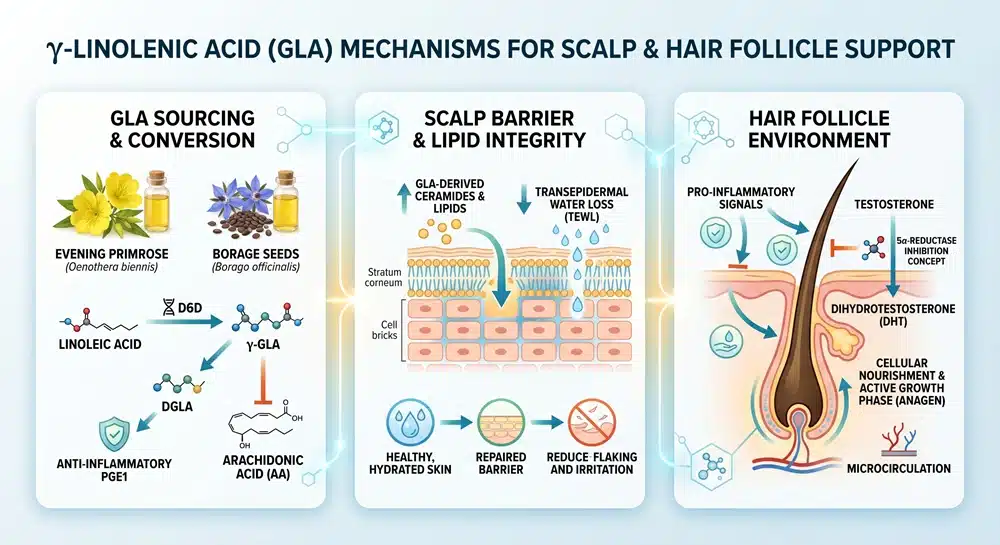
Onagre Vs. Onagre commune
L'onagre (Oenothera biennis) et la primevère (Primula vulgaris) sont des plantes différentes, souvent confondues en raison de noms similaires. L'onagre est une grande plante bisannuelle dont les fleurs jaunes s'ouvrent le soir. Ses graines sont pressées pour produire de l'EPO, riche en AGL. L'onagre, une plante vivace de faible hauteur aux fleurs jaune pâle ou roses, est surtout ornementale et n'est pas utilisée pour la production d'huile. Bien que la primevère commune ait quelques usages médicinaux traditionnels (par exemple, pour la toux), elle ne contient pas l'AGL qui rend l'EPO précieuse pour la santé des cheveux. Vérifiez toujours les étiquettes des produits pour vous assurer que vous obtenez de l'huile d'onagre et non un extrait d'onagre.
En ce qui concerne les produits botaniques et les huiles de graines, fabrication de compléments alimentaires à base de plantes Son expertise peut aider les marques à gérer l'identification des ingrédients, leur approvisionnement et la documentation relative à leur qualité.Ce que l'huile d'onagre peut et ne peut pas apporter aux cheveux
L'huile d'onagre peut contribuer indirectement à la santé des cheveux et du cuir chevelu en aidant à maintenir un apport en acides gras et en renforçant la fonction de barrière de la peau et du cuir chevelu. Le cuir chevelu faisant partie de la peau, les ingrédients qui favorisent le confort et l'hydratation de la peau peuvent être pertinents dans le cadre d'une gamme de soins capillaires.
Ce que l'EPO peut prendre en charge :
– hydratation et confort du cuir chevelu,
– une coiffure qui donne une impression de cheveux en bonne santé,
– des formules pour la beauté de l'intérieur,
– apport en acides gras pour la peau et le cuir chevelu,
– des idées de compléments alimentaires dédiés au bien-être des femmes.
Ce qu’il ne faut pas prétendre que l’EPO permet de faire :
– soigner la chute des cheveux,
– inverser l'alopécie androgénétique,
– traiter l'alopécie areata,
– bloquer la DHT selon un mécanisme similaire à celui des médicaments,
– favoriser la repousse des cheveux chez les utilisateurs souffrant de troubles médicaux entraînant une perte de cheveux.
Cette distinction est importante. Un complément alimentaire destiné à la santé capillaire peut être présenté comme un produit favorisant le bien-être du cuir chevelu, renforçant la barrière cutanée, favorisant la beauté de l’intérieur et contribuant à l’aspect sain des cheveux. Il ne doit pas être commercialisé comme un traitement contre la chute de cheveux d’origine médicale, sauf s’il bénéficie d’une autorisation réglementaire appropriée et de preuves cliniques à l’appui.
Dosage de l'huile d'onagre pour la chute des cheveux
Le bon dosage de l'huile d'onagre dépend de la prise orale ou de l'application sur le cuir chevelu. Pour les suppléments oraux, la dose courante est de 500 à 1 000 mg par jour, avec des capsules normalisées pour contenir 8-10% GLA. Commencez par une dose plus faible, comme 500 mg, et augmentez-la si nécessaire. Prenez l'EPO avec de la nourriture pour améliorer l'absorption et réduire les maux d'estomac. La constance est essentielle - les résultats peuvent prendre 2 à 3 mois avant de se manifester.
Pour un usage topique, mélangez quelques gouttes d'EPO à une huile de support comme l'huile de noix de coco ou de jojoba. Appliquez-le sur votre cuir chevelu 2 à 3 fois par semaine, en massant doucement pour stimuler la circulation. Laissez agir pendant 30 minutes ou toute la nuit avant de vous laver. Certains produits capillaires contiennent déjà de l'EPO, vérifiez donc les étiquettes pour éviter d'en abuser.
Consultez toujours un médecin avant de commencer à prendre de l'EPO, surtout si vous avez des problèmes de santé ou si vous prenez des médicaments. Il pourra vous recommander un dosage adapté à vos besoins, en particulier si la perte de cheveux est liée à des problèmes hormonaux ou médicaux.
Gélules à prendre par voie orale ou huiles capillaires à usage topique : quelle formule est la plus adaptée ?
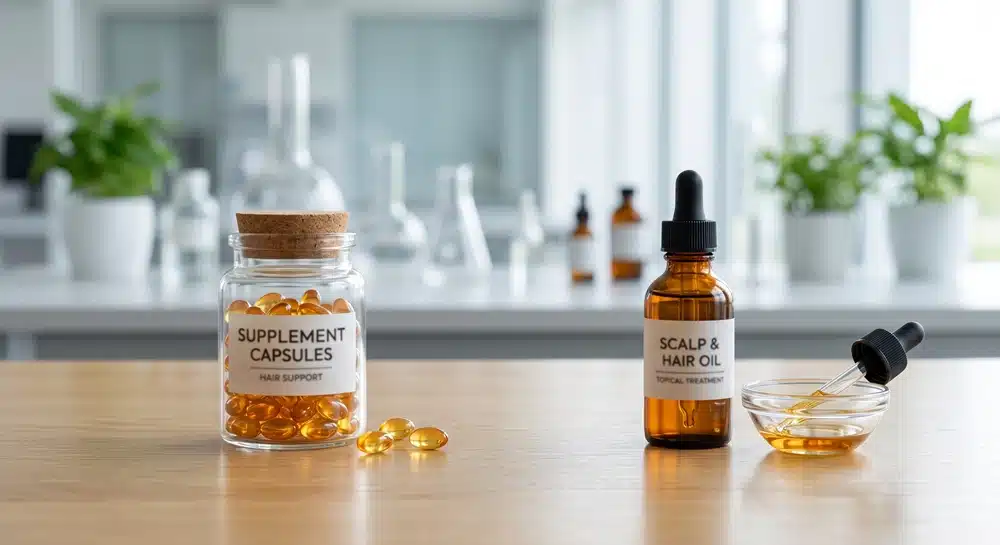
L'huile d'onagre se présente sous deux formes différentes : des compléments alimentaires à prendre par voie orale et des huiles à appliquer localement sur le cuir chevelu. Ces deux formes ne doivent pas être considérées comme un seul et même produit.
Les gélules molles d'EPO à prise orale sont mieux adaptées aux concepts de « beauté de l'intérieur », de bien-être féminin et d'apport en acides gras. Elles sont plus faciles à doser, plus simples à conditionner et plus familières aux consommateurs de compléments alimentaires.
Les huiles d'EPO à usage topique sont mieux adaptées au confort du cuir chevelu, aux routines de soins capillaires et aux applications cosmétiques. Cependant, les huiles à usage topique nécessitent un travail de formulation spécifique, notamment en ce qui concerne le choix de l'huile de support, la compatibilité des parfums, la sensation sur la peau, la viscosité, le contrôle de l'oxydation, ainsi que les considérations relatives aux conservateurs et au conditionnement.
Pour les marques, le choix dépend du modèle économique. Une marque de compléments alimentaires peut privilégier les gélules EPO. Une marque de soins capillaires peut préférer un mélange d'huiles pour le cuir chevelu. Une marque de beauté hybride peut utiliser les deux : une gélule à prendre par voie orale et une huile capillaire à appliquer localement, dans le cadre d'une routine combinée.
Comment utiliser l'huile d'onagre pour les cheveux
L'utilisation de l'huile d'onagre est simple et s'intègre facilement à votre routine quotidienne. En cas d'utilisation par voie orale, prenez les gélules au moment d'un repas pour faciliter leur absorption. Associez l'huile d'onagre à d'autres nutriments bénéfiques pour les cheveux, tels que la biotine, le zinc ou vitamine D pour obtenir de meilleurs résultats. Une alimentation riche en fruits, en légumes et en graisses saines contribue également à la bonne santé des cheveux.
Pour une utilisation topique, essayez un traitement du cuir chevelu fait maison. Mélangez 5 à 10 gouttes d'EPO avec une cuillère à soupe d'huile de support (noix de coco, jojoba ou amande). Massez votre cuir chevelu en insistant sur les zones clairsemées ou sèches. Laissez reposer pendant 30 à 60 minutes, ou toute la nuit pour une nutrition plus profonde, puis procédez au shampooing habituel. Vous pouvez également ajouter quelques gouttes d'EPO à votre après-shampooing pour une hydratation supplémentaire.
Pour obtenir les meilleurs résultats, utilisez l'EPO de manière régulière. Associez-la à des pratiques de soins capillaires doux, en évitant par exemple les shampooings agressifs ou le coiffage à la chaleur. Une approche holistique - bonne nutrition, gestion du stress et soins réguliers du cuir chevelu - maximisera les bienfaits de l'EPO.
Sécurité et effets secondaires de l'huile d'onagre
L'huile d'onagre est généralement sans danger pour la plupart des gens, mais des effets secondaires peuvent survenir. Les effets secondaires les plus courants sont de légers maux d'estomac, des nausées ou des maux de tête. La prise d'EPO avec de la nourriture peut réduire ces problèmes. Dans de rares cas, l'huile d'onagre peut provoquer des réactions allergiques, comme des éruptions cutanées. Arrêtez de l'utiliser si cela se produit.
L'EPO peut interagir avec certains médicaments, y compris les anticoagulants (par exemple, la warfarine) et les médicaments contre l'épilepsie (par exemple, la phénytoïne). Elle peut également augmenter le risque de saignement, il faut donc l'éviter avant une intervention chirurgicale. Les femmes enceintes ou allaitantes ne doivent utiliser l'EPO que sous contrôle médical, car elle peut affecter les hormones.
Choisissez une EPO de haute qualité pour éviter les contaminants. Recherchez des produits dont la pureté et l'efficacité ont été testées par une tierce partie. Les fabricants de suppléments à faible quantité de commande (MOQ) peuvent proposer des formulations personnalisées de haute qualité pour des besoins spécifiques. Respectez toujours les consignes de dosage et consultez un médecin en cas de doute.
Notes de formulation B2B pour les produits capillaires à base d'huile d'onagre
Pour les marques de compléments alimentaires, l'huile d'onagre est un ingrédient facile à appréhender, mais elle nécessite une manipulation minutieuse en tant que matière première à base d'huile.
Avant d'acheter de l'EPO dans le cadre d'une formule favorisant la pousse des cheveux, demandez :
– Pourcentage de GLA,
– indice de peroxyde,
– indice d'acidité,
– méthode d'extraction,
– Certificat d'origine et fiche technique,
– déclaration relative aux allergènes,
– analyse visant à détecter la présence de pesticides ou de solvants, le cas échéant,
– pays d'origine,
– température de conservation recommandée,
– ainsi que les données relatives à la durée de conservation.
En ce qui concerne les produits sous forme de gélules, les marques doivent également évaluer la taille des gélules, le poids de remplissage, la compatibilité entre les enveloppes en gélatine et les enveloppes végétariennes, le risque de fuite, le système antioxydant, ainsi que la protection offerte par l'emballage contre la chaleur, la lumière et l'oxygène.
En ce qui concerne les huiles à application topique pour le cuir chevelu, les marques doivent évaluer la sensation sur la peau, la compatibilité avec les huiles de support, le système de parfumage, le risque d'oxydation, le conditionnement (compte-gouttes ou pompe), ainsi que la question de savoir si le produit doit être positionné comme un produit cosmétique plutôt que comme un complément alimentaire.

Quand demander l'aide d'un professionnel
L'huile d'onagre peut contribuer à la santé des cheveux, mais ce n'est pas un remède contre la chute des cheveux. Si vous constatez une perte de cheveux soudaine ou importante, une calvitie parcellaire ou des douleurs au niveau du cuir chevelu, consultez un médecin ou un dermatologue. Ces symptômes peuvent être le signe de troubles de la thyroïde, d'une carence en fer ou de maladies auto-immunes, qui nécessitent un traitement médical.
Un professionnel peut également tester les carences en nutriments ou les déséquilibres hormonaux à l'origine des problèmes capillaires. Si l'EPO ou d'autres remèdes n'améliorent pas vos cheveux après 3 à 6 mois, un médecin peut recommander des traitements plus puissants, comme le minoxidil ou l'hormonothérapie. Ne comptez pas uniquement sur les suppléments si votre perte de cheveux affecte votre qualité de vie.
Preuves et limites scientifiques
Les données scientifiques concernant l'huile d'onagre et la repousse des cheveux sont limitées. Certaines études portant sur des associations d'acides gras et d'antioxydants ont fait état d'une amélioration de la densité capillaire ou des paramètres liés à la chute des cheveux, mais ces formules contiennent souvent plusieurs nutriments et non pas uniquement de l'huile d'onagre. Cela signifie que ces résultats ne doivent pas être interprétés comme la preuve que l'huile d'onagre, à elle seule, favorise la repousse des cheveux.
Le principal argument en faveur de l'EPO réside dans son rôle de source d'acide gamma-linolénique (GLA) et dans son importance pour le bon fonctionnement de la barrière cutanée et du cuir chevelu. Cela en fait un ingrédient utile dans les formules axées sur la beauté de l'intérieur et le confort du cuir chevelu, mais ne constitue pas une solution à part entière pour traiter la chute de cheveux d'origine médicale.
En ce qui concerne les allégations relatives au contenu et aux produits, l’approche la plus prudente consiste à présenter l’EPO comme favorisant le confort du cuir chevelu, la fonction de barrière cutanée et l’aspect sain des cheveux, tout en précisant clairement que les utilisateurs souffrant d’une chute de cheveux soudaine, sévère, par plaques ou persistante doivent consulter un professionnel de santé.
Conclusion : comment les marques devraient utiliser l'huile d'onagre dans leurs produits capillaires
L'huile d'onagre peut être un ingrédient utile dans les produits destinés à prendre soin des cheveux et à favoriser la beauté de l'intérieur, mais son utilisation doit être envisagée avec prudence. Son intérêt réside dans son apport en AGL et en acides gras, et non dans un effet garanti de repousse des cheveux.
Pour les consommateurs, l’EPO peut être considéré comme faisant partie d’une routine plus large de soins du cuir chevelu et de beauté. Pour les marques, l’EPO présente davantage d’intérêt en tant qu’ingrédient dans des gélules molles, des huiles pour le cuir chevelu ou des compléments alimentaires de beauté destinés aux femmes, à condition que la formule s’appuie sur une documentation COA solide, un contrôle de l’oxydation, un conditionnement adapté et des allégations réalistes.

Vous avez besoin d'aide pour développer un produit de soin capillaire protégé par un brevet européen (EPO) ?
Gensei propose des gélules d'huile d'onagre, des compléments alimentaires pour la beauté de l'intérieur, des mélanges d'huiles pour le cuir chevelu, des formulations sur mesure et des produits capillaires en marque de distributeur. Envoyez-nous la forme galénique souhaitée, les spécifications relatives au GLA, votre projet de conditionnement et votre positionnement sur le marché afin que nous puissions évaluer la faisabilité avant la production.
FAQ
L'huile d'onagre rend-elle les cheveux plus épais ?
Il ne faut pas affirmer que l'huile d'onagre permet d'épaissir directement les cheveux. Elle peut contribuer au bien-être du cuir chevelu, à l'apport en acides gras et à l'aspect sain des cheveux, mais son efficacité en tant que traitement visant à épaissir les cheveux n'est pas prouvée.
L'huile d'onagre peut-elle favoriser la repousse des cheveux ?
Il n'existe pas suffisamment de preuves pour affirmer que l'EPO, à elle seule, favorise la repousse des cheveux. Si la chute de cheveux est due à des facteurs génétiques, à des troubles thyroïdiens, à une carence en fer, à une maladie auto-immune ou à la prise de médicaments, l'EPO a peu de chances de traiter la cause profonde du problème. Elle s'inscrit davantage comme un ingrédient de soutien pour la beauté et la santé du cuir chevelu.
L'huile d'onagre est-elle plus efficace sous forme de gélules ou d'huile à application locale ?
Les gélules sont plus adaptées pour favoriser la beauté de l'intérieur et l'apport en acides gras. Les huiles à usage topique sont quant à elles plus indiquées pour le confort du cuir chevelu et les routines cosmétiques de soins capillaires. Les marques doivent choisir le format en fonction des allégations, du conditionnement, de la clientèle cible et de la catégorie réglementaire.
L'huile d'onagre contient-elle de la biotine ?
Non. L'huile d'onagre ne contient pas naturellement de biotine. Elle est principalement appréciée pour sa teneur en acide gamma-linolénique (GLA) et en acide linoléique. Une formule destinée à favoriser la santé capillaire peut associer l'huile d'onagre à de la biotine, du zinc, de la vitamine D, des peptides de collagène ou d'autres ingrédients de beauté, à condition que cette association soit appropriée et étayée par des preuves scientifiques.
Quels éléments les marques doivent-elles vérifier avant de s'approvisionner en huile d'onagre ?
Les marques doivent vérifier la teneur en GLA, l'indice de peroxyde, l'indice d'acide, la méthode d'extraction, le certificat d'analyse (COA), le pays d'origine, la liste des allergènes, les résultats des tests relatifs aux pesticides ou aux solvants, le cas échéant, ainsi que les conditions de stockage.
Un complément alimentaire à base d'EPO peut-il prétendre traiter la chute des cheveux ?
Non. Les compléments alimentaires ne doivent pas prétendre diagnostiquer, traiter, guérir ou prévenir la chute des cheveux ou l’alopécie. Il est plus prudent d’utiliser des formulations axées sur la structure et la fonction, telles que « favorise le confort du cuir chevelu », « soutient la fonction de barrière cutanée » et « favorise l’aspect sain des cheveux ».
Quelle est la meilleure forme galénique pour les produits capillaires à base d'EPO vendus sous marque de distributeur ?
Les gélules molles constituent généralement l'option la plus pratique pour les compléments alimentaires, car elles protègent l'huile, permettent de contrôler le dosage et atténuent les problèmes liés au goût. Les huiles topiques pour le cuir chevelu peuvent convenir aux marques de cosmétiques, mais nécessitent des tests de stabilité et de conditionnement spécifiques.
Qui devrait éviter l'huile d'onagre ?
Les consommatrices enceintes ou allaitantes, celles qui prennent des anticoagulants, celles qui se préparent à subir une intervention chirurgicale ou celles qui suivent un traitement antiépileptique doivent consulter un professionnel de santé avant d'utiliser l'EPO. Les marques doivent inclure des mises en garde appropriées, conformément à la réglementation en vigueur sur leur marché cible.
Références
- NCCIH. Huile d'onagre : efficacité et innocuité.
https://www.nccih.nih.gov/health/evening-primrose-oil - PubMed. Effet d'un complément alimentaire sur la chute des cheveux chez les femmes.
https://pubmed.ncbi.nlm.nih.gov/25573272/ - PubMed. La prise par voie systémique d'huile d'onagre améliore les paramètres biophysiques de la peau chez des adultes en bonne santé.
https://pubmed.ncbi.nlm.nih.gov/18492193/ - PMC. Le rôle de l'acide linoléique dans la santé de la peau et des cheveux : une revue de la littérature.
https://pmc.ncbi.nlm.nih.gov/articles/PMC11719646/ - PMC. Ingrédients naturels dans le traitement de l'alopécie : revue de l'efficacité dermatologique.
https://pmc.ncbi.nlm.nih.gov/articles/PMC10761108/ - FDA. Allégations relatives à la structure et à la fonction.
https://www.fda.gov/food/nutrition-food-labeling-and-critical-foods/structurefunction-claims - FDA. Questions et réponses sur les compléments alimentaires.
https://www.fda.gov/food/information-consumers-using-dietary-supplements/questions-and-answers-dietary-supplements - PMC. Compléments alimentaires pour la peau, les cheveux et les ongles : questions relatives au marketing et à l'étiquetage.
https://pmc.ncbi.nlm.nih.gov/articles/PMC7802115/

Warren Wan est un expert chevronné qui possède une vaste expérience dans la chaîne d’approvisionnement des compléments alimentaires, ainsi qu’une solide expertise pratique dans la recherche, le développement, le contrôle des processus et l’approvisionnement mondial d’ingrédients clés tels que les peptides de collagène, les protéines de bouillon d’os et la kératine. En tant qu'auteur de cette chronique, il s'attache à aller au-delà des discours marketing pour transformer les notions scientifiques obscures relatives aux ingrédients et les normes de contrôle qualité de la production en une vulgarisation scientifique rigoureuse et accessible, aidant ainsi les lecteurs à comprendre la vérité qui se cache derrière les étiquettes et à faire des choix plus rationnels en matière de santé.


