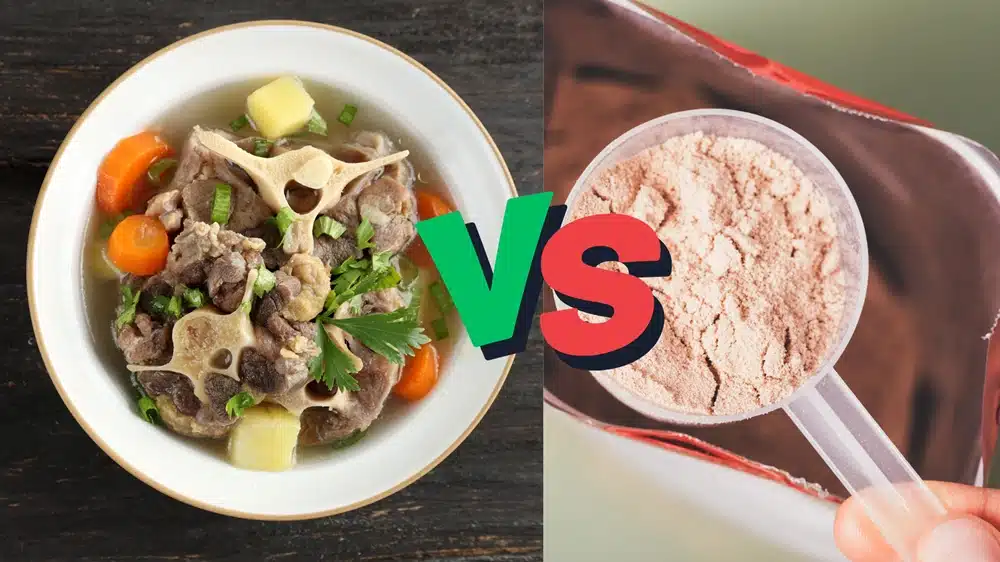
No mundo da nutrição funcional e dos suplementos alimentares, poucas tendências tiveram um renascimento tão grande quanto o caldo de ossos. Aclamado como um superalimento “ouro líquido”, é defendido por entusiastas da dieta paleo, adeptos da dieta cetogénica e profissionais de saúde holística. O principal argumento de venda? O seu potencial para apoiar a saúde das articulações, a elasticidade da pele e a integridade intestinal através do seu rico conteúdo em colagénio.
No entanto, para profissionais do setor, formuladores de produtos e consumidores preocupados com a saúde, uma questão crítica permanece sem resposta na maioria dos blogs de receitas: Quanto colagénio há no caldo de ossos?, exatamente?
Uma chávena de caldo caseiro equivale a uma colher de colagénio em pó padronizado? Como especialistas em matérias-primas nutricionais, estamos a desvendar os segredos da bioquímica para revelar a verdade sobre rendimento, consistência e biodisponibilidade.
Quick Answer: How Much Collagen Is in Bone Broth?
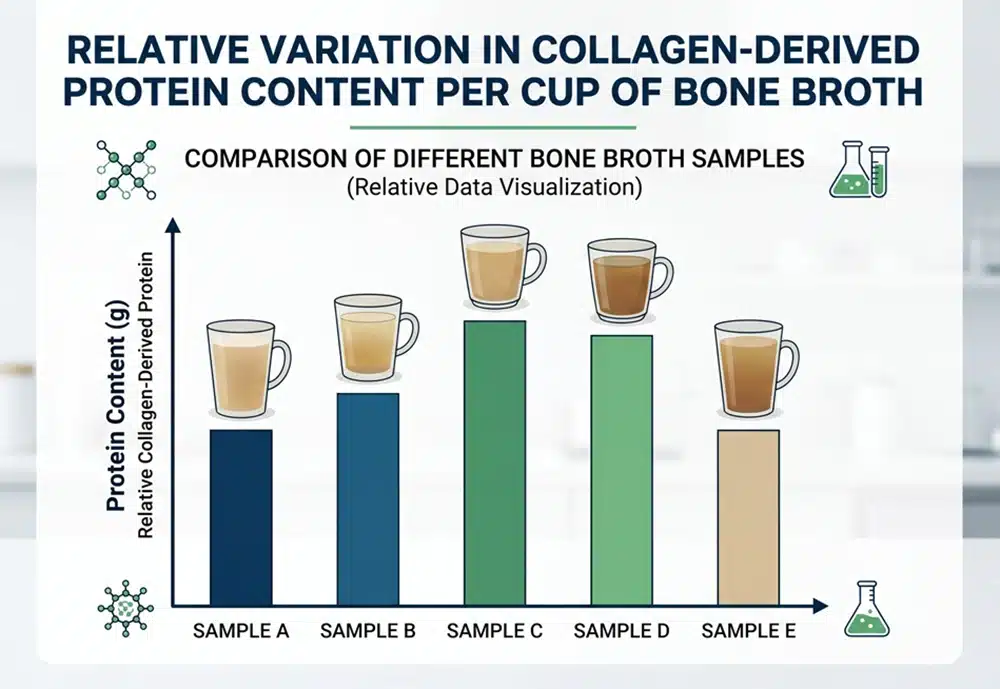
A cup of bone broth can contain collagen-derived gelatin, but the exact amount is highly variable. In practical terms, one cup may provide only a small amount of collagen-derived protein in a diluted commercial broth, or several grams in a concentrated homemade broth made with collagen-rich bones, skin, joints, feet, or connective tissue.
The key point is this: bone broth does not deliver a standardized collagen dose unless the manufacturer tests and declares the collagen or protein content. A cup of broth that contains 9 g of total protein is not automatically the same as 9 g of collagen peptides.
For general wellness, bone broth can be a valuable whole-food source of amino acids, minerals, flavor, and hydration. For targeted product development or clinical-style dosing, standardized hydrolyzed collagen peptides are more reliable because the serving size, molecular weight, amino acid profile, and collagen peptide content can be controlled.
Practical Per-Cup Estimate
| Tipo de produto | Typical Consumer Expectation | Formulation Reality |
| Diluted shelf-stable bone broth | Light protein and savory nutrition | May contain only a few grams of protein per cup; collagen content is not guaranteed unless tested. |
| Concentrated homemade bone broth | Gelatin-rich and collagen-rich | Can be higher in gelatin, especially when made with feet, joints, skin, and connective tissue. Still not standardized. |
| Bone broth powder | More concentrated and easier to label | Quality depends on raw material, drying process, protein content, sodium level, and COA testing. |
| Péptidos de colagénio hidrolisado | Precise collagen peptide dose | Best option when a brand needs a consistent 2.5 g, 5 g, or 10 g collagen peptide serving. |
If your goal is a comforting functional food, bone broth works well. If your goal is a measurable collagen dose, use a standardized collagen peptide ingredient.
What Counts as “Collagen” in Bone Broth?
When people ask how much collagen is in bone broth, they usually mean one of three different things:
1. Native collagen in the raw bones, skin, cartilage, and connective tissue before cooking.
2. Gelatin formed when heat denatures native collagen during simmering.
3. Collagen peptides formed when gelatin is further broken down through controlled enzymatic hydrolysis.
Bone broth mainly contains gelatin and collagen-derived amino acids, not the same low-molecular-weight hydrolyzed collagen peptides used in standardized supplement powders.
This distinction matters for supplement brands. A consumer may use the word “collagen” broadly, but a manufacturer must decide what is actually being delivered in the serving: total protein, gelatin, hydroxyproline-rich protein, bone broth solids, or hydrolyzed collagen peptides.
Collagen Form Comparison
| Formulário | Where It Appears | Typical Property | Formulation Meaning |
| Colagénio nativo | Raw skin, bone, cartilage, tendon | Large triple-helix structure | Not a practical supplement format without processing. |
| Gelatina | Cooked bone broth and cooked collagen | Gels when cooled; warm-water soluble | Gives broth its “jiggle,” but dosage and molecular size are variable. |
| Péptidos de colagénio hidrolisado | Standardized collagen peptide powders | Low molecular weight; cold-water soluble | Best for precise serving sizes, beverage powders, stick packs, capsules, and gummies. |
For a food blog, the “jiggle test” is useful. For a supplement brand, it is not enough. Brands need COA data, hydroxyproline testing, protein content, molecular weight distribution, and batch-to-batch consistency.
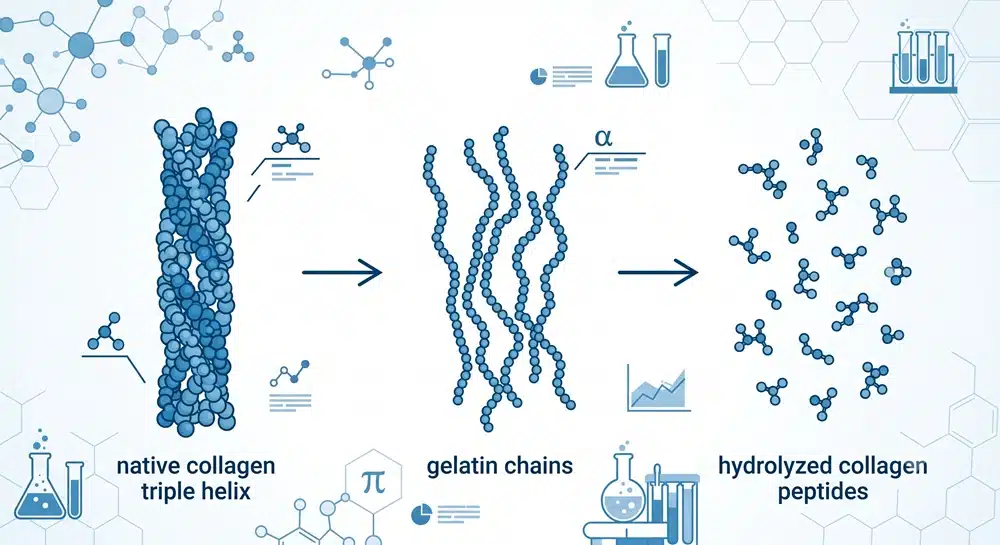
A química: colagénio, gelatina e peptídeos
Para compreender o valor do caldo de ossos, é preciso primeiro entender a transformação da molécula de colagénio.
1. Colagénio nativo (nos ossos): No seu estado natural, dentro do tecido conjuntivo animal, o colagénio existe como uma estrutura de tripla hélice. É incrivelmente resistente e insolúvel em água. Não é possível simplesmente comer um osso e digerir o colagénio; o peso molecular é muito alto (aproximadamente 300 000 Daltons).
2. Gelatina (no caldo): When bones are simmered in water for an extended period, the heat breaks the cross-links holding the collagen helix together. This process is called denaturation. The collagen unwinds and becomes gelatin.
- Característica principal: A gelatina solidifica quando arrefecida. É essa a consistência gelatinosa que se observa no caldo de ossos de alta qualidade.
- Peso molecular: A gelatina é menor do que o colagénio nativo, mas ainda assim é composta por longas cadeias de aminoácidos (aproximadamente 50.000 – 100.000 Daltons).
3. Peptídeos de colagénio hidrolisado (em suplementos): Esta é a forma encontrada em matérias-primas padronizadas. Através da hidrólise enzimática, a gelatina é ainda mais decomposta em pequenas cadeias de aminoácidos chamadas peptídeos.
- Característica principal: Totalmente solúvel em água fria; não forma gel.
- Peso molecular: Extremamente baixo (frequentemente 2.000 – 5.000 Daltons), otimizando a absorção.
Conclusão: Quando perguntamos “quanto colagénio há no caldo de ossos”, estamos, na verdade, a perguntar “quanta gelatina há no caldo?”. Embora tenham o mesmo perfil de aminoácidos, as suas propriedades físicas e digestibilidade são diferentes.
Os fatores variáveis: por que a consistência é impossível em casa
As a raw material supplier, we value Standardization. When you buy a drum of Collagen Peptides, you know exactly what you are getting. With bone broth, four primary variables dictate the final protein yield.
1. A origem dos ossos
Nem todos os ossos são iguais. A densidade do colagénio tipo I, II e III varia dependendo do animal e da anatomia específica.
- Ossos de carne bovina: Os ossos com tutano são deliciosos e ricos em minerais, mas na verdade têm um teor mais baixo de colagénio. O maior rendimento de colagénio provém dos “ossos das juntas” e das articulações, onde o tecido conjuntivo é mais denso.
- Pés e asas de frango: Estas são a arma secreta da indústria. Como são compostas quase inteiramente por pele, cartilagem e tendões, produzem uma concentração significativamente maior de gelatina em comparação com uma carcaça de frango assado.
- Estruturas para peixes: O colagénio de peixe é altamente biodisponível, mas as espinhas de peixe são delicadas. Elas requerem tempos de cozedura muito mais curtos para extrair o colagénio antes que as proteínas se degradem.
2. O tempo de cozedura
A extração de colagénio é uma função do tempo e da temperatura.
- Menos de 12 horas: Um caldo de carne cozido por apenas 8 horas extrairá o sabor, mas deixará uma quantidade significativa de colagénio retida na densa matriz óssea.
- 24 a 48 horas: Este é o ponto ideal para a carne bovina. Permite energia térmica suficiente para desnaturação completa do colagénio em gelatina.
- Cozinhar sob pressão: As panelas de pressão modernas podem acelerar esse processo, alcançando em 3 horas o que uma panela elétrica demora 24 horas para fazer, embora os puristas discutam sobre o impacto no perfil de aminoácidos.
3. O meio ácido
É comum encontrar receitas que pedem vinagre de maçã (ACV) ou vinho. Isso não é apenas para dar sabor. O ácido ajuda a descalcificar os ossos, efetivamente “abrindo a porta” para a liberação do colagénio. Cozinhar ossos em água neutra (pH 7) rende significativamente menos proteína do que cozinhar em água levemente ácida.
4. Proporção água-osso
Este é o fator mais óbvio, mas frequentemente ignorado. Uma panela cheia de ossos e mal coberta com água produzirá um gel espesso e rico em proteínas. Uma panela com dois ossos e um galão de água produzirá um caldo diluído. Sem testes laboratoriais, o consumidor não tem como saber se a sua chávena de caldo contém 1 g ou 8 g de proteína.
Formulator’s Test Matrix: How to Verify Collagen in a Bone Broth Ingredient
For consumers, taste and texture may be enough. For supplement brands, bone broth ingredients should be evaluated with measurable quality parameters.
Before using a bone broth powder or collagen-rich broth ingredient in a commercial formula, request and review:
- Total protein content
- Hydroxyproline content
- Perfil de aminoácidos
- Teor de humidade
- Sodium content
- Teor de cinzas
- Metais pesados
- Limites microbianos
- Source species and part used
- Drying method
- Solubilidade e dispersibilidade
- Flavor and odor profile
- Batch-to-batch consistency
- Allergen and animal-origin documentation
Hydroxyproline is especially useful because it is strongly associated with collagen-rich material. If a supplier claims a bone broth powder is collagen-rich but cannot provide amino acid or hydroxyproline data, the ingredient should be treated as a flavor or protein ingredient rather than a precise collagen source.

O perfil de aminoácidos: o ouro escondido
Independentemente do método de extração, o verdadeiro valor do colagénio — seja proveniente de caldo ou suplementos — reside no seu perfil único de aminoácidos. Ao contrário da proteína de soro de leite ou de soja, o colagénio é excepcionalmente rico em três aminoácidos específicos:
- Glicina: Frequentemente ausente nas dietas modernas à base de carne magra. Atua como um neurotransmissor inibidor, auxiliando no sono, na desintoxicação e na redução da inflamação.
- Prolina: Essencial para a síntese e estrutura das proteínas, fundamental para a saúde cardiovascular.
- Hidroxiprolina: Este aminoácido é exclusivo do colagénio. É vital para a estabilidade da tripla hélice do colagénio no nosso corpo.
Bone broth provides these amino acids, but it also delivers Glycosaminoglycans (GAGs) like glucosamine, chondroitin sulfate, and hyaluronic acid, which are leached from the cartilage. This “full-spectrum” matrix is the primary advantage of broth over isolated peptide powders.
Biodisponibilidade: Caldo vs. Peptídeos Hidrolisados
Here is where the distinction becomes critical for manufacturers and consumers focusing on efficacy.
A Barreira de Absorção O sistema digestivo humano deve decompor as proteínas em aminoácidos ou di/tripeptídeos para absorvê-las na corrente sanguínea.
- Caldo de ossos (gelatina): Requer um esforço digestivo significativo (pepsina e ácido gástrico) para quebrar as longas cadeias de gelatina. Para indivíduos com digestão comprometida (comum em idosos ou pessoas com problemas intestinais), a absorção pode ser ineficiente.
- Peptídeos hidrolisados: Estes são “pré-digeridos”. O seu baixo peso molecular permite que atravessem rapidamente a barreira intestinal e entrem na corrente sanguínea, atingindo frequentemente o pico no plasma 1 a 2 horas após a ingestão.
O efeito “Sinal” Research suggests that specific collagen peptides (like Pro-Hyp and Hyp-Gly) act not just as building blocks, but as signaling molecules. They trigger fibroblasts in the skin to produce mais colagénio. As matérias-primas padronizadas são frequentemente otimizadas para conter níveis elevados destes peptídeos bioativos específicos. Não é claro se o caldo de ossos, com a sua hidrólise aleatória, produz estes peptídeos sinalizadores em quantidades clinicamente relevantes.
Why Hydrolyzed Collagen Peptides Are Better for Label Claims
Bone broth is a variable food matrix. Hydrolyzed collagen peptides are a standardized ingredient.
That difference matters when a brand wants to make a clear front-panel claim such as “10 g collagen peptides per serving” or wants to build a product around skin, joint, beauty, mobility, or active aging positioning.
Hydrolyzed collagen peptides give formulators more control over:
- Dose
- Contribuição proteica
- Distribuição do peso molecular
- Solubility in cold or hot liquids
- Sabor e odor
- Fluxo de pó
- Clinical-style dosage alignment
- Stick pack, tub, capsule, tablet, gummy, or RTD format feasibility
A bone broth concept product can still be highly attractive. The best approach is often to combine the consumer appeal of bone broth with the precision of standardized collagen peptides.
Formulator’s Note: How to Build a Standardized Bone Broth Concept Product
For supplement brands, the strongest opportunity is not choosing between bone broth and collagen peptides. It is combining the market appeal of bone broth with the precision of standardized collagen peptide ingredients.
Option 1: Traditional Bone Broth Powder
This is best for brands focused on savory nutrition, gut comfort, whole-food positioning, and culinary use. The main formulation challenges are sodium, flavor, aroma, solubility, and protein consistency.
Option 2: Hydrolyzed Collagen Peptide Powder
This is best for beauty, joint, mobility, sports recovery, and active aging products that require a clear collagen dose. It works well in stick packs, tubs, capsules, tablets, and gummies.
Option 3: Bone Broth + Collagen Peptide Hybrid
This is often the best commercial format. The bone broth component provides the story, taste, and whole-food identity. The hydrolyzed collagen peptide component provides the measurable collagen dose.
A strong hybrid positioning might be: “Bone broth-inspired collagen peptide powder with standardized collagen peptides and savory whole-food flavor.”
This avoids relying on variable broth solids alone while still preserving the consumer-friendly bone broth concept.
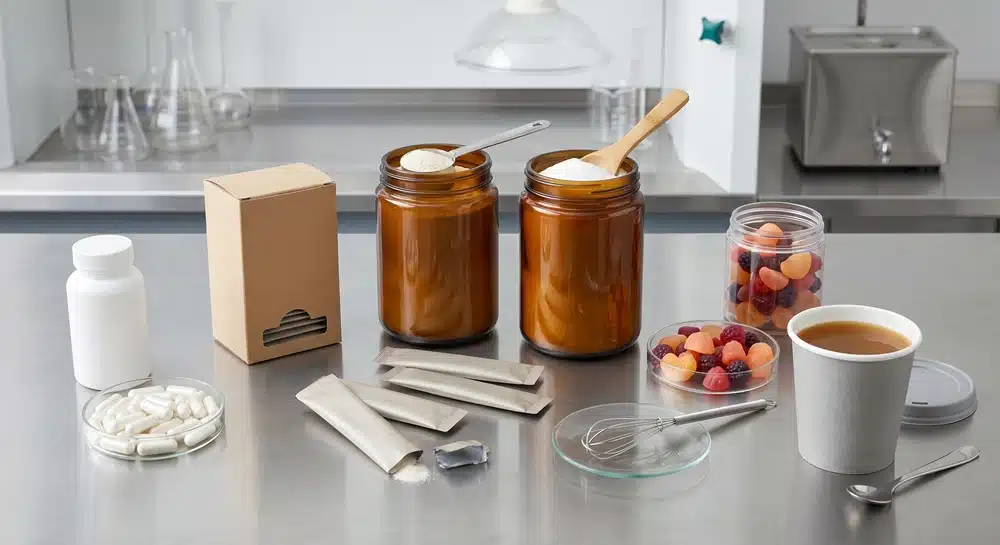
Example Product Architecture
| Tipo de fórmula | Main Ingredient Strategy | Best Format | Posicionamento da marca |
| Pure bone broth powder | Bone broth solids | Savory drink powder | Whole-food nutrition and comfort. |
| Collagen peptide powder | Péptidos de colagénio hidrolisado | Stick pack or tub | Beauty, joint, mobility, active aging. |
| Bone broth collagen blend | Bone broth powder + standardized collagen peptides | Savory powder or capsule | Bone broth story with precise collagen dose. |
| Joint-health collagen formula | Collagen peptides + vitamin C + apoio às articulações ingredientes | Powder, tablet, capsule | Mobility and connective tissue support. |
O veredicto: suplemento, alimento ou ambos?
Então, como devemos encarar o caldo de ossos no contexto de um regime nutricional?
Os argumentos a favor do caldo de ossos: O caldo de ossos é um alimento holístico. Ele oferece hidratação, eletrólitos (cálcio, magnésio, fósforo) e um conforto saboroso que um comprimido não pode proporcionar. É excelente para a manutenção intestinal e o enriquecimento geral da dieta.
O caso dos suplementos padronizados: Para obter resultados terapêuticos específicos, como reduzir a profundidade das rugas, aumentar a elasticidade da pele ou acelerar a recuperação de lesões, a consistência é fundamental.
- Precisão: Um suplemento permite consumir exatamente 10 g de colagénio por dia.
- Conveniência: Sem tempos de cozedura de 24 horas.
- Eficiência: A maior biodisponibilidade garante que os aminoácidos cheguem aos tecidos-alvo.
Conclusion: Bone Broth Is Valuable, But Not Precise
Bone broth can be a nutritious whole food and a strong product story. It provides gelatin, amino acids, minerals, flavor, and a comforting format that many consumers understand.
But if the goal is a reliable collagen dose, bone broth alone is not precise enough. The collagen-derived content depends on raw material selection, cooking time, acid level, water ratio, concentration, drying method, and batch testing.
For consumers, bone broth can be part of a healthy diet. For supplement brands, standardized hydrolyzed collagen peptides are the better foundation for measurable collagen claims, consistent formulation, and repeatable product performance.
The most commercially useful solution is often a hybrid: use bone broth for the story and sensory identity, and use standardized collagen peptides for the actual collagen dose.
Need help developing a bone broth collagen product?
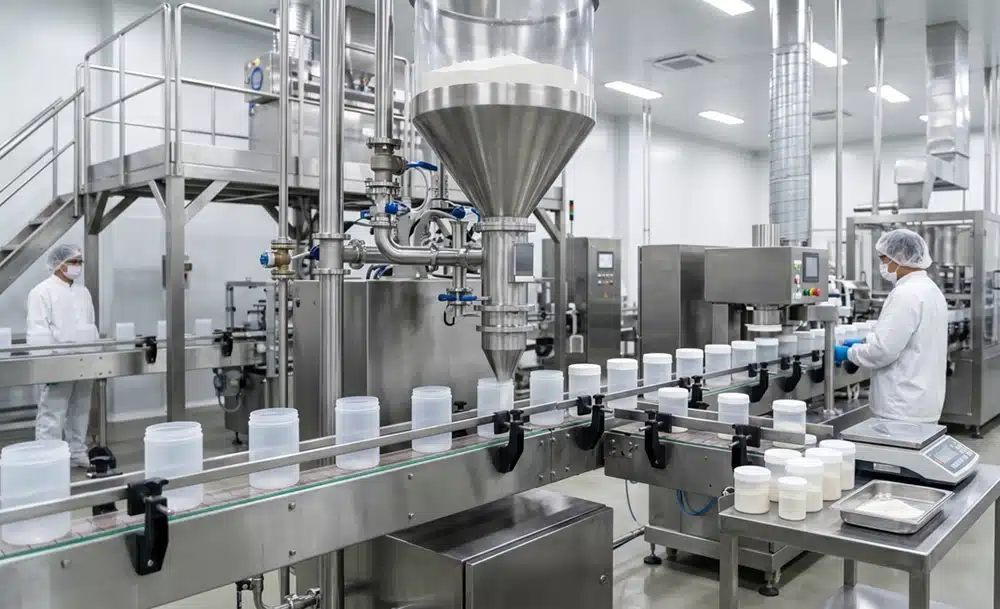
If you are developing a bone broth powder, collagen peptide formula, savory protein drink, capsule, gummy, tablet, or private-label collagen product, send us your target serving size, protein claim, flavor direction, and dosage format. Our formulation team can help evaluate collagen peptide selection, bone broth powder feasibility, label-claim strategy, and manufacturing options.
FAQs About Collagen in Bone Broth
How much collagen is in one cup of bone broth?
There is no universal number. One cup of bone broth may contain only a small amount of collagen-derived gelatin if it is diluted, or several grams if it is concentrated and made with collagen-rich bones and connective tissue. The only reliable way to know is to check tested protein and amino acid data.
Is the protein in bone broth the same as collagen?
Not exactly. Bone broth protein may come from gelatin, meat residues, connective tissue, and other soluble proteins. Gelatin is derived from collagen, but total protein grams should not automatically be treated as collagen peptide grams.
O caldo de ossos é melhor do que os peptídeos de colagénio?
Bone broth is better as a whole-food, savory nutrition product. Collagen peptides are better when a precise collagen dose, solubility, low molecular weight, and consistent serving size are required.
Can a supplement brand make a collagen claim from bone broth powder?
Only if the ingredient and finished product support the claim through testing and documentation. Brands should request COA data, amino acid profile, protein content, hydroxyproline data, and label compliance review before making collagen-related claims.
Why does homemade bone broth gel in the refrigerator?
The gel texture comes from gelatin, which forms when collagen-rich connective tissue is heated and denatured. A strong gel usually indicates a higher gelatin content, but it still does not provide a precise collagen peptide dose.
What bones produce the most collagen-rich broth?
Bones and parts rich in connective tissue usually produce the most gelatin. Examples include knuckle bones, oxtail, chicken feet, wings, necks, fish heads, and fish frames. Marrow bones add flavor and fat but are not always the highest collagen source.
Is bone broth collagen bioavailable?
Bone broth provides gelatin and amino acids that can be digested, but gelatin chains are generally larger and less standardized than hydrolyzed collagen peptides. Hydrolyzed collagen peptides are processed to a lower molecular weight for better solubility and more predictable absorption.
Should a brand use bone broth powder or hydrolyzed collagen peptides?
Use bone broth powder when the main goal is flavor, whole-food positioning, and savory nutrition. Use hydrolyzed collagen peptides when the main goal is a measurable collagen serving size, beauty, joint, mobility, or active-aging positioning. Use both when you want a bone broth story with a standardized collagen dose.
Referências
- Alcock, R. D. et al. Bone Broth Unlikely to Provide Reliable Concentrations of Collagen Precursors Compared With Supplemental Sources of Collagen Used in Collagen Research. PubMed.
https://pubmed.ncbi.nlm.nih.gov/29893587/ - Shaw, M. H. & Flynn, N. E. Amino acid content of beef, chicken, and turkey bone broth. Journal of Undergraduate Chemistry Research, 2019.
https://www.westmont.edu/sites/default/files/users/user1231/V19No4/Nick%20Flynn_final.pdf - Khatri, M. et al. The effects of collagen peptide supplementation on body composition, collagen synthesis, and recovery from joint injury and exercise. Amino Acids, 2021.
https://pmc.ncbi.nlm.nih.gov/articles/PMC8521576/ - Pu, S. Y. et al. Effects of Oral Collagen for Skin Anti-Aging: A Systematic Review and Meta-Analysis. Nutrients, 2023.
https://pmc.ncbi.nlm.nih.gov/articles/PMC10180699/ - Martínez-Puig, D. et al. Collagen Supplementation for Joint Health: The Link between Composition and Scientific Knowledge. Nutrients, 2023.
https://pmc.ncbi.nlm.nih.gov/articles/PMC10058045/ - Sato, K. Collagen-Derived Di-Peptide, Prolylhydroxyproline (Pro-Hyp): A New Low Molecular Weight Growth-Initiating Factor. International Journal of Molecular Sciences, 2020.
https://pmc.ncbi.nlm.nih.gov/articles/PMC7728856/ - Virgilio, N. et al. Absorption of bioactive peptides following collagen hydrolysate intake: effect of molecular weight and raw material source. 2024.
https://pmc.ncbi.nlm.nih.gov/articles/PMC11325589/ - Harvard Health Publishing. Savoring the benefits of bone broth: Worth a taste?
https://www.health.harvard.edu/diet-and-nutrition/savoring-the-benefits-of-bone-broth-worth-a-taste - FDA. Alegações relativas à estrutura/função.
https://www.fda.gov/food/nutrition-food-labeling-and-critical-foods/structurefunction-claims - UCLA Health. Should you take collagen supplements?
https://www.uclahealth.org/news/article/should-you-take-collagen-supplements

Warren Wan é um especialista experiente com vasta experiência na cadeia de abastecimento de suplementos alimentares, possuindo uma rica experiência prática na investigação, desenvolvimento, controlo de processos e aquisição global de ingredientes essenciais, tais como peptídeos de colagénio, proteína de caldo de ossos e queratina. Como autor desta coluna, dedica-se a ir além do discurso de marketing, transformando a ciência obscura dos ingredientes e as normas de controlo de qualidade da produção numa divulgação científica rigorosa e de fácil compreensão, ajudando os leitores a compreender a verdade por trás dos rótulos e a fazer escolhas mais racionais em matéria de saúde.