
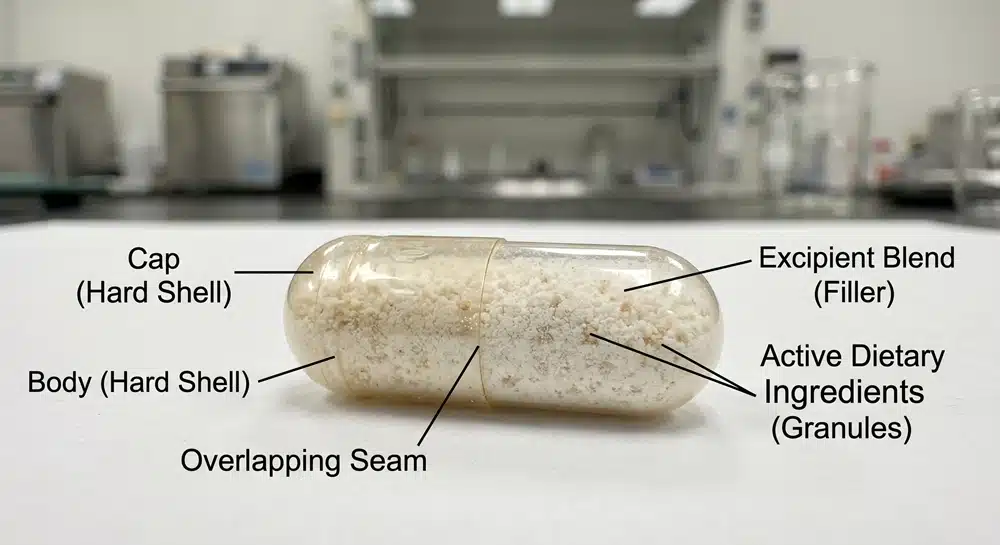
The capsule shell is separate from the material inside it. The fill may contain vitamins, minerals, botanicals, amino acids, probiotics, oils, powders, granules, beadlets, and excipients. For a broader overview of formats, benefits, and selection criteria, see our capsule supplements guide.
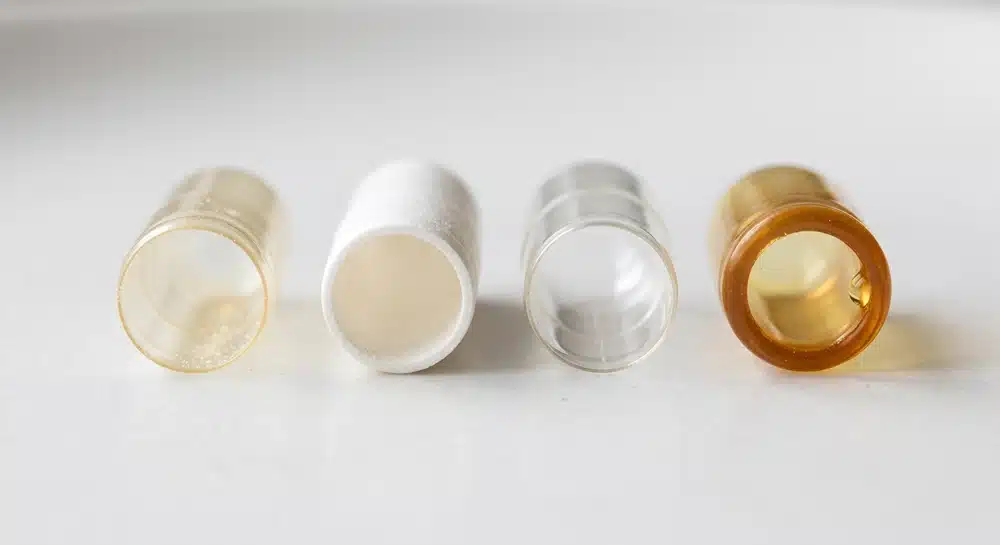
Capsule Shell vs. Capsule Fill: What Are You Actually Looking At?
A capsule product normally has two ingredient systems:
- The shell: the edible outer casing, usually gelatin, HPMC, pullulan, or a specialty softgel or delayed-release system.
- The fill: the active dietary ingredients plus any excipients needed for flow, uniformity, stability, processing, or release.
This distinction matters when reading a label. The Supplement Facts panel lists dietary ingredients, while the ingredient statement generally identifies shell materials and other ingredients that are not declared in Supplement Facts. Depending on the formula, the label may list terms such as gelatin, hypromellose, glycerin, purified water, rice flour, silicon dioxide, magnesium stearate, colors, or other excipients.
Main Capsule Shell Materials Compared
| Capsule shell | Main material | Animal-free? | Typical formulation fit | Key checks |
|---|---|---|---|---|
| Gelatin hard capsule | Collagen-derived gelatin, commonly bovine or porcine; fish gelatin is also available | No | General powder, granule, and beadlet formulas | Species source, moisture compatibility, cross-linking risk, halal/kosher documentation |
| HPMC hard capsule | Hypromellose, a cellulose ether | Generally positioned as non-animal | Vegetarian or vegan-positioned products and many moisture-sensitive fills | Supplier composition, gelling system, dissolution, certification, fill compatibility |
| Pullulan hard capsule | Fermentation-derived polysaccharide | Generally positioned as non-animal | Premium plant-based products and selected oxygen-sensitive formulas | Barrier data, availability, cost, certification scope, packaging and stability testing |
| Conventional softgel | Usually gelatin, water, and a plasticizer such as glycerin or sorbitol | Usually no | Oils, suspensions, and selected liquid or semi-solid fills | Plasticizer system, seam integrity, fill-shell interaction, moisture migration |
| Non-animal softgel | Supplier-specific starch, carrageenan, modified cellulose, or other polysaccharide systems | Potentially, subject to documentation | Plant-based oil and liquid products | Supplier technology, processing window, stability, certification, target-market rules |
| Delayed-release capsule | Specialized shell polymer or coating system | Depends on system | Formulas designed for release beyond the stomach | Validated dissolution method, label wording, storage, and instructions for use |
Gelatin Capsules
What Is a Gelatin Capsule Made From?
Gelatin is a protein produced from collagen-containing animal tissues. Capsule-grade gelatin is commonly sourced from bovine or porcine materials, although fish-derived gelatin is available for specialized products. The source should be verified through the shell supplier’s specification, traceability documents, and any relevant religious or dietary certificates. A generic “gelatin” declaration does not, by itself, identify the animal species.
Hard gelatin capsules are usually two-piece shells made with gelatin and water. Supplier formulations may also include approved colors, opacifiers, or processing aids. Softgel shells are different: they require a plasticizer to remain flexible and are formed, filled, and sealed in one process. For a deeper material and quality-control explanation, read how gelatin capsule shells are made.
Benefits and Limitations of Gelatin
- Established manufacturing performance: gelatin is widely used and works well on many high-speed encapsulation lines.
- Cost and availability: it is often more economical than specialty plant-based shell systems.
- Dietary restrictions: it is not suitable for vegan or vegetarian products, and halal or kosher suitability requires appropriate sourcing and certification.
- Environmental sensitivity: shell behavior can change under very dry, humid, or hot conditions.
- Formula compatibility: some fills can interact with gelatin or promote cross-linking, so dissolution and stability testing are important.
HPMC Vegetarian Capsules
What Is HPMC?
HPMC stands for hydroxypropyl methylcellulose and is also called hypromellose. It is a cellulose ether manufactured from purified cellulose through controlled chemical modification. The resulting material is used to form non-animal hard capsule shells. Although the cellulose source is plant-derived, claims such as vegan, non-GMO, halal, or kosher should still be supported by supplier documentation and certification rather than assumed from the material name alone.
HPMC and Moisture-Sensitive Formulas
HPMC shells commonly have a lower equilibrium moisture range than gelatin shells, which can make them useful for some hygroscopic or moisture-sensitive ingredients. This does not mean HPMC is automatically superior for every formula. Shell performance depends on the capsule supplier, gelling system, fill composition, storage humidity, packaging, and dissolution requirements. Compare these factors in our gelatin vs. HPMC formulation guide.
Brands should confirm shell moisture specifications, brittleness risk, dissolution behavior, compatibility with hygroscopic ingredients, and performance after accelerated and real-time stability testing.
Pullulan and Other Plant-Based Capsules
What Is Pullulan?
Pullulan is a water-soluble polysaccharide made by microbial fermentation. It can be formed into clear, plant-based capsule shells and is often used for premium positioning. Pullulan may provide useful oxygen-barrier properties, but the practical protection of a finished supplement also depends on shell thickness, fill chemistry, headspace, bottle material, closure, desiccant or oxygen absorber, and storage conditions. Do not rely on one universal barrier multiple without supplier-specific test data.
Does Pullulan Make a Product USDA Organic?
No capsule material automatically makes a finished product “100% organic” or “organic.” USDA rules allow pullulan for organic handling in products labeled “Made with organic (specified ingredients or food group(s)),” subject to the National Organic Program and certifier review. The finished product’s ingredients, percentages, processing aids, records, facility controls, and label must meet the applicable certification category. Obtain written approval from the organic certifier before finalizing claims or packaging.
Other non-animal hard capsule systems may use starches, carrageenan, gellan gum, modified cellulose, or blends of polysaccharides. Their composition and processing behavior are supplier-specific, so the common or usual ingredient names and technical documents should be reviewed before using broad terms such as “vegetable capsule.”
Hard Capsules vs. Softgels vs. Delayed-Release Capsules
| Format | Structure | Common fill | Important limitation |
|---|---|---|---|
| Two-piece hard capsule | Separate cap and body | Powders, granules, pellets, beadlets, and selected non-aqueous fills | Not every formula can be opened or mixed into food; check product instructions |
| Softgel | One-piece, flexible, hermetically sealed shell | Oils, suspensions, and selected liquid or semi-solid systems | Fill and shell can exchange moisture or plasticizer, affecting stability |
| Delayed-release capsule | Specialized shell or coated system | Ingredients intended for delayed release or protection from stomach conditions | Do not open, crush, or chew unless the product manufacturer confirms that it is appropriate |
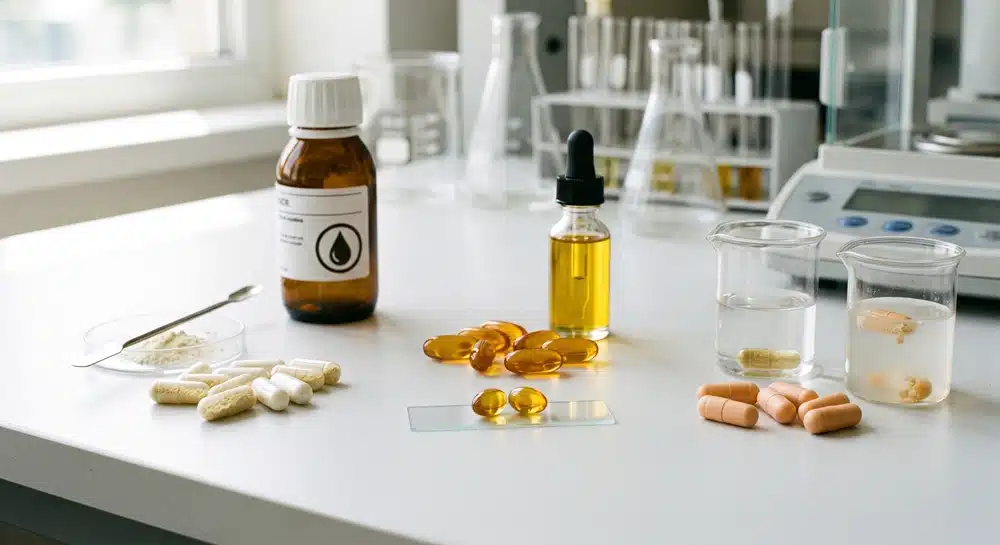
What Else Can Be in a Capsule Shell?
Water, Plasticizers, and Gelling Agents
Water is used during shell formation and remains at a controlled level in many finished shells. Softgels normally contain a plasticizer such as glycerin or sorbitol to keep the shell flexible. Some HPMC or plant-based capsule technologies use gelling agents or salts to support film formation. Exact compositions vary by supplier.
Colorants and Opacifiers
Capsules may be clear, naturally colored, synthetically colored, or opaque. Colors can support product identification and branding, while opacity can reduce light exposure or hide an unattractive fill. A clear capsule is not necessarily additive-free, and an opaque capsule does not reveal which opacifier was used. Review the supplier’s complete composition and the finished label.
Titanium dioxide requirements differ by market. It remains permitted under applicable U.S. color-additive rules when used in compliance with those rules, while the European Union no longer authorizes titanium dioxide (E171) as a food additive. Brands selling across markets should select shell colors and opacifiers against the rules of every intended destination.
Preservatives and Processing Aids
Do not assume that every gelatin shell contains preservatives or that every plant-based shell is preservative-free. Modern empty hard capsules are supplied to defined microbiological and moisture specifications, and formulas differ. Ask for a complete ingredient statement, specification, allergen statement, and certificate of analysis for the exact shell grade and color.
Are Supplement Capsules Made of Plastic?
No. Edible pill and supplement capsules are not made from ordinary packaging plastic. Gelatin is a protein, while HPMC, pullulan, and other plant-based systems are edible film-forming polymers or polysaccharides designed to disintegrate or dissolve under specified conditions. “Polymer” is a chemistry term and does not mean that the shell is conventional plastic.
However, specialized delayed-release or pharmaceutical capsule systems can use modified polymers or coatings with controlled-release functions. Consumers should follow the product instructions, and brands should use the correct common or usual ingredient names and validated dissolution specifications.
How to Read “Other Ingredients” on the Label
In the United States, ingredients not declared in the Supplement Facts panel are generally listed in an ingredient statement headed “Other Ingredients.” The shell material, colors, flavors, fillers, binders, flow agents, and other excipients may appear there. Ingredients are generally listed in descending order of predominance by weight.
| Label term | What it usually means | What to verify |
|---|---|---|
| Gelatin | Animal-derived capsule shell or softgel shell component | Bovine, porcine, fish, or mixed source; halal/kosher status |
| Hypromellose or HPMC | Cellulose-derived hard capsule shell | Full shell composition, gelling system, vegan and other certificates |
| Pullulan | Fermentation-derived polysaccharide shell | Source materials, certification scope, supplier barrier data |
| Glycerin or sorbitol | Common softgel plasticizer | Source, grade, formula compatibility, dietary claims |
| Color added or named colors | Colorant used in shell or product | Target-market permission, source, allergen or dietary implications |
| Titanium dioxide | White colorant or opacifier in markets where permitted | Destination-market compliance and customer requirements |
Which Capsule Material Is Best for Consumers?
There is no single best capsule material for everyone. Use the label and your dietary needs to narrow the choice:
- Choose a verified non-animal shell if you follow a vegan or vegetarian diet.
- Look for valid halal or kosher certification rather than relying only on “vegetable” or “bovine” wording.
- Check the full Other Ingredients list if you avoid particular colors, sweeteners, carrageenan, or other excipients.
- Do not open delayed-release, enteric, extended-release, or specialized capsules unless the manufacturer or a qualified healthcare professional confirms that it is appropriate.
- Ask a healthcare professional about the complete supplement formula if you are pregnant, nursing, taking medication, managing a medical condition, or have a known allergy.
Which Capsule Shell Should Supplement Brands Choose?
For brands and formulators, shell selection should be made after evaluating the fill—not from a marketing claim alone.
| Decision factor | Questions to answer before selection |
|---|---|
| Dietary positioning | Does the product require vegan, vegetarian, halal, kosher, non-GMO, allergen, or organic certification? |
| Fill compatibility | Is the fill hygroscopic, oxygen-sensitive, acidic, alkaline, oily, reactive, or prone to cross-linking? |
| Release profile | Is immediate release acceptable, or is a validated delayed-release system required? |
| Serving size | What fill weight and tapped density are required, and how many capsules per serving will consumers accept? |
| Target markets | Are every shell ingredient, color, and claim permitted in the United States, European Union, United Kingdom, Canada, Australia, and other intended markets? |
| Stability | How will heat, humidity, oxygen, light, and packaging affect the shell and fill over shelf life? |
| Manufacturing | Does the shell run reliably on the selected equipment, and are weight variation, locking, polishing, inspection, and metal detection controls defined? |
| Commercial terms | What are the minimum order quantity, lead time, color matching process, tooling needs, and supply continuity plan? |
Before requesting a quote, estimate the required shell size from formula density and target fill weight using a capsule size chart and dimensions guide.
Capsule Shell Supplier and COA Checklist
- Complete shell composition and common or usual ingredient names
- Source and traceability information for gelatin, cellulose, starch, and plasticizers
- Certificate of analysis and current specification for the exact lot and shell grade
- Microbiological, heavy-metal, residual-solvent, moisture, and physical specifications as applicable
- Disintegration or dissolution method and acceptance criteria
- Allergen, GMO, BSE/TSE, vegan/vegetarian, halal, kosher, and organic documents as applicable
- Color-additive and target-market regulatory statements
- Storage conditions, shelf life, packaging configuration, and change-control commitments
- Compatibility, pilot-run, accelerated-stability, and real-time-stability data for the finished formula
GENSEI supports shell selection, formula review, capsule sizing, pilot and production planning, testing, packaging, and label coordination. Explore our capsule supplement manufacturing capabilities to discuss a custom capsule project.
Frequently Asked Questions
What are pill capsules made of?
Most hard pill capsule shells are made from gelatin or HPMC. Gelatin is animal-derived, while HPMC is a cellulose-derived, non-animal material. Selected plant-based capsules use pullulan, starch, or other polysaccharide systems. Softgels usually contain gelatin or a specialized non-animal shell system, water, and a plasticizer.
What are vitamin capsules made of?
The shell is commonly gelatin or HPMC, while the fill contains the vitamins and any excipients needed for manufacturing or stability. Both the Supplement Facts panel and Other Ingredients list should be reviewed.
What are vegetarian capsules made of?
Many vegetarian hard capsules are made from HPMC, also called hypromellose. Others use pullulan or supplier-specific starch and polysaccharide systems. Verify the complete shell composition and any vegan, halal, kosher, or non-GMO documentation.
Are gelatin capsules made from pork?
Some are, but not all. Gelatin capsules may use porcine, bovine, fish, or other approved gelatin sources. The animal source should be confirmed from the label, manufacturer, or supplier documentation.
Are supplement capsules made of plastic?
No. Standard edible capsules are made from film-forming materials such as gelatin, HPMC, or pullulan. These are not ordinary packaging plastics and are designed to disintegrate or dissolve under specified conditions.
Can you open a supplement capsule?
Some immediate-release powder capsules can be opened, but delayed-release, enteric, extended-release, beadlet, probiotic, enzyme, and moisture-sensitive products may not be suitable for opening. Follow the label and ask the manufacturer or a qualified healthcare professional when uncertain.
Is HPMC always better than gelatin?
No. HPMC can support non-animal positioning and may be useful for some moisture-sensitive fills, while gelatin may offer cost and processing advantages. The better choice depends on fill compatibility, release requirements, certification, target markets, packaging, stability, and cost.
References
- FDA: Questions and Answers on Dietary Supplements
- FDA: Dietary Supplement Labeling Guide, Chapter V—Ingredient Labeling
- FDA: Dietary Supplement Current Good Manufacturing Practice Compliance Guide
- FTC: Health Products Compliance Guidance
- USDA AMS: National Organic Program Amendment Adding Pullulan
- U.S. eCFR: Titanium Dioxide Color Additive Regulation
- European Commission Regulation (EU) 2022/63 on Titanium Dioxide (E171)
- Comparative Evaluation of Gelatin and HPMC Capsule Shells Under Humidity Conditions
Editorial note: This article provides general educational and formulation information. Finished-product suitability, claims, labeling, certification, and regulatory compliance must be assessed for the exact formula, supplier documentation, manufacturing process, and target market.

Warren Wan is a seasoned expert with extensive experience in the dietary supplement supply chain, possessing rich practical experience in the research, development, process control, and global sourcing of core ingredients such as collagen peptides, bone broth protein, and keratin. As the author of this column, he is dedicated to stripping away the marketing packaging, transforming obscure ingredient science and production quality control standards into easy-to-understand, hardcore science popularization, helping readers understand the truth behind the labels and make more rational health choices.


