
Vitamin D is essential for strong bones, immune health, and overall well-being, yet many people struggle to maintain adequate levels. When it comes to supplementation, the choice between prescription vitamin D vs over the counter (OTC) options can be confusing. This guide explores the differences, benefits, risks, and best use cases for each, helping you make an informed decision based on your health needs.
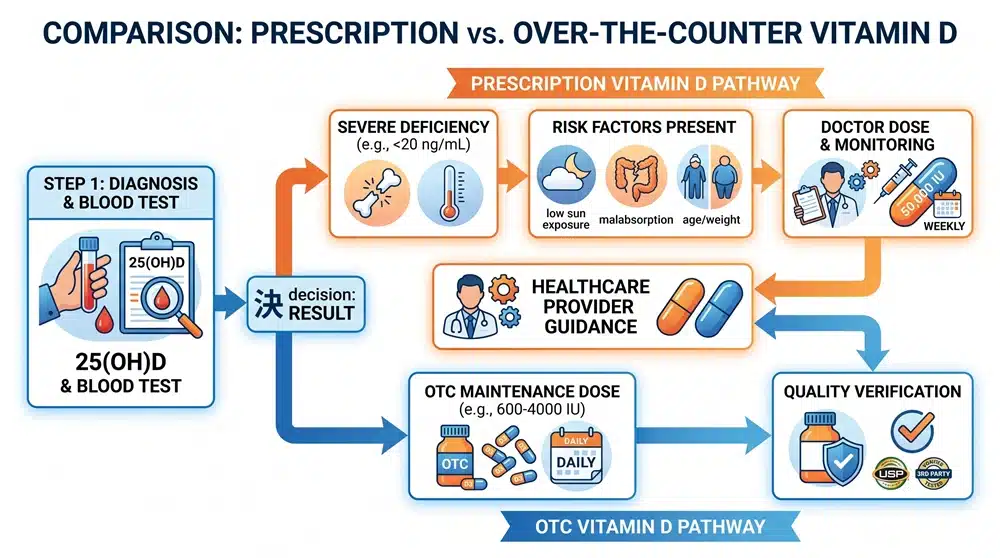
Quick Summary: Prescription vitamin D is usually a short-term, high-dose medical treatment for confirmed deficiency, often given as 50,000 IU weekly under clinician monitoring. Over-the-counter vitamin D, usually D3 at 400–5,000 IU per serving, is better suited for daily maintenance, mild insufficiency, or people who need flexible long-term support. The safest choice depends on your 25(OH)D blood test, medical history, medications, and supplement quality.
Understanding Vitamin D
Vitamin D, often called the “sunshine vitamin,” supports calcium absorption, bone health, and immune function. It exists in two main forms: vitamin D2 (ergocalciferol) and vitamin D3 (cholecalciferol). D3 is more effective at raising blood levels and is the form naturally produced by the skin when exposed to sunlight. Sources of vitamin D include sunlight, foods like fatty fish and fortified dairy, and supplements.
Vitamin D deficiency is common, affecting up to 40% of adults in some populations, particularly those with limited sun exposure, darker skin, or certain medical conditions. Deficiency can lead to weak bones (osteoporosis or rickets), muscle weakness, and increased infection risk. Blood tests measuring 25-hydroxyvitamin D levels (in ng/mL) determine deficiency, with levels below 20 ng/mL typically requiring intervention.
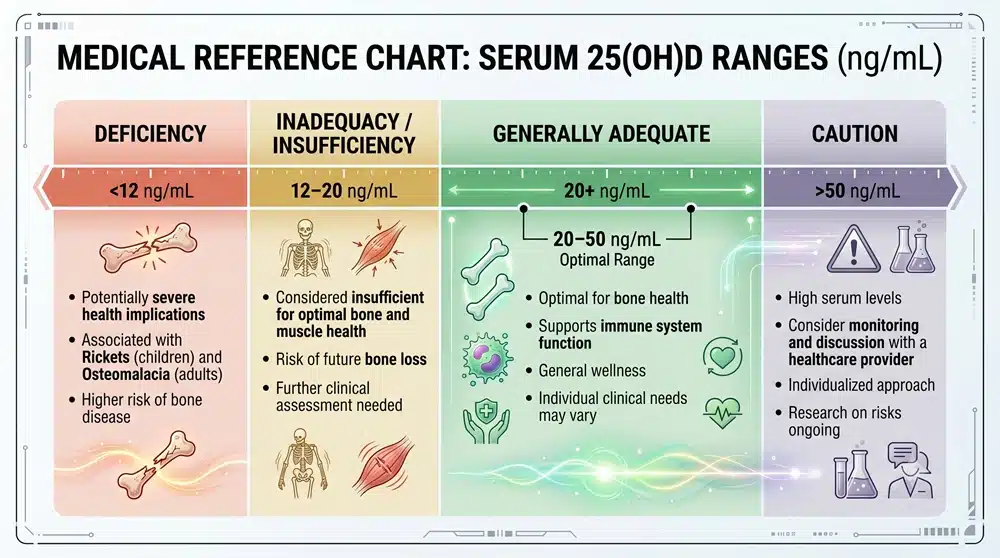
| 25(OH)D Level | General Interpretation | What It Means For This Article |
| <12 ng/mL (<30 nmol/L) | Associated with vitamin D deficiency. | Do not self-treat with random OTC dosing; medical evaluation may be needed. |
| 12–20 ng/mL (30–50 nmol/L) | May be inadequate for some people. | OTC D3 may be used in some cases, but risk factors and clinician advice matter. |
| ≥20 ng/mL (≥50 nmol/L) | Generally adequate for most healthy individuals. | Maintenance-focused OTC use may be enough for many people. |
| >50 ng/mL (>125 nmol/L) | May be associated with adverse effects in some contexts. | Avoid stacking multiple vitamin D products; review intake and testing with a clinician. |
Why The 25(OH)D Blood Test Matters More Than Symptoms
Vitamin D decisions should not be based on symptoms alone. The main lab marker is serum 25-hydroxyvitamin D, written as 25(OH)D. According to the NIH Office of Dietary Supplements, levels below 12 ng/mL are associated with deficiency, 12–20 ng/mL may be inadequate for some people, and 20 ng/mL or higher is generally adequate for most healthy individuals. However, target levels can vary by health status, age, kidney function, medication use, and the testing method used by the laboratory.
For this reason, prescription vitamin D is best understood as a medically monitored correction tool, while OTC vitamin D is usually a maintenance or prevention option. If you have kidney disease, malabsorption, osteoporosis, a history of stones, or take medications that affect calcium or vitamin D metabolism, ask a healthcare professional before self-adjusting your dose.
Prescription Vitamin D
What Is It?
Prescription vitamin D is a high-dose supplement, often vitamin D2 or D3, prescribed by a doctor to treat significant deficiencies or specific medical conditions. Common dosages include 50,000 IU weekly for 8–12 weeks, though regimens vary based on the patient’s needs.
Important dosage note: A 50,000 IU vitamin D prescription is not the same as a daily wellness supplement. It is commonly used as a short-term repletion dose for confirmed deficiency and should be taken exactly as directed. Taking high-dose vitamin D every day without medical supervision can increase the risk of hypercalcemia, kidney stones, abnormal heart rhythm, and other complications.
Who Needs It?
Prescription vitamin D is typically recommended for:
- Individuals with severe deficiency (blood levels below 12 ng/mL).
- Patients with conditions impairing vitamin D absorption, such as Crohn’s disease, celiac disease, or cystic fibrosis.
- Those with chronic kidney disease, where the body struggles to convert vitamin D to its active form.
- People with osteoporosis or a history of fractures, requiring rapid correction to support bone health.
Benefits
- Rapid Correction: High doses quickly raise vitamin D levels, critical for severe deficiencies.
- Medical Supervision: Doctors monitor blood levels and adjust doses, reducing the risk of toxicity.
- Tailored Treatment: Prescriptions are customized to the patient’s condition, ensuring effective results.
Risks
- Toxicity Risk: Excessive vitamin D can cause hypercalcemia (high blood calcium), leading to nausea, kidney stones, or heart issues. Monitoring is essential.
- Cost: Prescription vitamin D is often more expensive, especially without insurance coverage.
- Access: Requires a doctor’s visit and prescription, which may be inconvenient.
Usage Tips
- Follow the prescribed schedule strictly, as high doses are not meant for daily use.
- Regular blood tests (every 3–6 months) ensure levels stay within the safe range (30–50 ng/mL).
- Report side effects like nausea or fatigue to your doctor immediately.
Over-the-Counter Vitamin D
What Is It?
OTC vitamin D supplements, typically D3, are available in pharmacies, supermarkets, or online without a prescription. Common doses range from 400 to 5,000 IU daily, with 1,000–2,000 IU being most popular for general use.
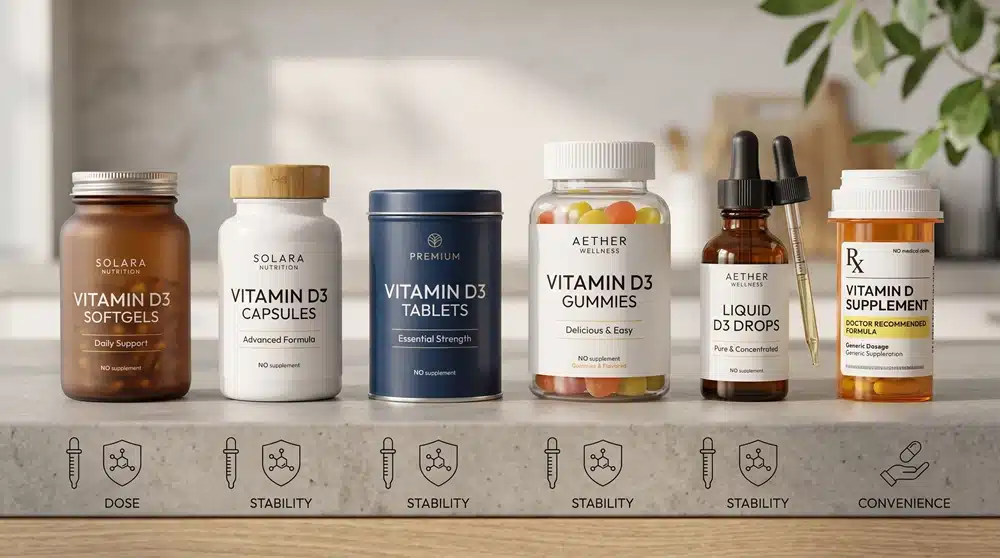
OTC vitamin D is available in softgels, capsules, tablets, gummies, liquid drops, and sprays. Vitamin D3 is the most common OTC form because it is widely available and often preferred for maintaining blood levels over time. For consumers, the most important quality signals are third-party verification, clear Supplement Facts labeling, appropriate serving size, and packaging that protects fat-soluble vitamin D from heat, light, and oxidation.
For supplement brands, OTC vitamin D can be developed in multiple formats depending on dose, target audience, and shelf-life needs. A reliable vitamin contract manufacturing partner can help review dosage form, ingredient compatibility, packaging, and finished product testing before launch.Who Needs It?
OTC vitamin D suits:
- Healthy individuals seeking to maintain adequate levels, especially in winter or with limited sun exposure.
- Those with mild deficiency (levels between 12–20 ng/mL).
- People aiming to support general health, such as immune function or bone strength.
Benefits
- Accessibility: Widely available and easy to purchase without a doctor’s visit.
- Affordability: OTC supplements are generally cheaper, with bottles costing $5–20 for months of supply.
- Flexibility: Lower doses allow for daily use, ideal for long-term maintenance.
Risks
- Quality Variability: Not all brands are equal. Poor-quality supplements may have inconsistent potency or contaminants.
- Self-Management Risks: Without medical guidance, users may take incorrect doses, either too low to be effective or high enough to risk toxicity.
- Drug Interactions: Vitamin D can interact with medications like steroids or statins, and users may overlook this without professional advice.
Usage Tips
- Choose reputable brands certified by third parties like USP or NSF.
- Stick to the Recommended Dietary Allowance (RDA): 600–800 IU for adults, or up to 2,000 IU for maintenance, unless advised otherwise.
- Take with a meal containing fat to improve absorption.
Comparing Prescription and OTC Vitamin D
The table below summarizes key differences:
| Comparison Factor | Prescription Vitamin D | Over-the-Counter Vitamin D | Best Practical Use |
|---|---|---|---|
| Typical Dose | Often high-dose, such as 50,000 IU weekly for short-term deficiency correction when prescribed | Commonly 400–5,000 IU per serving, often used daily | Prescription for confirmed deficiency; OTC for maintenance or mild insufficiency |
| Common Form | Often vitamin D2 or D3 capsules prescribed by a clinician | Usually D3 softgels, capsules, gummies, tablets, drops, or sprays | D3 is common for daily support; D2 may appear more often in prescription-strength products |
| Monitoring | Requires medical supervision and repeat blood testing | Usually self-managed, though testing is still useful for higher doses or risk groups | Use blood testing when deficiency, kidney disease, malabsorption, or high-dose intake is involved |
| Safety Risk | Higher dose means higher risk if misused, but the process is monitored | Lower dose per serving, but risk increases with stacking multiple supplements | Avoid taking high-dose vitamin D daily unless directed by a healthcare professional |
| Product Quality | Dispensed through pharmacy channels and prescribed for a specific treatment plan | Quality can vary by brand, batch, verification, formulation, and packaging | Look for reputable brands, clear Supplement Facts, and USP/NSF verification when available |
| Cost & Access | Needs doctor visit and prescription; cost depends on insurance and pharmacy | Easy to buy online or in stores; usually lower cost per bottle | Prescription for medical treatment; OTC for routine long-term convenience |
| Manufacturing Consideration | High potency increases the need for strict dosing accuracy and documentation | Dosage form, stability, oil carrier, packaging, and label accuracy strongly affect quality | Brands should validate potency, uniformity, contaminants, and shelf-life stability |
Dosage and Absorption
Prescription vitamin D, often D2, is given in high doses to quickly raise levels. Studies show D2 and D3 are equally effective at high doses, but D3 sustains levels longer. OTC supplements, typically D3, are better for gradual increases and maintenance due to their lower doses and daily use.
Cost and Accessibility
Prescription vitamin D requires a healthcare provider’s involvement, which may involve consultation fees and limited insurance coverage. For example, a 12-week course of 50,000 IU D2 may cost $50–100 without insurance. OTC options are far cheaper, with a 90-day supply of 2,000 IU D3 costing as little as $10.
Safety and Regulation
Prescription vitamin D is tightly regulated, with doctors ensuring safe use through blood tests. OTC supplements, while generally safe, fall under less strict FDA oversight. A 2013 study found some OTC brands deviated from labeled doses by up to 30%, highlighting the need for reputable brands.
Label accuracy is especially important for fat-soluble vitamins because consumers may take them daily for months. Our supplement quality control process can include potency review, appearance checks, microbial testing, heavy metal testing, and other project-specific quality documentation.Why OTC Vitamin D Quality Can Vary
OTC vitamin D products are regulated as dietary supplements in the United States, not as prescription drugs. The FDA does not approve dietary supplements for safety and effectiveness before they reach the market; manufacturers are responsible for ensuring that products are safe, properly labeled, and manufactured according to dietary supplement cGMP requirements.
This is why third-party verification matters. A 2013 JAMA Internal Medicine research letter reported that tested OTC and compounded vitamin D products ranged from 9% to 146% of the labeled amount. For a consumer with a true deficiency, a subpotent product may delay correction; for someone taking multiple supplements, an over-potent product may increase safety risk. Look for credible verification programs such as USP or NSF when available, especially for high-dose or long-term use.
Manufacturing View: What Makes A High-Quality Vitamin D Supplement?
From a supplement manufacturing perspective, the difference between a reliable vitamin D product and a weak one is not only the labeled IU amount. Brands should control raw material identity, assay potency, dosage uniformity, oxidation risk, packaging protection, microbial limits, and heavy metal specifications before a finished product reaches consumers.
Vitamin D is fat-soluble, so it is often formulated in oil-based softgels, liquid drops, or dry beadlet forms for tablets, capsules, powders, and gummies. Each format has different stability risks. Softgels need oil carrier and peroxide control; gummies need heat and moisture control; tablets and capsules need uniform blending and disintegration review. For brand owners, the best format depends on dose, target audience, shelf life, packaging, label claims, and testing budget.
A practical quality checklist should include: active vitamin D assay, identity confirmation, dosage uniformity, heavy metals, microbial testing, disintegration or dissolution where relevant, stability review, packaging compatibility, and batch documentation. This manufacturing layer is especially important when a brand wants to sell high-potency OTC vitamin D products or combine vitamin D with calcium, K2, magnesium, omega-3, or immune-support ingredients.

Applicable Scenarios
- Prescription: Best for rapid correction in severe deficiency or when medical conditions (e.g., malabsorption syndromes) require high doses.
- OTC: Ideal for healthy individuals with minimal sun exposure, those in northern climates, or anyone maintaining normal levels.
How to Choose
Simple Decision Flow: Prescription Or OTC Vitamin D?
- Start with your 25(OH)D blood test. If your level is severely low or you have symptoms of bone pain, muscle weakness, or fracture risk, consult a clinician before choosing a dose.
- Check medical risk factors. Malabsorption, kidney disease, liver disease, bariatric surgery, osteoporosis, hyperparathyroidism, or certain medications may require professional monitoring.
- Use prescription vitamin D when rapid correction is needed. High-dose therapy is typically short-term and should be followed by repeat testing.
- Use OTC vitamin D for maintenance. Daily D3 is often practical for long-term support when your clinician agrees that self-managed maintenance is appropriate.
- Choose quality, not just dose. For OTC products, look for transparent labeling, reputable brands, third-party verification, and dosage forms that match your lifestyle.
Assess Your Needs
Start with a blood test to check your 25-hydroxyvitamin D level. The National Institutes of Health (NIH) defines:
- Deficiency: <20 ng/mL
- Adequate: 20–50 ng/mL
- High (potential toxicity): >50 ng/mL
Severe deficiency often warrants prescription vitamin D, while mild cases or prevention suit OTC supplements.
Consult a Doctor
If you have chronic conditions (e.g., kidney disease, inflammatory bowel disease) or take medications affecting vitamin D metabolism (e.g., glucocorticoids), consult a doctor. They can recommend prescription doses or guide OTC use.
Consider Lifestyle
Limited sun exposure (less than 15–30 minutes daily), darker skin, or a diet low in vitamin D-rich foods (e.g., salmon, fortified milk) increases the need for supplementation. OTC options are often sufficient for these cases.
Short-Term vs Long-Term
Prescription vitamin D is typically short-term (8–12 weeks) to correct deficiency, followed by OTC maintenance. For long-term use, OTC D3 at 1,000–2,000 IU daily is effective and safe for most adults.
For Supplement Brands: How To Position OTC Vitamin D Products
For consumers, the choice is usually medical treatment versus daily maintenance. For supplement brands, the decision is broader: dose level, dosage form, target user, quality testing, packaging, and claim language must work together. A 1,000–2,000 IU daily D3 softgel may fit a general adult wellness line, while gummies or drops may fit children’s or family nutrition. Higher-potency products require extra caution in labeling, serving instructions, and quality verification.
Brands should avoid positioning OTC vitamin D as a substitute for medical treatment when deficiency is severe. Instead, the stronger angle is responsible daily support: clear dosage, transparent quality control, third-party testing where possible, and education that encourages consumers to test and consult healthcare professionals when needed.
If you are unsure whether your vitamin D concept should be a softgel, capsule, gummy, tablet, powder, or liquid, our custom formula supplement manufacturer team can help evaluate dose, format, stability, packaging, and commercial feasibility before production.Conclusion
The best vitamin D option is not simply the strongest one. Prescription vitamin D is designed for medically supervised correction of confirmed deficiency or special clinical situations. OTC vitamin D is better for maintenance, convenience, and long-term daily use when the dose is appropriate. The safest decision starts with a 25(OH)D blood test, a review of medications and health conditions, and a product quality check.
References
- NIH Office of Dietary Supplements – Vitamin D Fact Sheet for Health Professionals: https://ods.od.nih.gov/factsheets/VitaminD-HealthProfessional/
- FDA – Questions and Answers on Dietary Supplements: https://www.fda.gov/food/information-consumers-using-dietary-supplements/questions-and-answers-dietary-supplements
- FDA – Information for Consumers on Using Dietary Supplements: https://www.fda.gov/food/dietary-supplements/information-consumers-using-dietary-supplements
- eCFR – 21 CFR Part 111 Current Good Manufacturing Practice in Manufacturing, Packaging, Labeling, or Holding Operations for Dietary Supplements: https://www.ecfr.gov/current/title-21/chapter-I/subchapter-B/part-111
- Endocrine Society – Vitamin D for the Prevention of Disease Guideline Resources, 2024: https://www.endocrine.org/clinical-practice-guidelines/vitamin-d-for-prevention-of-disease
- Mayo Clinic – Vitamin D: https://www.mayoclinic.org/drugs-supplements-vitamin-d/art-20363792
- Mayo Clinic – Vitamin D toxicity: What if you get too much?: https://www.mayoclinic.org/healthy-lifestyle/nutrition-and-healthy-eating/expert-answers/vitamin-d-toxicity/faq-20058108
- LeBlanc et al. – Over-the-Counter and Compounded Vitamin D: Is Potency What We Expect? JAMA Internal Medicine 2013: https://jamanetwork.com/journals/jamainternalmedicine/fullarticle/1570096
- Kaiser Permanente – Vitamin D Potency Varies Widely in Dietary Supplements: https://research.kpchr.org/News/Press-Releases/Vitamin-D-Potency-Varies-Widely
- USP – Dietary Supplement Verification Program / USP Verified Mark: https://www.usp.org/verification-services/dietary-supplements-verification-program
- NSF – Dietary Supplement and Vitamin Certification: https://www.nsf.org/consumer-resources/articles/supplement-vitamin-certification

Warren Wan is a seasoned expert with extensive experience in the dietary supplement supply chain, possessing rich practical experience in the research, development, process control, and global sourcing of core ingredients such as collagen peptides, bone broth protein, and keratin. As the author of this column, he is dedicated to stripping away the marketing packaging, transforming obscure ingredient science and production quality control standards into easy-to-understand, hardcore science popularization, helping readers understand the truth behind the labels and make more rational health choices.


